

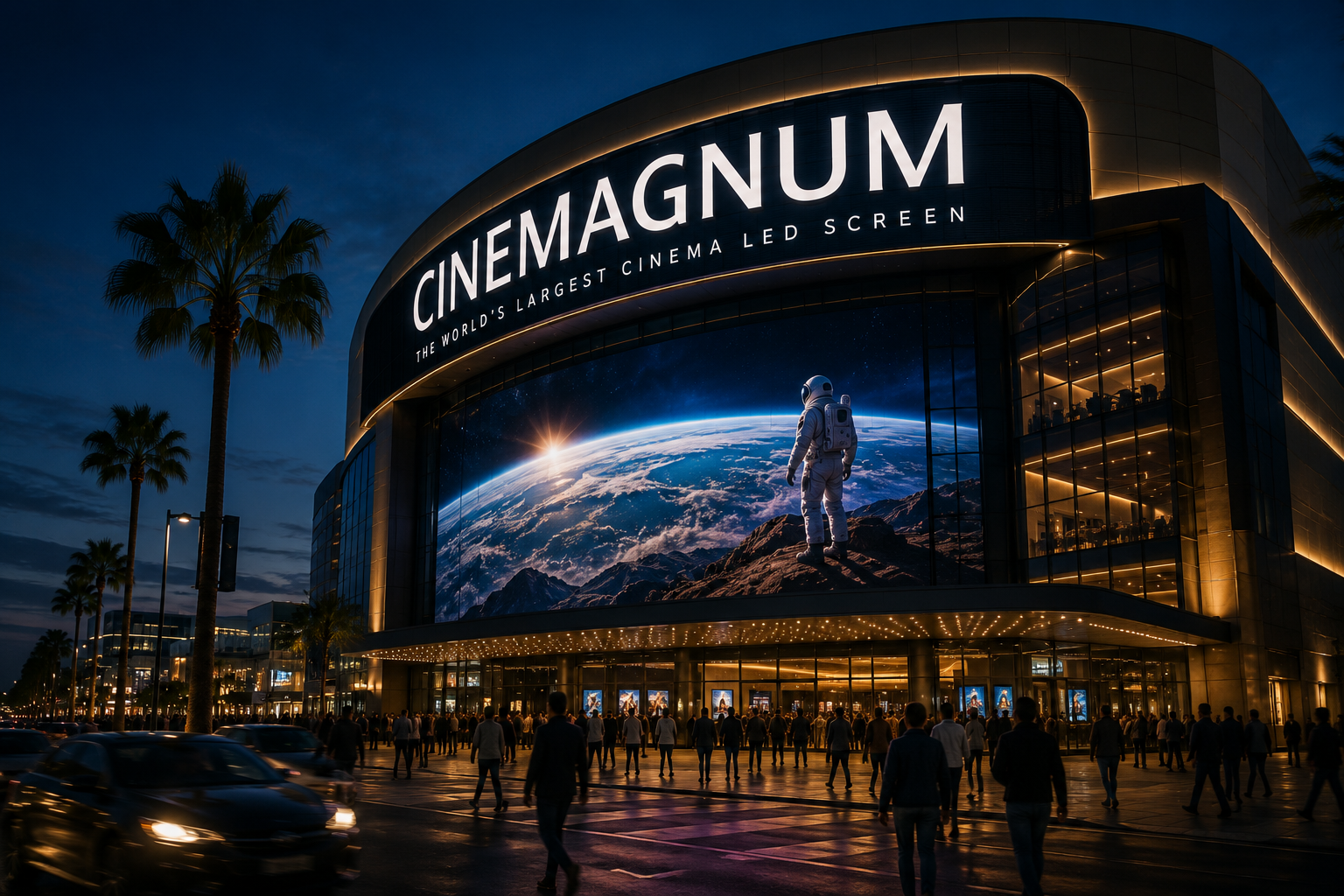
CINEMAGNUM Isn’t Just Building the World’s Largest Cinema LED Screen—It’s Building the Kind of Experience Streaming Can’t Recreate
By Garrett Ellison
Every era forces an industry to rediscover what it actually sells.
For most of modern cinema history, movie theaters believed they sold movies.
That was true when theatrical exhibition was the only place audiences could experience a new release. The theater’s greatest competitive advantage was access. If you wanted to see the latest blockbuster, there was only one destination.
Streaming permanently changed that reality.
Today, millions of people can watch extraordinary films from home on large televisions with immersive sound, on-demand convenience, and increasingly sophisticated technology. Audiences haven’t stopped loving movies. They have simply gained another way to experience them.
That shift has quietly changed one of the oldest businesses in entertainment.
Movie theaters are no longer competing to provide access.
They are competing to provide a reason to leave home.
CINEMAGNUM’s decision to install what is expected to become the world’s largest 30-meter-wide cinema LED screen should be understood through that lens.
On the surface, the announcement is about engineering. The new auditorium will feature a record-setting direct-view LED display with HDR presentation and acoustically transparent LED technology that allows sound to originate naturally through the screen while preserving the visual advantages of direct-view LED.
Those achievements deserve recognition.
But they are not the most important part of the story.
Technology rarely changes an industry simply because it becomes more advanced.
It changes an industry when it changes what customers believe is worth paying for.
That is exactly what CINEMAGNUM is investing in.
The company is not spending millions to improve the movie.
The movie already exists before anyone buys a ticket.
It is investing in something much more valuable.
The experience surrounding the movie.
That distinction explains why this announcement matters.
Studios create content.
Movie theaters create context.
One tells the story.
The other shapes how that story is experienced.
The scale of the screen.
The precision of the sound.
The architecture of the room.
The anticipation before the lights dim.
The collective silence before the opening scene.
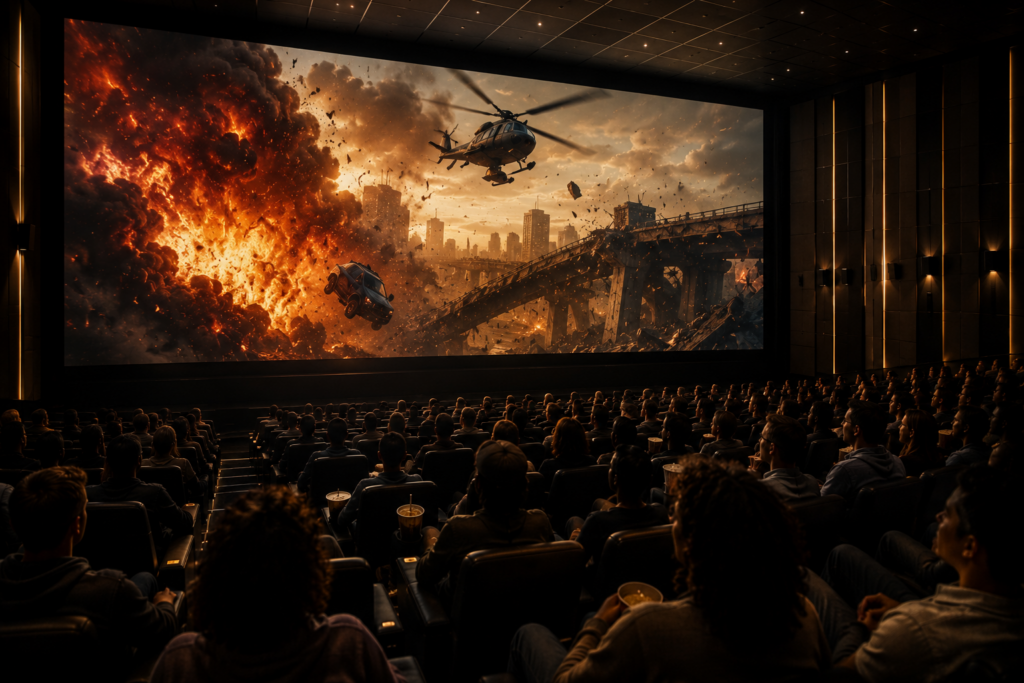
The shared laughter, suspense, and applause that ripple through hundreds of strangers experiencing the same moment together.
None of those things exist inside the film itself.
They exist because of the environment in which the film is presented.
That environment has quietly become one of theatrical exhibition’s greatest competitive advantages.
For decades, theaters generated value by distributing films.
Increasingly, they generate value by staging experiences.
Those are fundamentally different businesses.
Distribution asks one question:
“How do we deliver this movie?”
Experience asks another:
“Why should someone choose to experience this movie here?”
That single question is reshaping the exhibition industry.
Around the world, theaters continue investing in premium large formats, immersive sound systems, luxury seating, elevated hospitality, and next-generation display technologies. These investments are not attempts to imitate streaming.
They are attempts to become something streaming was never designed to be.
A destination.
Streaming excels at convenience.
Movie theaters are learning that their greatest opportunity lies somewhere else entirely.
Presence.
Presence cannot be downloaded.
It cannot be compressed into a file.
It cannot be recreated simply by purchasing a larger television or a more powerful sound system.
Presence emerges when architecture, technology, storytelling, and hundreds of people gather inside the same room to experience the same moment together.
That is why the theatrical experience continues to matter.
Not because audiences lack alternatives.
But because some forms of entertainment become more meaningful when they are shared.
CINEMAGNUM’s record-setting LED screen is therefore more than a technological milestone.
It is evidence of an industry redefining its own purpose.
The future of movie theaters will not be determined by how closely they compete with streaming on convenience.
Streaming has already won that battle.
The future will belong to theaters that become destinations—places where the experience itself becomes part of the reason for buying a ticket.
That is what this investment ultimately represents.
The world’s largest cinema LED screen may capture the headlines.
But the larger story is that movie theaters have stopped asking how to compete with streaming.
They have started asking a far more important question.
How do we create an experience people simply cannot have anywhere else?
Related Posts

Beyond Collaboration: Creative Power Reassigned — G-DRAGON and the Author Era
From Image to Authority

When Speed Meets Sound: The High-Fidelity Fusion of McLaren and Bowers & Wilkins
A Symphony on the Track

AIAIAI Unveils TMA-2 DJ Wireless Headphones, Claiming the Title of First-Ever Wireless DJ Gear
AIAIAI Announces 'World's First Wireless DJ Headphones', Launching Ear

Shutterstock Unveils Revolutionary Generative 3D API
Shutterstock Launches First Ethical Generative 3D API.


LG Introduces TONE Free T90S: Advanced Earbuds for Superior Listening Experience
LG’s New TONE Free Wireless Earbuds With Pure Graphene