

Apple Didn’t Replace Tim Cook. They Repositioned Power
By Brian K. Neal
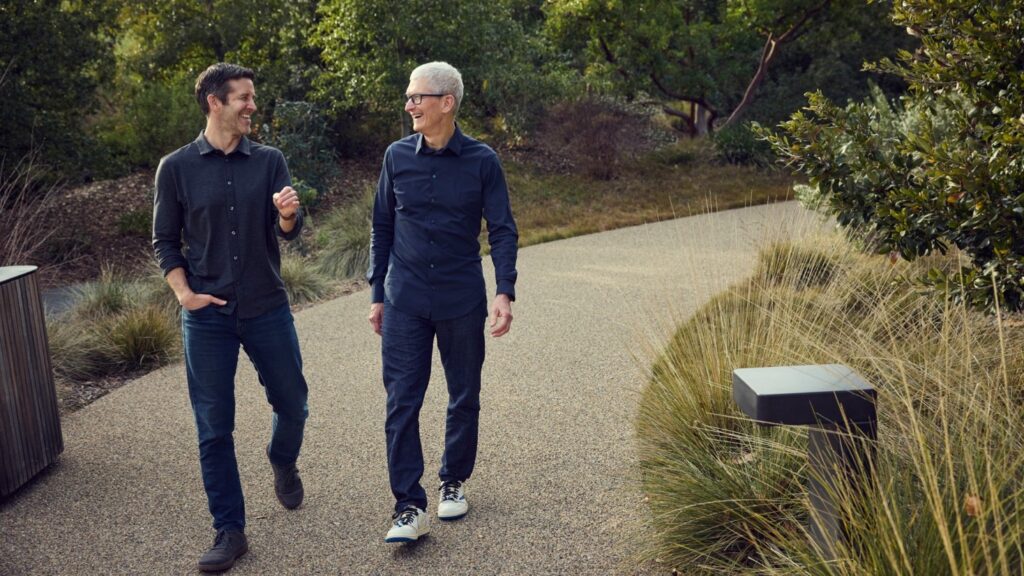
The image is quiet: a table after a moment has passed. A glass half-finished, a napkin left without ceremony, light still warm enough to suggest that whatever happened here mattered. Nothing dramatic. Nothing broken. Just… absence.
That is how real transitions look.
The headline says Tim Cook becomes Executive Chairman, John Ternus becomes CEO of Apple Inc.. It reads like continuity. Stability. A clean handoff between two people who already understand each other.
But this is not a story about departure.
It is a story about where power moves when a system is finished.
For nearly fifteen years, Cook engineered Apple into something few companies ever become: infrastructure. Not just a brand, not just a product company, but a system that behaves with precision at a global scale. Devices arrive on rhythm. Supply chains move with near invisibility. Services layer quietly beneath the surface until they feel inevitable.
He didn’t need to invent the future to secure it. He made the present operate so efficiently that the future had somewhere to land.
Efficiency built the empire.
But efficiency has a boundary. It perfects what exists. It extends dominance. It stabilizes growth. What it does not always do is define what comes next when the ground itself begins to shift.
And the ground is shifting.
For two decades, Apple controlled the most important layer in modern technology: the interface. You touched the screen, and Apple decided what happened next. The iPhone was not just a device—it was a gate. iOS was not just software—it was a set of rules governing how human intention became machine response.
Apple sat between you and the outcome.
That position is now under pressure.
AI does not wait for a touch. It does not require a screen. It anticipates, interprets, and acts before the moment of interaction becomes visible. The interface is no longer the glass. It is the system that understands you before you make a decision.
Which means the point of control is moving.
And if Apple does not own that point, it risks becoming something quietly diminished: the most beautifully designed surface in a system it does not control.
This is where the transition reveals itself.
John Ternus is not a disruption. He is not an outsider. He is Apple’s internal logic made visible—product discipline, hardware precision, the belief that the future should be something you can hold, see, and trust.
His appointment says Apple is not abandoning its identity. It is reinforcing it.
But reinforcement is not the same as protection.
Because the next era may not reward what is held. It may reward what is understood.
Ternus inherits a company that is not unstable, not declining, not searching—but positioned at a structural threshold. The question is no longer whether Apple can build the best product. It is whether the product remains the place where control lives.
And that is why Cook does not leave.
He moves.
Executive Chairman is not absence. It is proximity without friction. It allows him to step out of execution while remaining embedded in direction. Culture stays anchored. Strategy remains intact. Risk is managed not from distance, but from above.
This is not succession. It is architecture.
Cook becomes the guardrail. Ternus becomes the driver.
The system continues, but its center of gravity is being tested.
Historically, companies fracture when leadership transitions are treated as moments—events that happen and pass. They endure when transitions are designed as systems—structures that absorb change without losing coherence.
Apple is choosing the latter.
But even the strongest systems are defined by how they respond when the environment changes faster than the system itself.
AI is not the iPhone. It does not unfold slowly. It does not wait for mass adoption to matter. It reshapes behavior as it arrives, compressing time, collapsing steps, removing friction that once defined entire industries.
It moves the value upward—from the object in your hand to the intelligence interpreting your need.
Which reframes the entire battlefield.
The question is no longer:
Who builds the best device?
It becomes:
Who controls the moment before the device is needed at all?
That is the space Apple now has to defend.
Not by replacing Tim Cook.
But by repositioning him.
The table is still warm. The system is still intact. The people are still walking, talking, smiling as if nothing fundamental has changed.
And that is precisely how you know something has.
Efficiency built the empire.
Now they need something else to defend it.
Related Posts

Tinder Implements Warning System to Curb Inappropriate Behavior
Tinder Is Warning Users When They're Being Inappropriate.

Roku Debuts NBA FAST Channel and NBA Zone
Roku is poised to enhance its TV home screens

Transform Your Tesla into a Private Karaoke Lounge with the CaraokeMic
Tesla is calling all karaoke lovers.

PowerA Expands FUSION® Line with Two New Pro-Level Controllers for Xbox Series X|S
PowerA Unveils the Next Generation of FUSION® Controllers for Xbox.
DJI Enters the 360º Arena with Groundbreaking Osmo 360 Camera
A New Perspective
Microsoft Brings Copilot AI to macOS with a Dedicated App
US, UK and Canada will receive it first.