
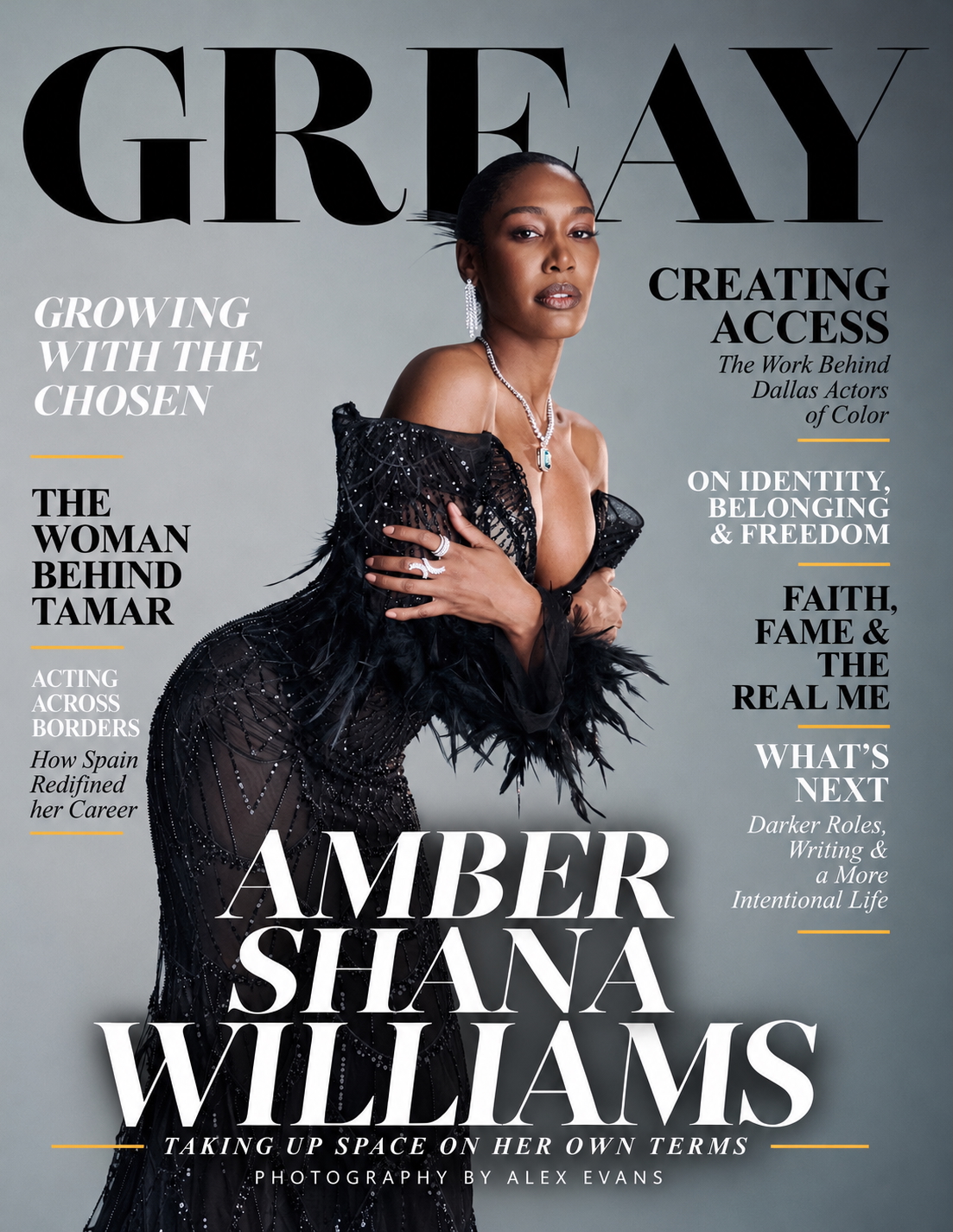
Amber Shana Williams Is Learning to Take Up Space on Her Own Terms
By DaMarko GianCarlo
Before Amber Shana Williams understood acting as a profession, she understood it as freedom. Growing up in Dallas, Texas, she found herself in an environment where silence and obedience were rewarded, and expressing emotion was not always encouraged. Performing offered another way to exist. With a small karaoke machine and an audience assembled at home, she could become whoever she wanted, say whatever she felt, and experience the joy of being heard without having to explain herself. Reflecting on those early years, Williams tells GREAY that “That little girl just wanted to be understood and heard.” It was an instinct that would follow her into adulthood, shaping not only her relationship with acting but also her understanding of what it means to have a voice.
More than fifteen years into her career, Williams has worked across international entertainment industries, built opportunities for other performers, and become familiar to audiences through her portrayal of Tamar in The Chosen. Yet the experiences that have shaped her most profoundly extend beyond the roles she has played. Her career has been a gradual negotiation between the expectations placed upon her and the person she has worked to become. What began as a childhood escape into imaginary worlds has evolved into a more complicated pursuit: finding the confidence to occupy her own.
That process has rarely followed a predictable path. When Williams moved to Spain, she entered an unfamiliar country with limited independence, little command of the language, and no established professional network. The transition brought loneliness and depression, and her early attempts to establish herself in the Spanish entertainment industry were discouraging. During one audition, a casting director questioned her decision to pursue acting in a country where she could not yet speak the language. Williams remembers crying on the journey home, uncertain whether she had made the right decision.
She continued auditioning anyway. What initially seemed like an impossible professional transition became one of the most productive periods of her career. Learning to work within another language and culture required her to become more adaptable, but it also challenged her understanding of belonging. Without the familiarity of home or the reassurance of an established reputation, Williams had to determine who she wanted to be independently of the people and circumstances that had previously defined her. She came to understand that belonging did not necessarily mean fitting into an existing environment. Sometimes it meant becoming comfortable enough with herself to remain different.
That understanding would eventually find an unexpected expression in Tamar, the character Williams portrays in The Chosen. Introduced as a woman determined to help someone she cared about, Tamar possesses a directness that Williams immediately recognized but had not always practiced in her own life. She enters unfamiliar spaces with conviction, maintains her cultural identity, and seeks connection without surrendering her individuality. Williams admires that certainty, explaining that “Tamar doesn’t wait to be invited. She shows up, states her intention, and lets the room adjust.” Over several seasons, the relationship between actress and character became more personal than Williams initially anticipated.
For Williams, that confidence represented something she was still learning. Having spent years worrying about being too much or occupying more space than others expected, she found herself portraying a woman who seemed largely unconcerned with those limitations. Tamar’s determination became a reminder that confidence does not always arrive before action. Sometimes it develops through the repeated decision to stand by what one believes.
As The Chosen expanded its audience, Williams also encountered the creative limitations of working within a large ensemble. Although Tamar remained part of the series, her role became more supporting after the third season. Williams acknowledges a measure of regret that audiences have not always been able to explore the character’s personal history and emotional complexity. Rather than allowing those absences to diminish her understanding of Tamar, she constructed an internal life that extended beyond the scenes written for her. She considered the woman’s experiences before joining the community, the culture she carried with her, and the loneliness of living among people who did not entirely share her background.
That attention to a character’s unseen experiences reflects Williams’s broader understanding of performance. Formal training in acting techniques provided a foundation, but personal experiences taught her that human behavior is rarely simple. Grief, love, disappointment, and the contradictions within relationships cannot be fully understood through technique alone. Her more recent exploration of somatic approaches to acting has strengthened her interest in the connection between emotion and the body, particularly the feelings people experience before they can articulate them.
That sensitivity became especially important during production of the sixth season of The Chosen, which moves toward the crucifixion. Williams advocated for Tamar to express an emotionally difficult moment in Tigrinya rather than transition almost immediately into English. To her, the decision was not simply about dialogue. It concerned the emotional authenticity of a woman whose language remains inseparable from her identity, especially during grief. The experience also reflected Williams’s increasing willingness to speak up when she believed something essential to a character was at risk of being lost.
Her commitment to representation predates her involvement with the series. In 2015, Williams founded Dallas Actors of Color after observing talented performers struggle to access the relationships, resources, and professional opportunities necessary to advance their careers. The organization was intended to create a supportive community where actors could share knowledge and develop opportunities rather than navigate the industry entirely alone. Although her relocation to Spain required her to pause the initiative, its purpose remains connected to her belief that representation must extend beyond simply placing different faces on screen. Characters need the freedom to possess contradictions, ambitions, vulnerabilities, and identities that cannot be reduced to a single characteristic.
The distinction between visibility and individuality has become increasingly relevant in Williams’s own career. Through Tamar, she has encountered audiences who feel deeply connected to the character and the faith-centered world of The Chosen. Some viewers recognize their own experiences in Tamar’s determination, cultural identity, or devotion. Others develop expectations about Williams herself, assuming the actress must reflect the same beliefs, personality, and behavior as the woman she portrays.
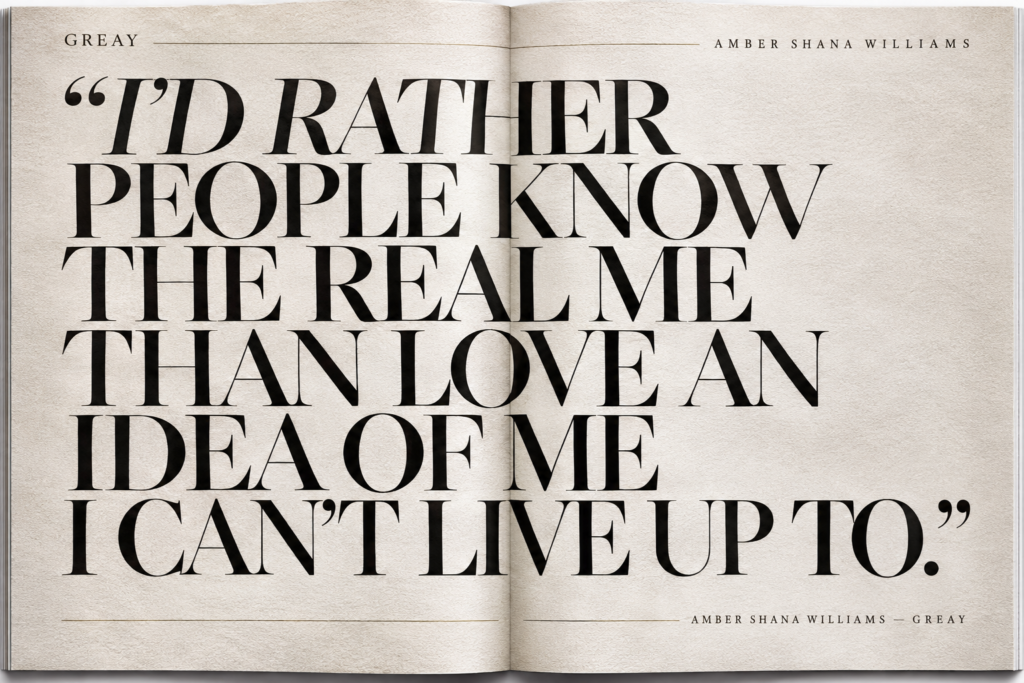
Williams appreciates the significance the series holds for its audience, but she also recognizes the difficulty of being understood primarily through a fictional character. Her personal relationship with faith, her sense of humor, her opinions, and the way she chooses to present herself do not always conform to the image viewers have developed. She does not consider those differences a contradiction. They are simply part of being a person whose identity extends beyond her work. Williams has become increasingly comfortable allowing audiences to make that distinction for themselves, telling GREAY, “I’d rather people know the real me than love an idea of me I can’t live up to.”
It is a revealing position for someone whose earliest experiences with acting were rooted in the freedom to become someone else. The profession that once allowed Williams to escape expectations has also introduced new ones, particularly as her visibility has grown. The challenge is no longer only to create convincing characters, but to maintain a clear distinction between the person audiences recognize and the woman who exists when the cameras stop rolling.
That distinction also informs the way Williams approaches her future. Although Tamar has introduced her to a substantial audience, she remains interested in characters far removed from the qualities associated with the role. She is drawn to darker material, morally complicated people, and stories that allow her to explore mistakes and consequences without requiring characters to remain admirable. She has also begun writing more, expanding the ways she can express herself creatively rather than waiting for another opportunity to arrive.
Her ambitions, however, have become less dependent on professional recognition. Earlier in her career, Williams measured success through bookings and the reassurance that each new role offered. Years of uncertainty made achievement feel like evidence that she belonged in the industry. With experience, that understanding has changed. She now places greater importance on the quality of her work, the relationships she maintains, and the freedom to make decisions without constantly seeking external validation.
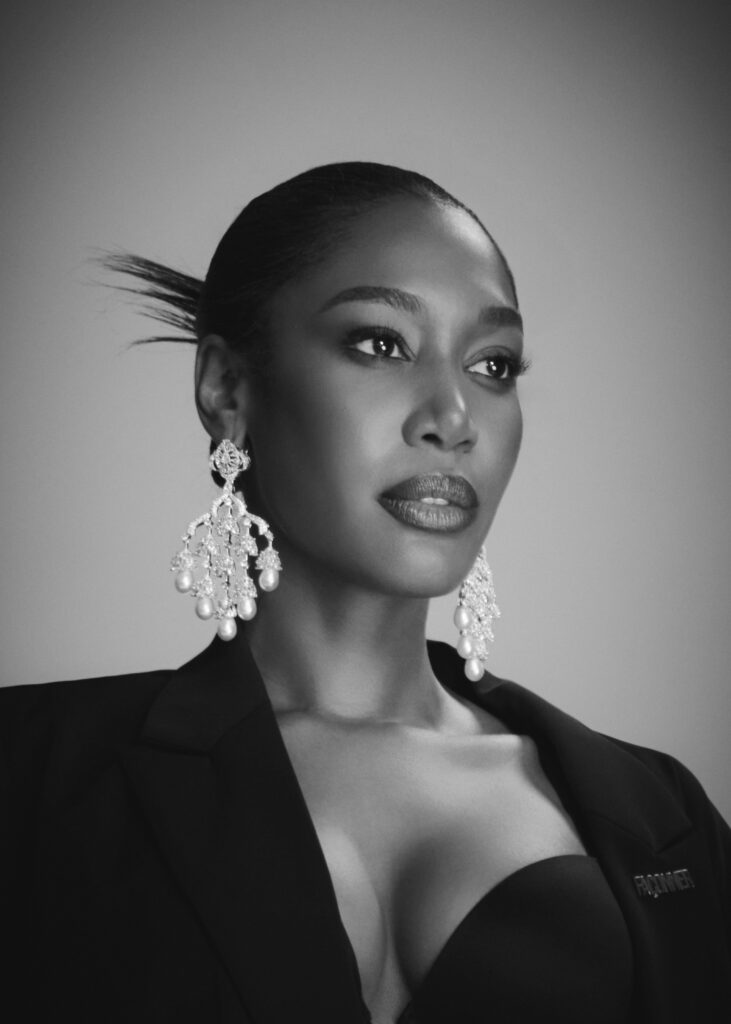
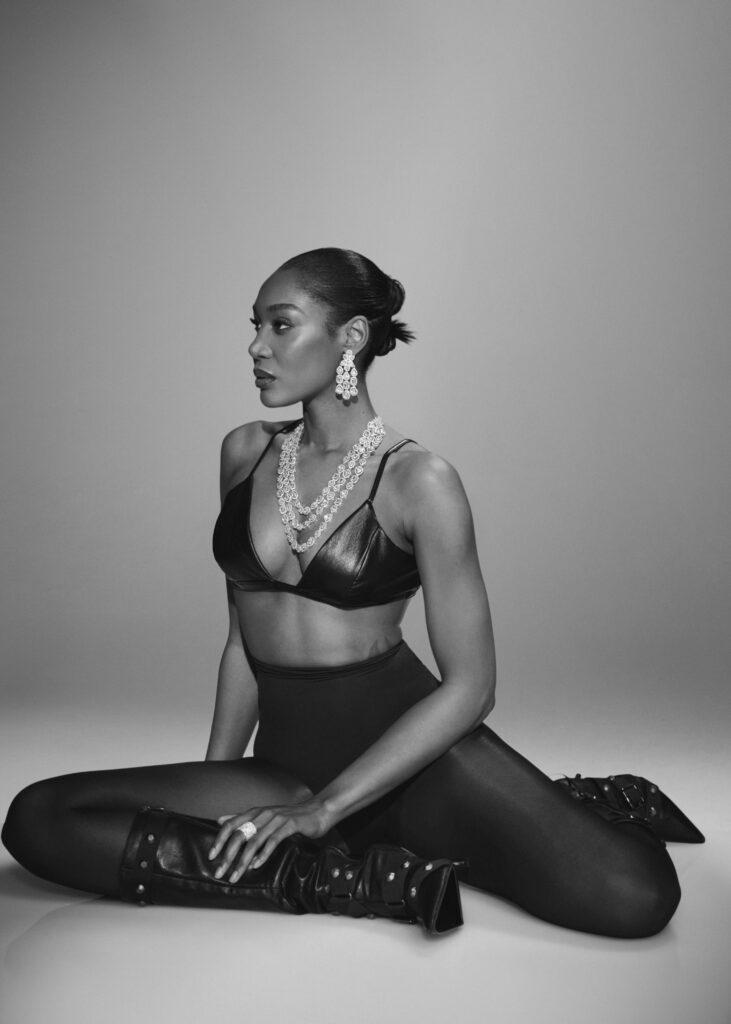
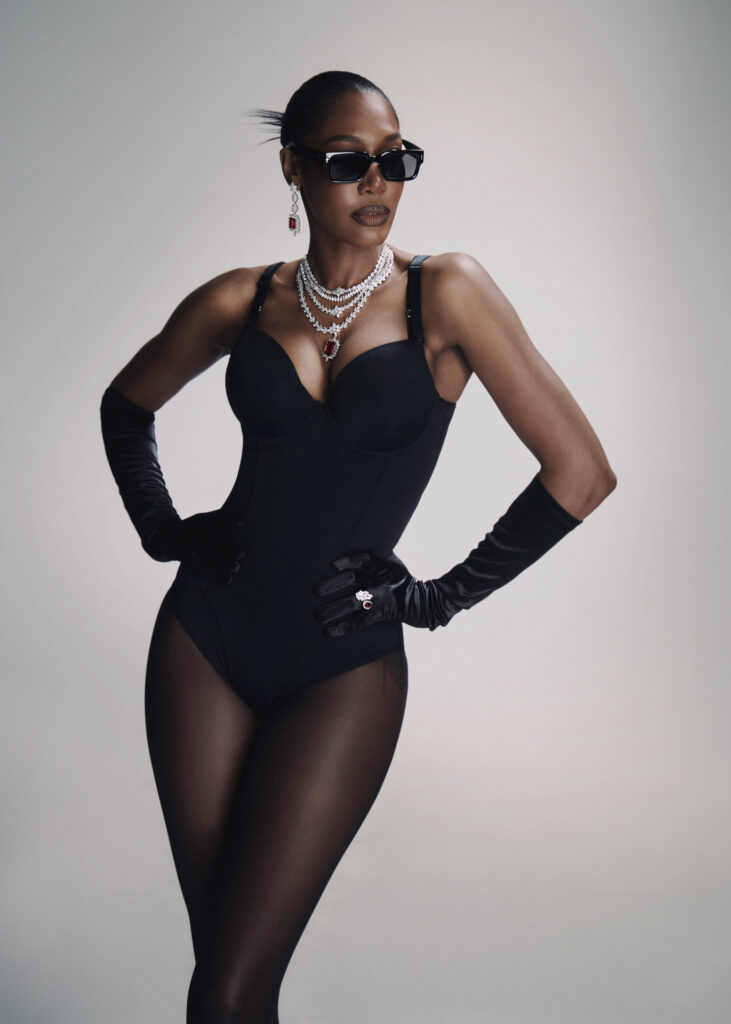
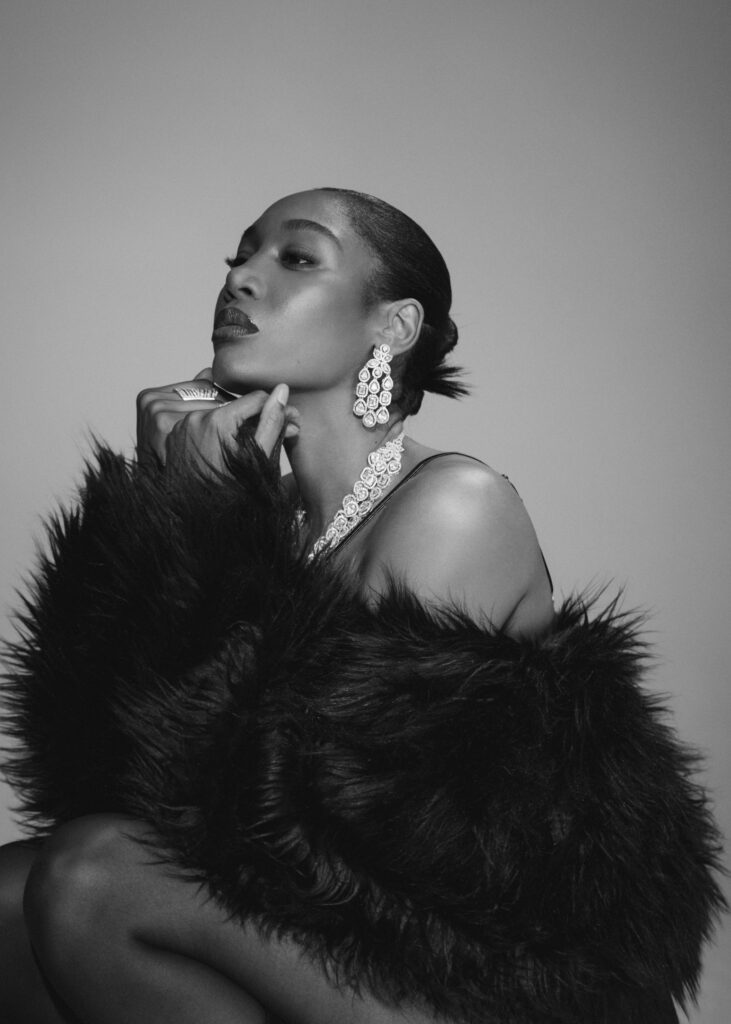
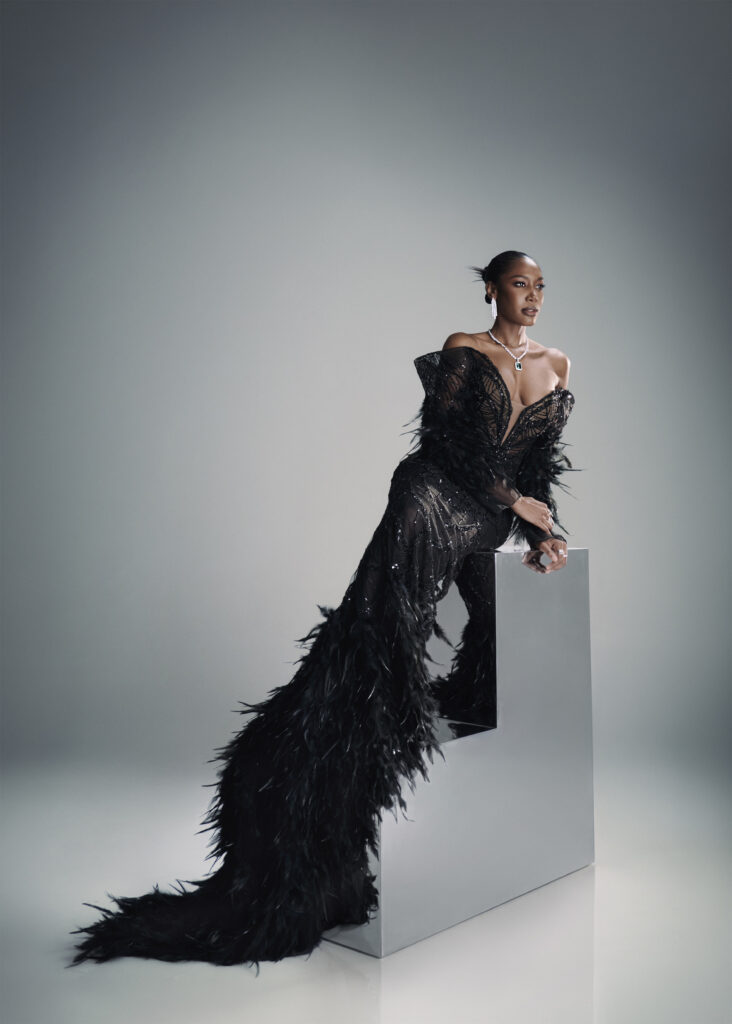
For this GREAY editorial, Williams appears outside the visual world audiences associate with Tamar. The fashion-forward photographs offer an opportunity to encounter her without the familiar costume, setting, or narrative of The Chosen. She describes being photographed without a character to inhabit as both vulnerable and liberating. There is no fictional identity to provide distance, but there is also no requirement to become anyone other than herself. The images introduce another dimension of an actress who has spent much of her professional life being recognized through someone else’s story.
The timing is significant. As The Chosen approaches another major chapter, Williams is also considering what she wants from the years ahead. She has spent much of her life striving for the next opportunity, often believing that fulfillment would arrive once she had accomplished enough. Now she is increasingly interested in the experiences that exist outside professional achievement: travel, long dinners, laughter, meaningful relationships, and the ability to enjoy moments without measuring their productivity.
The little girl who once gathered an audience around a karaoke machine wanted the freedom to express herself. The woman she has become is learning that freedom also includes the ability to step away from performance, release the pressure to prove herself, and build a life that feels complete without an audience. For Williams, the realization has changed how she understands the relationship between ambition and happiness. As she reflects on the life she wants to build, she recognizes that the things she once intended to enjoy after achieving enough were never supposed to be postponed. “Now I understand they were never meant to be a reward. They’re the entire point.”
Photographer Alex Evans @alexevansphotography
Creative Director Dion Xu
Make Up Dion Xu @dionxu
Hair Kee @sosheargenius
Wardrobe Vincent Weathersby Jr @styledbyweathersby
Wardrobe Asst @elizaxmora @its_cheetah_frida @stylebyliinda
Produced By FSI Productions @firstsight.intl
Related Posts

HERBALIFE AND LA GALAXY UNVEIL 2024 JERSEY
Herbalife and the LA Galaxy unveil the club's latest jersey
Dune: Prophecy Prepares for Launch with Official Trailer Drop at NYCC
HBO releases Trailer for 'Dune: Prophecy' Max Series
Steven Bartlett and Authentic Are Building a System to Turn Creators Into Companies
The New Creator Economy Begins After the Follow

2024 Welcomes Rapid Arrival of Innovative Drivers by Cobra Golf
Cobra Golf takes a step beyond introducing its DARKSPEED drivers

The Body Is the Interface Now
Sneakers are no longer worn — they are programmed
POST COMMENT