

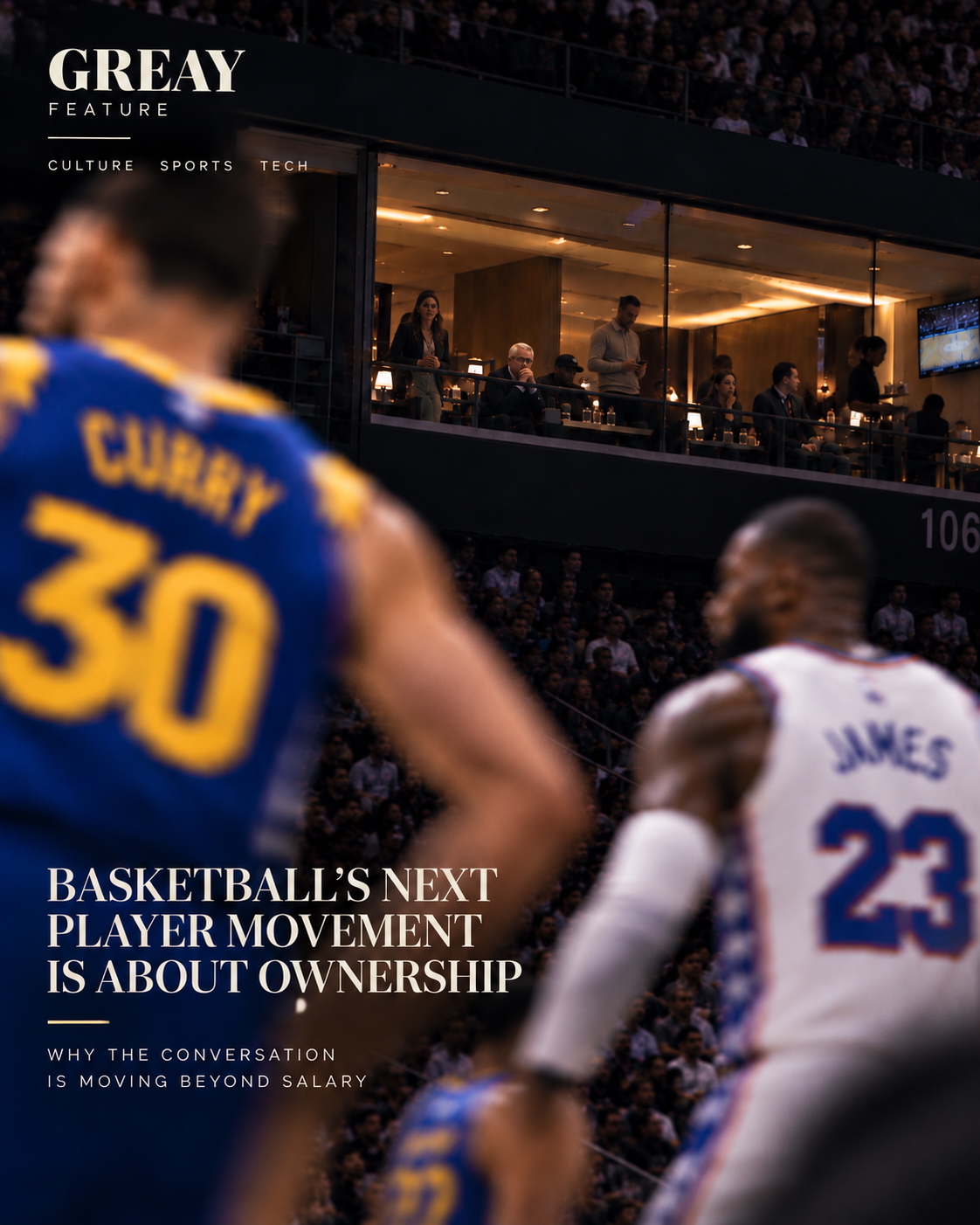
The NBA’s Next Labor Question May Be Ownership
By Cassir Basptiste
For most of NBA history, the central economic argument between players and owners has been about how much money players should receive. Salaries rose. Revenue sharing became more sophisticated. Free agency expanded player power. The salary cap grew alongside the business. The underlying architecture, however, remained largely intact: owners owned the appreciating asset, while players were compensated for performing inside it. Now, across basketball, another question is beginning to emerge. What happens when players no longer want the conversation to end with compensation?
Stephen Curry gave that question unusually direct language. Speaking in 2025, Curry argued that NBA players could still be considered underpaid because active players generally cannot participate in the equity of the franchises whose value they help create. Taken literally, the idea that one of basketball’s wealthiest stars is underpaid sounds almost absurd. But Curry was drawing a distinction that becomes more consequential the longer you examine it. Salary is income. Ownership is an asset. A player can earn hundreds of millions of dollars during his career and still have no ownership interest in the franchise whose valuation may continue climbing long after his final game.
The observation is not new. More than a decade ago, Kevin Garnett encountered the boundary firsthand. In 2012, Garnett attempted to become an investor in Italian soccer club AS Roma, but the NBA objected because Roma investor James Pallotta also held an ownership interest in the Boston Celtics. The concern was straightforward: allowing an active player to enter a business relationship with someone connected to the ownership of his NBA team could blur the line between investment and compensation. Years later, when LeBron James approached free agency in 2018, variations of the same question surfaced around whether an ownership opportunity in the Cleveland Cavaliers could ever become part of his future. Again, league rules made the boundary clear. An active player’s compensation could become enormous. His ownership relationship with an NBA franchise was something different.
That distinction still exists. The current NBA-NBPA Collective Bargaining Agreement was ratified in 2023 and runs through the 2029–30 season, although either side can opt out following 2028–29. But something important changed within that agreement. While active players remain restricted from simply buying stakes in NBA teams, the 2023 deal expanded pathways through which players collectively could participate in certain equity investments. Former NBPA president CJ McCollum later described the agreement as having opened new equity investment opportunities for players.
That was not NBA players suddenly becoming franchise owners. It was something subtler. The idea of players participating in ownership had begun moving into the governing architecture of the sport.
By 2026, the language around that idea was becoming much harder to miss.
Jaylen Brown, then serving as an NBPA vice president, publicly argued in January that players should be able to build equity alongside owners as NBA franchise values rise. Brown compared the situation with the corporate world, where valuable employees and executives can receive equity in addition to compensation. His argument effectively asked why professional basketball should permanently separate the people generating extraordinary value from the appreciating asset around that value.
Then the players’ union began using the language of ownership itself.
In June, the NBPA launched PLYRS UNTD, a consumer-facing commercial operation designed to turn the collective influence and intellectual property of more than 500 NBA players into products, licensing, content, partnerships and investment opportunities. NBPA president Fred VanVleet said the organization grew from the players’ desire to “own a piece of the ecosystem we built.” Incoming executive director David Kelly went further, describing a shift away from simply providing player talent toward players operating an enterprise capable of building equity. The campaign surrounding the launch carried an unusually revealing name: Own the Game.
PLYRS UNTD does not give players equity in NBA franchises, and treating it as though it does would miss the point. What it demonstrates is a change in economic thinking. The union is increasingly positioning the collective value of players as something that can be owned, developed and compounded, rather than merely licensed in exchange for another payment.
Outside the NBA, basketball is already testing what that distinction can look like.
Unrivaled was founded with player ownership embedded in its model. When the women’s basketball league completed an oversubscribed Series C financing round in August 2026, it raised more than $100 million at a $650 million valuation. Players remained its largest shareholder group, with their collective equity worth nearly $200 million. All 36 players from the inaugural season had received ownership stakes, while the league also guaranteed players six-figure salaries.
That combination matters.
The players are being paid to play basketball. But if the enterprise becomes more valuable, their economic participation does not necessarily stop when the paycheck arrives. They can participate in the appreciation of the asset itself.
That is fundamentally different from the traditional professional sports relationship.
And Unrivaled is no longer the only experiment. Days ago, recently retired Russell Westbrook joined the emerging Project B basketball venture as a co-founder and chief strategy officer, with an equity stake and a seat on its board. Describing the model, Westbrook said Project B was imagining players not simply as value drivers but as “shareholders and decision makers.” The league is preparing to launch its women’s competition in early 2027.
None of these examples are identical. That distinction is essential.
Curry is talking about the economics surrounding NBA franchise ownership. Brown is raising a potential labor-policy question. PLYRS UNTD represents collective player commercialization. Unrivaled has placed equity directly into the compensation architecture of a new basketball league. Westbrook has entered another emerging league as an owner and executive after retirement.
Different structures. Different circumstances. Different players.
But the direction is becoming increasingly difficult to miss.
For decades, basketball’s labor economics largely revolved around dividing the money the business generated. Owners controlled franchises and assumed the financial risk of owning them. Players supplied the scarce athletic talent that made the product possible. Collective bargaining determined how the revenue flowing between those sides would be divided.
Ownership changes the question because ownership is not simply another percentage of annual revenue.
An NBA franchise can appreciate dramatically regardless of whether a particular season produces a championship. That appreciation belongs to its owners. Players receive negotiated compensation during their careers, but when their contracts expire, their economic participation generally ends. The franchise remains. The asset remains. And whatever that asset becomes worth belongs to whoever owns it.
There are powerful reasons the NBA has historically kept those categories separate. Giving active players franchise equity would immediately create difficult questions. How would a stake be valued for salary-cap purposes? Could ownership become a mechanism for circumventing maximum salaries? What happens when a player is traded? Would he be required to sell his stake? How quickly? What happens when one franchise appreciates much faster than another? Could a player simultaneously become an employee, investor and negotiating counterparty to the same organization?
Those are not minor technicalities. They reach directly into competitive balance and the integrity of the league’s economic system.
They also explain why the title of this conversation requires one important word: may.
There is currently no established NBA labor battle in which players are collectively demanding franchise ownership. The next collective bargaining negotiation remains years away, and there is no guarantee that direct team equity becomes a central issue when it arrives. The NBA is also fundamentally different from a startup league that can design player ownership into its capitalization from the beginning.
But labor questions rarely begin at the bargaining table. They begin when enough people start questioning an assumption that previously seemed permanent.
That is what makes this moment worth watching.
Garnett encountered the boundary. James demonstrated how relevant it could become for basketball’s most powerful stars. The 2023 CBA began creating limited pathways around player investment. Curry articulated the difference between compensation and ownership. Brown brought equity into the language of player leadership. The NBPA built a commercial operation explicitly talking about owning more of the ecosystem players create. Unrivaled demonstrated that salary and player equity can exist together. Westbrook has now joined another basketball venture built around athletes becoming shareholders and decision makers.
The observation is old. The architecture around it is new.
The NBA does not need to be on the verge of giving players pieces of franchises for that change to matter. The larger development is that basketball’s most valuable labor force is beginning to think beyond the paycheck.
For generations, the defining economic question in professional basketball was how much of the value should players receive?
The question forming underneath the sport now is different.
What part of the value should players own?
Related Posts
Scrappy, Brilliant, Unstoppable: Riri Williams Is Back in ‘Ironheart’
Scrappy, Brilliant, Unstoppable

Ben Hundreds Opens The Benjamin in Hollywood, Serving American Classics in a 1920s Art Deco Setting
Ben Shenassafar is stepping into the restaurant scene.

A Spirited Kick-Off: Chivas Regal and Arsenal Unite in a Multi-Year Partnership
CHIVAS REGAL SCORES BIG WITH GLOBAL ARSENAL PARTNERSHIP

MM6 Maison Margiela and SALOMON Unveil the X-Alp: A Stylish Fusion of Urban and Outdoor Footwear
MM6 Maison Margiela and SALOMON Unveil the X-Alp