

Samsonite’s BÉIS Deal Shows What a Celebrity Brand Has to Become to Last
By DaMarko GianCarlo
Celebrity can introduce a brand. It cannot guarantee that people will keep buying from it.
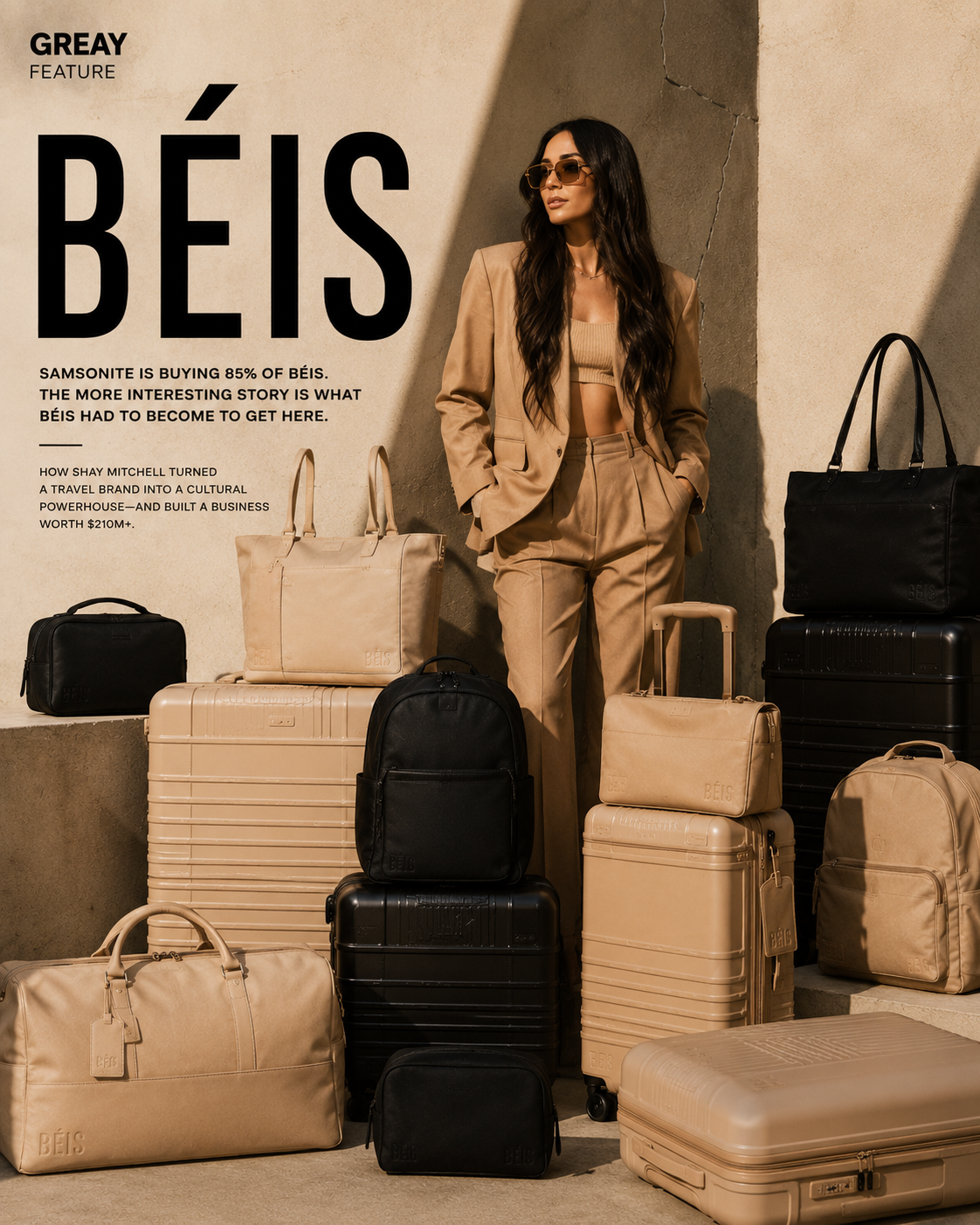
That distinction sits underneath Samsonite Group’s agreement to acquire 85 percent of BÉIS, the travel and lifestyle brand co-founded by Shay Mitchell in 2018. Announced in August 2026, the transaction calls for Samsonite to pay $178.5 million in cash for its stake, implying an enterprise value of approximately $210 million for BÉIS. Mitchell will retain 15 percent and continue as Founder and Head of Creative and Design, while Adeela Hussain Johnson remains CEO.
Those numbers make the acquisition notable. What BÉIS had to become to produce them makes it more interesting.
BÉIS began with an advantage most new consumer companies spend enormous amounts of money trying to manufacture: attention. Mitchell arrived with an established audience from television, film and social media, giving a new luggage company immediate visibility. In the crowded direct-to-consumer era, that recognition could dramatically shorten the distance between introducing a product and finding its first customers.
But attention and enterprise value are different things.
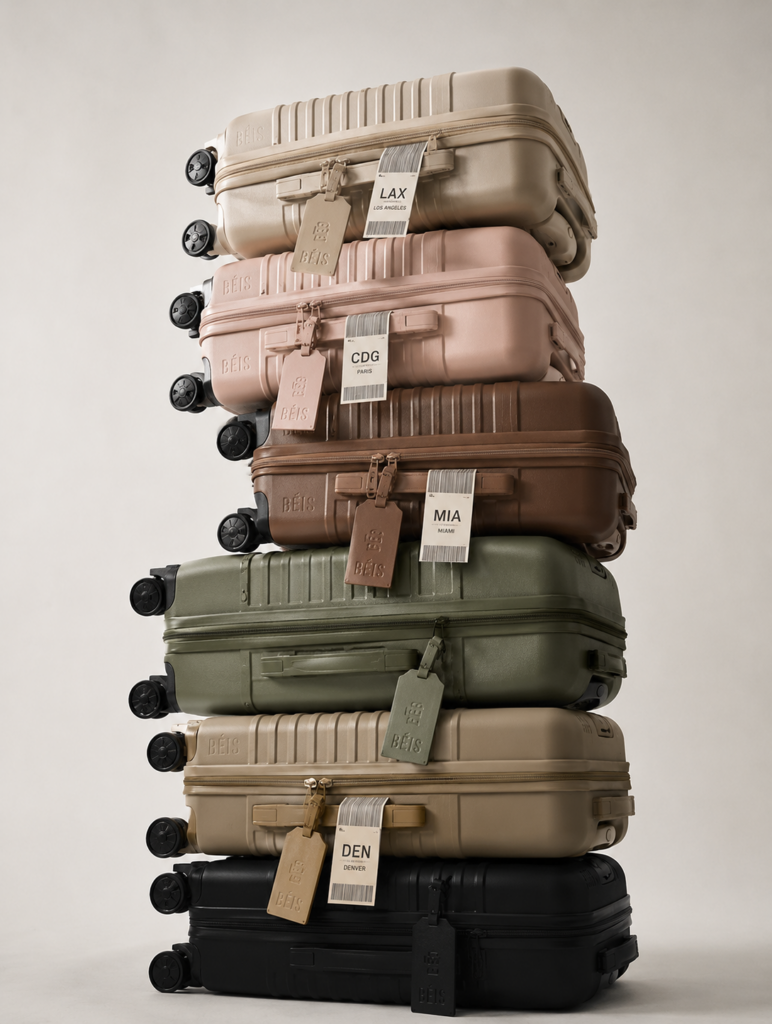
By 2025, BÉIS was generating approximately $210 million in annual net sales and operating profitably. Lifestyle bags had grown to roughly half of the company’s sales, meaning BÉIS was no longer dependent solely on consumers needing a new suitcase. It had expanded the relationship into totes, backpacks, work bags and other products that could move through everyday life.
That evolution matters because luggage is an unusually difficult category in which to build frequent consumer behavior. A good suitcase can remain useful for years. A lifestyle bag gives the same customer another reason to return.
BÉIS was quietly changing the question from Where are you traveling? to What are you carrying today?
Its collaborations helped push that transition forward. BÉIS has partnered across entertainment, fashion, beauty and consumer culture, repeatedly placing its name beside brands and properties with their own audiences. The individual collections mattered, but collectively they did something larger: they helped teach consumers to recognize BÉIS as a cultural participant rather than simply a product attached to a famous founder.
The 2025 Gap partnership made that particularly visible. Gap × BÉIS expanded beyond luggage into a broader travel collection spanning apparel, bags and accessories, while bringing BÉIS into Gap’s retail ecosystem.
The important part was almost hidden in the name.
It was Gap × BÉIS, not Gap × Shay Mitchell.
Mitchell remained central to the company and creatively involved in the collaboration, but BÉIS itself had become valuable enough to occupy the other side of the “×.” That is one of the clearest signs that a celebrity-founded company is developing equity of its own.
Celebrity businesses can become trapped by the same advantage that made them possible. When the founder remains the primary reason consumers notice the company, every launch requires another injection of personality. The founder has to post it, wear it, explain it, promote it and continually transfer attention from themselves to the product.
That can build a successful business. It is harder to build something that can eventually stand on its own.
BÉIS did not solve that problem by separating itself from Mitchell. It appears to have solved it by changing what Mitchell needed to do.
Her celebrity could remain an asset without remaining the entire proposition. Products could become recognizable. Customers could develop habits around the company. Collaborations could introduce BÉIS through other cultural doors. A management team could operate the business. And the company could increasingly be evaluated through the conventional language of consumer businesses: revenue, profitability, customer loyalty, category expansion and growth.
That helps explain why Samsonite is such an interesting buyer.
Samsonite already knows how to sell luggage. Its portfolio includes Samsonite, Tumi and American Tourister. It does not need BÉIS simply because BÉIS also makes suitcases.
What BÉIS offers is something different: a younger, predominantly female consumer, strong digital commerce, a highly engaged customer community and growing exposure to lifestyle bags. Samsonite is not simply acquiring what BÉIS sells. It is acquiring who BÉIS has learned to sell to and how it has learned to reach them.
There is something instructive about the valuation as well. BÉIS generated approximately $210 million in 2025 net sales, while the transaction implies an enterprise value of roughly the same amount. This is not a story built around an enormous multiple being attached to celebrity heat. Samsonite appears to be evaluating BÉIS as a functioning, profitable consumer company with capabilities that make sense inside a much larger portfolio.
Mitchell retaining 15 percent also matters.
She is not disappearing after helping build the company. She remains financially connected to what happens next and creatively involved with the brand. Samsonite gets control, but the structure preserves the founder whose taste, visibility and perspective helped establish BÉIS in the first place.
There is a lesson in that arrangement for the larger generation of companies being built around public figures.
Celebrity is not the weakness. Dependence on celebrity can be.
Fame can compress the extraordinarily difficult first stage of building a consumer company. It can create awareness before a traditional startup could afford it, generate attention, establish an initial community and make customers curious enough to try something new. Those are genuine advantages.
But eventually the company has to earn something its founder cannot simply lend it: its own reputation.
Customers have to recognize the product before seeing the social post. Collaborators have to want the brand name on their side of the partnership. Executives have to be capable of operating the company beyond the founder’s personal schedule. And eventually, another company evaluating an acquisition has to be able to look past the celebrity and see a business worth owning.
That may be the most important thing about Samsonite’s BÉIS deal.
Shay Mitchell helped give BÉIS an audience. Eight years later, Samsonite has agreed to spend $178.5 million for control of the company that BÉIS built around that opportunity.
Celebrity opened the door.
The business had to become valuable enough to stay in the room.
Related Posts

Wonyoung Joins the Tommy Jeans Family, Ushering in a New Era of Global Cool
Denim Days with Wonyoung

Professional Women’s Basketball League Unrivaled Announces Groundbreaking Compensation and Ownership Model
Professional Women's Basketball League Unrivaled Announced

Salomon’s Paris Hub Signals a New Era for Performance-Led Lifestyle
From Trail to City

Louis Vuitton’s Luxurious Chocolate Shop Debuts in Shanghai
Louis Vuitton's Chocolate Shop Expands to China With New Shanghai Loca

ESPN Thinks SportsCenter NEXT Can Become a Lifestyle Brand: Kaleena Smith and Beckham Black Are the Bet
The apparel matters, but the identity is the real product

Gatorade Named Official Sports Beverage Partner of Wrexham AFC, Co-Owned by Rob McElhenney and Ryan Reynolds
Gatorade Named Official Sports Beverage Partner of Wrexham AFC.