


YouTube Is Changing Who Controls the Business of Television
By DaMarko GianCarlo
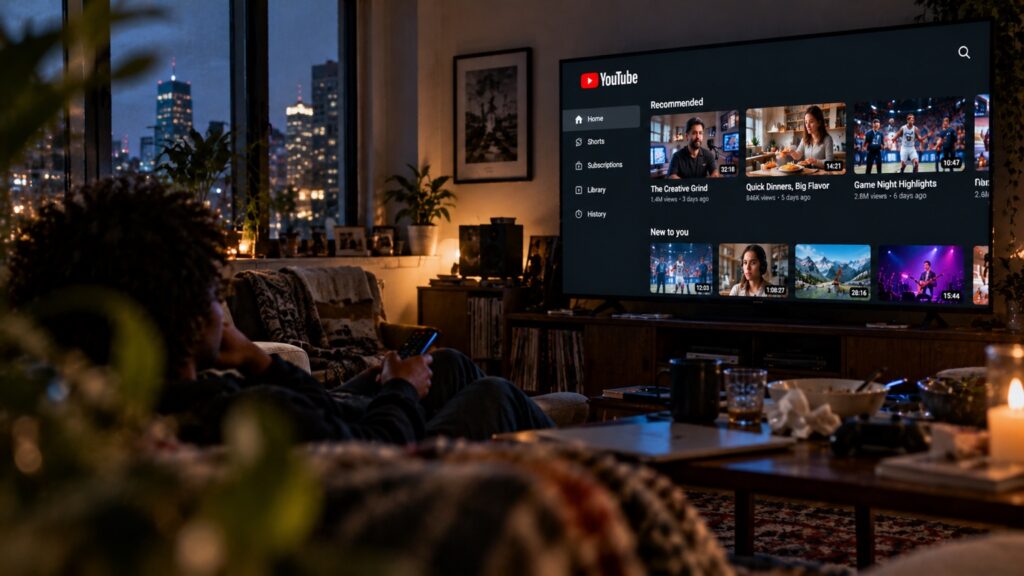
YouTube now commands more American television viewing than any other individual media distributor, yet some of the companies competing with it are also establishing partnerships to distribute their programming through its services. That relationship reflects a changing television business in which producing entertainment, attracting audiences, and controlling distribution are no longer necessarily responsibilities held by the same company. Studios continue to finance productions, streaming services compete for subscribers, and advertisers invest in reaching consumers, but the relationships connecting those activities are evolving as YouTube occupies a larger position in the television market.
According to Nielsen’s August 2026 Media Distributor Gauge, released October 22, YouTube accounted for a record 15.8 percent of total television viewing in the United States. Disney followed with 9.3 percent across its television and streaming properties, while Netflix represented 7.7 percent. Streaming collectively accounted for 49.6 percent of television viewing. YouTube’s viewing increased 6 percent from July, including a 9 percent increase among adults aged 50 and older. The figures establish the platform’s position across a broadening television audience, although they do not demonstrate that traditional entertainment companies are losing revenue or subscribers directly because of its growth.
For decades, television production and distribution operated through closely connected relationships among networks, studios, and broadcasters. Networks commissioned programming, studios financed productions, and distributors determined how audiences could access entertainment. Advertising supported much of that business by connecting companies with viewers gathered around scheduled programming. Subscription streaming changed how television was delivered and purchased, but many of those commercial arrangements remained familiar. Entertainment companies continued investing in productions, maintaining their own services, and competing to attract viewers through exclusive programming.
YouTube operates through a different model. Independent creators, professional production companies, broadcasters, and established entertainment brands can distribute programming through the same platform without following a single financing or production structure. Some creators develop projects independently, while others operate media businesses employing writers, producers, editors, and production crews. The platform does not eliminate the cost or uncertainty of producing entertainment, but it allows programming to reach television audiences without first requiring a traditional network to commission or acquire it.
In his 2026 annual letter, YouTube CEO Neal Mohan described creator productions as “shows, built by creators who green-light themselves.” His observation identifies an important difference in how entertainment enters the market. A creator developing a documentary series, interview program, or recurring entertainment format can begin production without securing network approval. Whether that programming attracts a substantial audience remains uncertain, but the opportunity to introduce it independently changes who can participate in television production.
Creative independence, however, does not mean complete control over distribution. Creators may determine what they produce, but YouTube operates the systems through which their programming is discovered, recommended, and monetized. Audience development depends on viewer behavior, platform policies, and sustained engagement. Traditional television companies make decisions through commissioning, licensing, and distribution agreements, while YouTube provides broader access to publication within a commercial environment it manages. The difference lies not in the absence of gatekeepers, but in how their influence is exercised.
That distinction becomes particularly important in advertising, where the relationship between audience attention and commercial opportunity is changing. Historically, broadcast and cable networks developed advertising businesses around programming schedules and the audiences those programs attracted. Streaming introduced subscription tiers, advertising-supported services, and digital targeting capabilities. YouTube’s growing television audience adds independently produced entertainment to that competitive environment, allowing advertisers to reach viewers gathered around individual creators and recurring programs alongside established television properties.
In October 2026, measurement company Comscore introduced a monthly report examining advertising exposure across American television. Its August findings showed broadcast accounting for 43.2 percent of measured television advertising exposure time, cable representing 34.5 percent, and streaming accounting for 22.3 percent. Traditional television therefore continued to account for most measured advertising exposure, even as streaming approached half of overall television viewing in Nielsen’s separate measurements. The difference is significant because time spent watching programming does not necessarily correspond to time spent encountering advertisements.
Within streaming, YouTube accounted for 44.4 percent of measured advertising exposure time, followed by Tubi at 11.6 percent and Hulu at 8.5 percent. Those figures do not represent advertising revenue or establish how much money individual companies receive from advertisers. They do, however, demonstrate YouTube’s substantial presence in advertising-supported television. For companies purchasing advertising, the challenge increasingly involves understanding where audiences can be reached, how advertising is delivered, and which environments provide access to the consumers they want to engage.
For independent creators, those relationships can create commercial opportunities beyond the revenue generated through standard platform advertising. A recurring entertainment program with an established audience may attract sponsorships, branded productions, licensing arrangements, or other partnerships. These opportunities existed before YouTube became a major television destination, but the platform’s growing presence on television screens places creator-led programming within a market historically associated with established networks and professional entertainment companies.
The financial opportunities are not uniform. A creator with a large audience may still face substantial production expenses, limited advertiser demand, or uncertainty about future revenue. A successful program may also require professional staff, equipment, marketing, and additional investment as its ambitions grow. YouTube provides access to distribution and monetization opportunities, but the creators and companies supplying programming generally remain responsible for determining whether their operations can support continued production.
That responsibility can influence how independent creators approach traditional entertainment companies. A creator who has already developed a recognizable program and established audience enters potential discussions with a studio from a different position than someone seeking approval for an unproduced concept. The creator may bring an existing format, demonstrated audience interest, and commercial relationships, while a studio can offer financing, production capabilities, marketing resources, and access to additional distribution markets. These arrangements do not eliminate the importance of traditional entertainment companies. They expand the ways programming can develop before entering those relationships.
Established media companies are also adjusting how they reach audiences. In July 2026, NBCUniversal and YouTube announced a multiyear global strategic partnership that includes plans to bundle Peacock Premium with YouTube Premium for eligible subscribers in the United States beginning in early 2027. The agreement also expands international distribution opportunities involving Universal+ and Hayu, extends existing relationships with YouTube TV, and creates additional opportunities involving advertising, technology, and sports programming. NBCUniversal described the arrangement as Peacock’s largest wholesale distribution partnership to date.
Comcast co-CEO Mike Cavanagh described the agreement as bringing NBCUniversal’s entertainment properties to “YouTube’s unmatched scale and global platforms.” The statement reflects the value an established media company sees in reaching audiences through a platform that also competes for their viewing time. NBCUniversal continues developing and distributing its own entertainment while using YouTube’s subscription and distribution relationships to extend the reach of its programming. YouTube, meanwhile, expands its role in connecting consumers with content and services supplied by other entertainment companies.
The partnership demonstrates that competition and cooperation are becoming increasingly connected in television distribution. Streaming originally gave entertainment companies opportunities to establish direct subscription relationships with viewers rather than relying entirely on traditional television distributors. Those relationships remain valuable, but partnerships with outside platforms can provide additional opportunities to reach customers, introduce programming, and support subscription growth. Working with another distributor does not necessarily indicate that an existing service is struggling. It can reflect a decision about how to reach audiences more effectively.
Netflix illustrates why the competitive landscape cannot be understood through viewing share alone. Its business remains centered on attracting and retaining paying subscribers through original productions, licensed entertainment, and advertising-supported memberships. YouTube distributes programming supplied by a much broader range of creators and media companies, generating revenue through advertising and subscription products. Both compete for attention on television screens, but their production responsibilities, financial structures, and relationships with audiences differ substantially. YouTube’s larger share of measured American television viewing does not, by itself, establish that Netflix’s business is declining.
The differences extend to how financial risk is distributed. Traditional studios may commit substantial resources to productions before their commercial performance becomes clear. Independent creators can begin with smaller projects and expand as audiences develop, although larger creator-led operations can also require significant investment. YouTube accommodates a wide range of production models without assuming the same financial responsibilities as a studio commissioning every program available through its service. That arrangement allows the platform to distribute programming developed through different commercial approaches while creators and production companies retain much of the responsibility for financing their work.
For audiences, those differences are becoming less visible. A television screen can display a studio-produced drama, an independent documentary, a creator-led interview series, or a podcast without requiring viewers to consider how each production was financed or distributed. The programming may serve similar entertainment interests while operating through entirely different business relationships. That shared viewing environment brings traditional entertainment companies and independent creators into closer competition, even when their resources, production methods, and financial expectations remain different.
For the businesses involved, however, the distinctions remain consequential. Studios control valuable intellectual property, production resources, and established commercial relationships. Independent creators can develop programming and audience connections without first securing traditional network distribution. Advertisers can reach viewers across different forms of entertainment, while the platforms distributing that programming determine many of the advertising products, discovery systems, and monetization arrangements available to participants.
The resulting market is not a straightforward transfer of power from Hollywood to independent creators. Traditional entertainment companies remain important producers and distributors, particularly for programming requiring substantial investment and specialized production resources. YouTube has expanded the number of participants capable of reaching television audiences, but it also occupies an influential position between those participants and the viewers they seek. Its distribution capabilities create opportunities for creators and media companies while giving the platform considerable influence over how their programming reaches consumers.
That balance is becoming an important feature of the television business. Independent creators can introduce programming without traditional commissioning agreements, advertisers can evaluate audiences across a broader range of entertainment, and established companies can use distribution partnerships to extend the reach of their services. These developments do not require one business model to replace another. They demonstrate how different approaches to producing and distributing entertainment are increasingly operating within the same commercial market.
YouTube’s growing position in American television is therefore more than a measurement of audience attention. It reflects a change in the relationships connecting the people who create programming, the companies that distribute it, and the businesses that finance its continued production. The ability to bring entertainment to television audiences no longer depends exclusively on the institutional arrangements that defined the industry for decades, even as control over distribution and monetization remains commercially significant.
YouTube has expanded who can participate in television without eliminating the power of the companies that control access to audiences. Creators can decide what to produce, studios can finance and develop programming, and advertisers can support the audiences those productions attract. But the ability to reach viewers and sustain a business still depends on distribution relationships that individual creators and entertainment companies do not always control. As YouTube’s presence on American television continues to grow, that relationship between creative independence and commercial access is becoming central to how the business operates.
Related Posts

Michael Bublé Brings It Home in Rolex’s Most Intimate Documentary Yet
Time, Family, and Craft

The Waldorf Astoria Sale May Reveal How Investors Value Trophy Assets
Some assets are measured in decades, not square feet

Ja Rule Unveils ‘The Sunrise Tour’: A Spectacular Celebration of 25 Years in Music and Culture, Set to Kick Off in Spring 2024
Renowned rapper, actor, entertainer, and entrepreneur Ja Rule is geari

THE LUXURY COLLECTION DEBUTS IN GERMANY WITH THE OPENING OF KOENIGSHOF, A LUXURY COLLECTION HOTEL, MUNICH
THE LUXURY COLLECTION DEBUTS IN GERMANY

What Happens When a Shoe Stops Explaining Itself
The Social Work of a Shoe

Footshop x BAPE Shift Into High Gear With a High-Octane Streetwear Drop
Racing the Streets
POST COMMENT