

Why Tao Group Keeps Building Bigger Rooms
By DaMarko GianCarlo
For years, people treated nightlife like entertainment.
A place to drink.
A place to dance.
A place to be seen.
But companies like Tao Group Hospitality increasingly understand that nightlife is becoming something much larger than that.
It is becoming infrastructure for human presence itself.
That is why Tao Group’s decision to open a 46,000-square-foot OMNIA Dayclub & Skybar at Caesars Palace matters beyond hospitality news or another Las Vegas expansion headline. On paper, it looks like a luxury nightlife investment designed for excess and spectacle.
In reality, it reveals a much deeper belief about where modern culture is heading.
Tao Group is betting that the more digital life becomes, the more valuable physical energy becomes alongside it.
That is the real story.
Because by every traditional technological assumption, environments like this should be shrinking. The internet already solved convenience. Music is streamable. Gambling is mobile. Celebrity access happens through social media. Entertainment is infinite. Entire weekends can now unfold without people physically leaving their homes.
Yet Tao Group is doing the opposite of shrinking.
They are building larger rooms.
Larger atmospheres.
Larger sensory environments.
Larger environments designed to pull human beings back into collective physical proximity.
That contradiction is not accidental.
It is strategic.
The company understands something many industries are still struggling to accept:
The digital world did not eliminate the human need for gathering.
It intensified it.
Because the more life moves through screens, the rarer unrepeatable physical experiences begin to feel. Human beings are now surrounded by constant connection while simultaneously experiencing historic levels of isolation. People consume endless content but increasingly struggle to feel genuinely inside anything.
Convenience solved effort.
It did not solve emptiness.
And that may be the hidden emotional engine underneath the entire modern experience economy.
Tao Group appears to recognize that vacuum clearly.
Which is why OMNIA is not being positioned merely as a club.
It is being constructed as atmosphere at architectural scale.
That distinction matters.
A dayclub in 2026 is no longer competing against another venue down the street. It is competing against the couch. Against streaming platforms. Against TikTok. Against sports betting apps. Against every frictionless form of private consumption modern technology now offers.
And Tao Group’s response is incredibly revealing:
If people are going to leave home, the experience must feel larger than convenience.
It must feel emotionally undeniable.
That is why modern Vegas environments continue becoming more immersive, more cinematic, more spatially ambitious, and more psychologically engineered. The venue itself is now the attraction. The room has become the product.
And what makes these environments work is not simply spectacle.
It is layered human energy.
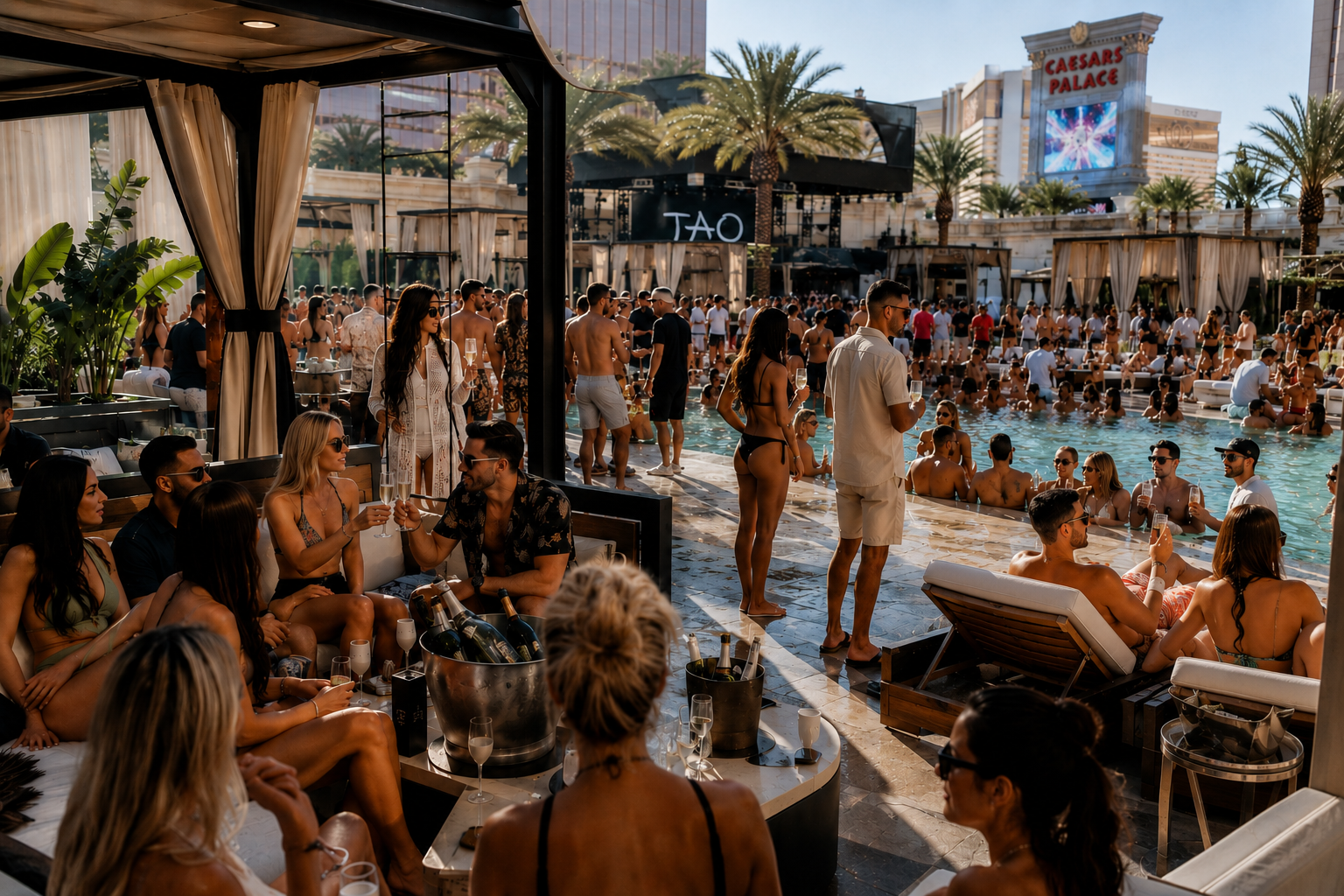
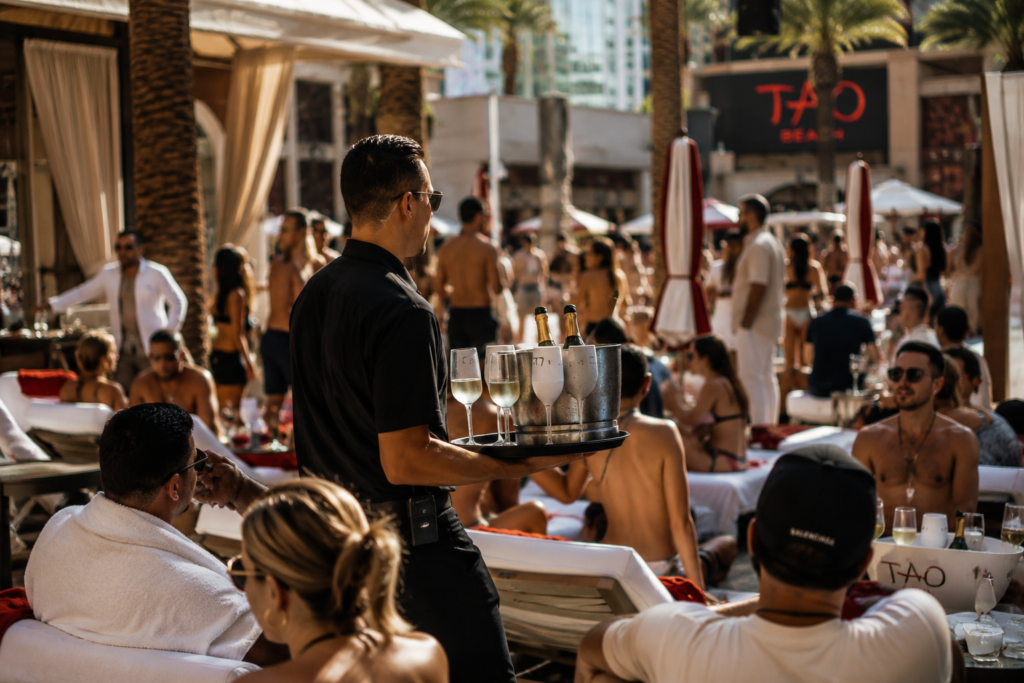
A luxury dayclub does not function because everyone inside behaves the same way. It functions because multiple emotional worlds exist simultaneously within the same atmosphere. One cabana is celebrating. Another is networking. Someone is quietly observing the crowd. Someone else is detached from it entirely. A server moves constantly through the environment maintaining the rhythm of the room while conversations, flirtation, performance, exhaustion, escape, and aspiration all overlap beneath the same desert light.
That complexity is what makes the environment feel alive.
Not the DJ.
Not the branding.
Not even the music itself.
The feeling.
That is the deeper shift happening underneath modern hospitality culture.
For years, industries believed technology would eventually replace physical congregation. Instead, technology changed the economic logic of why people gather in the first place.
The internet absorbed transactions.
Physical environments now survive through emotional intensity.
Retail increasingly survives through immersion.
Luxury survives through atmosphere.
Live sports survive through collective energy.
Restaurants survive through identity and ritual.
Concerts survive through communal feeling.
And nightlife is evolving the same way.
Tao Group is not simply selling music, alcohol, or tables anymore.
They are selling temporary participation inside a living social environment.
A feeling.
A shared emotional frequency.
An engineered collision between architecture, sunlight, movement, status, anticipation, and collective human presence.
That is why these spaces keep expanding despite economic uncertainty. Because Tao Group is not betting on nightlife alone.
They are betting on the continuing value of physical presence in a world increasingly designed for isolation.
And Las Vegas becomes the perfect laboratory for that experiment because the city itself has always functioned as emotional infrastructure disguised as entertainment. The casino floor was never the true product. It was merely the mechanism that brought bodies into proximity with one another beneath spectacle.
Now that gambling itself has escaped into apps and mobile platforms, Vegas is reorganizing around what technology still struggles to replicate emotionally.
Presence.
Atmosphere.
Scale.
Collective sensation.
That is why the OMNIA expansion matters symbolically.
A 46,000-square-foot dayclub opening during the height of digital saturation is not just hospitality growth.
It is a statement.
It says Tao Group believes human beings will continue paying premium prices to feel socially and emotionally alive around other people.
And honestly, that belief may end up being correct.
Because despite every technological advancement promising frictionless convenience, society continues revealing the same contradiction over and over again:
People do not only want content.
They want communion.
Not virtual proximity.
Real proximity.
Not passive consumption.
Participation.
Not endless access.
Emotional atmosphere.
Human beings built the internet to remove friction from life.
Then slowly discovered friction was often where feeling lived.
The line outside the venue.
The anticipation before entry.
The heat.
The movement.
The strangers sharing the same moment together beneath the same music and sunlight.
Technology made isolation efficient.
Tao Group is betting people will eventually pay a premium to feel close to one another again.
And the deeper irony is that they may not be selling nightlife at all anymore.
They may be selling relief from digital loneliness disguised as spectacle.
Related Posts

Barbora Krejčiková Joins Rado as a Brand Ambassador, Embodying Excellence in Tennis and Design
Rado Signs Wimbledon Champion Barbora Krejčiková.

Into the Rabbit Hole: Sabrina Carpenter’s First Major Studio Lead
Through the Pop-Star Looking Glass

Nike’s Rejuven8 Returns: A 2008 Icon Reimagined for 2026
The Comeback Sneaker
LACMA and the End of Institutional Control
What L.A. Just Built Isn’t a Museum

Fernando Tatis Jr. Didn’t Lose $34 Million — He Revealed the New Economy
Future Earnings. Present Cost.