

The Sunset Strip Isn’t Reinventing Itself—It’s Demonstrating How Great Urban Districts Stay Competitive
By Ryan Simmons
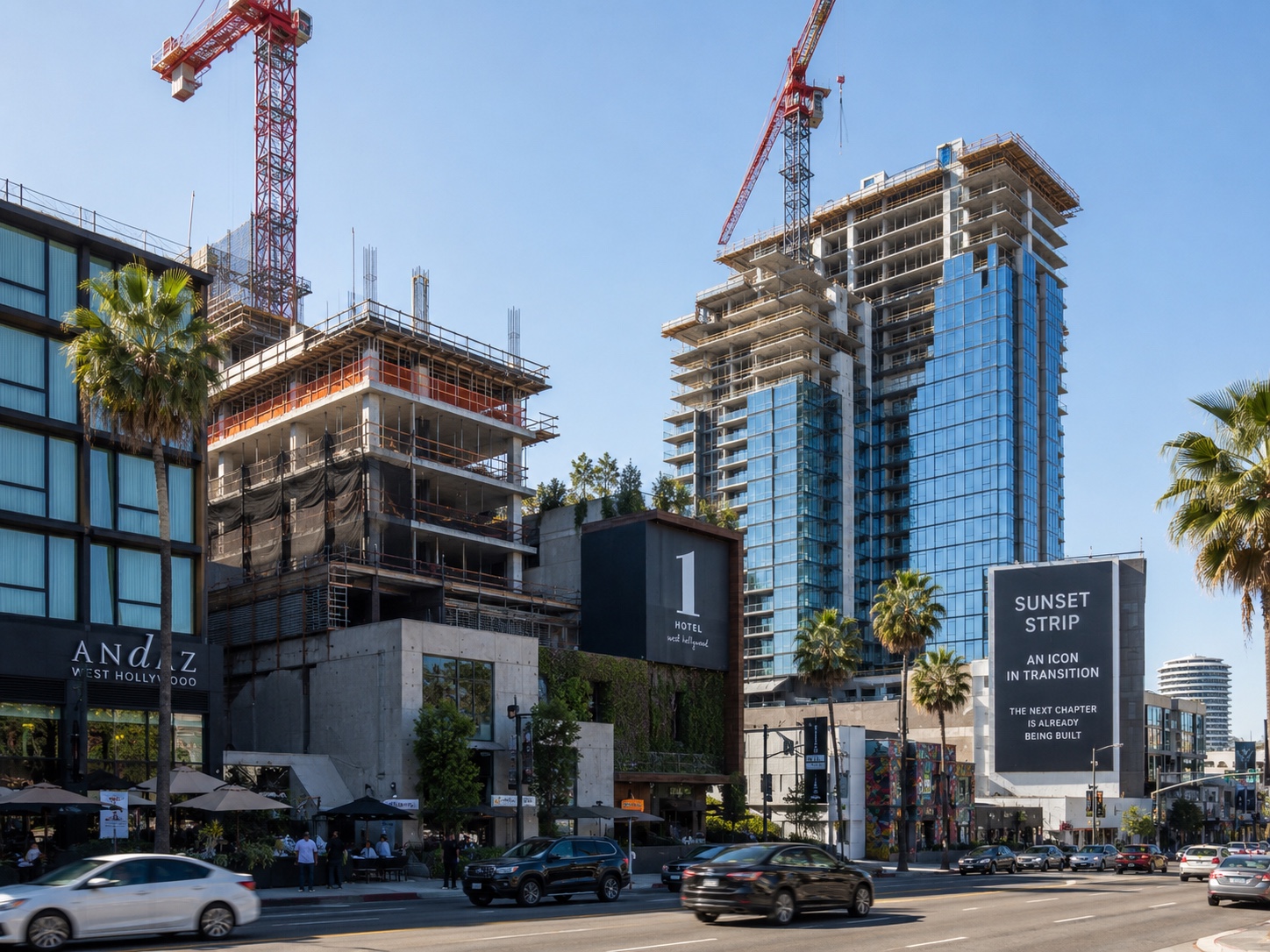
The easiest way to misunderstand the Sunset Strip is to see the cranes and assume the district is still becoming something.
In reality, it already is.
Restaurants are full. Hotels welcome guests. Luxury brands continue to invest. Traffic flows through one of Los Angeles’ most recognizable corridors every day. At the same time, new towers rise, buildings are renovated, and another generation of investment reshapes the skyline.
That apparent contradiction is not a sign of instability.
It is one of the defining characteristics of a great urban district.
The Sunset Strip is not rebuilding because it has failed.
It is rebuilding because it intends to remain relevant.
For much of the twentieth century, cities often measured success by what they had already built. A landmark hotel, a celebrated music venue, or a famous boulevard could define a destination for decades. Once a district achieved global recognition, its identity often became its greatest competitive advantage.
Today’s economy is far less forgiving.
Consumer expectations evolve faster.
Luxury standards rise continuously.
Hospitality competes globally.
Entertainment is increasingly digital.
Retail has expanded beyond physical storefronts.
Every city is competing not only with neighboring districts but with destinations around the world for a finite amount of attention, investment, and time.
That has fundamentally changed how successful urban districts create value.
Their advantage is no longer found in standing still.
It is found in continuously improving while remaining operational.
That is exactly what the Sunset Strip demonstrates today.
Drive its length and you experience two realities at once.
Completed luxury hotels stand beside new construction.
Restaurants serve full dining rooms while cranes rise overhead.
Existing investments continue generating economic activity even as new investments prepare for the next chapter.
Nothing has stopped.
Everything is evolving.
That coexistence is not accidental.
It represents one of the most resilient economic models in modern urban development.
Great districts rarely experience a single moment of completion.
Instead, they operate through continuous reinvestment.
Each generation improves upon the previous one.
Older properties are renovated.
New developments introduce additional hospitality, residential, retail, and entertainment offerings.
Public spaces improve.
Infrastructure evolves.
Capital continually renews the district without replacing its identity.
The objective is not to erase what came before.
It is to increase the value of everything already there.
That is why construction should not be viewed as evidence that a district is unfinished.
It is evidence that investors continue to believe in its future.
Every tower crane represents long-term confidence.
Every redevelopment project reflects a belief that demand will remain strong years after construction is complete.
Capital does not simply follow successful places.
It extends their success.
This pattern is visible across many of the world’s most recognizable urban districts.
New York’s Meatpacking District continues to evolve decades after its transformation began.
Miami’s Design District consistently introduces new architecture, luxury retail, hospitality, and public spaces while remaining an international destination.
Covent Garden in London continues to invest in its public realm, retail mix, and visitor experience despite its centuries-old history.
None of these places are waiting to become complete.
Their competitiveness depends on never assuming they already are.
The Sunset Strip belongs within that conversation.
Its future will not be determined by one luxury hotel, one residential tower, or one redevelopment project.
It will be determined by whether the district continues creating an environment where each new investment strengthens every existing one.
That is how great urban ecosystems compound value.
Hotels benefit from restaurants.
Restaurants benefit from entertainment.
Entertainment benefits from hospitality.
Retail benefits from pedestrian activity.
Every successful addition increases the strength of the surrounding district rather than existing in isolation.
The ecosystem becomes more valuable than any individual building.
Perhaps that is the most important lesson hidden behind the cranes.
They do not symbolize a district searching for an identity.
They symbolize a district protecting one.
The Sunset Strip is not replacing its legacy.
It is investing in its next generation.
Because the world’s great urban districts are never truly finished.
Their greatest competitive advantage is not what they built decades ago.
It is their ability to keep building while the world continues to arrive.
Related Posts

adidas Originals Teams Up with BAPE® for Special Stan Smith Collaboration Celebrating BAPE®’s 30th Anniversary
Stan Smith Collaboration Celebrating BAPE®'s 30th Anniversary
Nike Extends Historic Partnership with NBA, WNBA, and G League Through 2037
Nike Inc. Lands Historic 12-Year Partnership Extension With NBA and WN
A Taste of Havana Hits the Las Vegas Strip: Havana 1957 and Cortadito Coffee House Open at Flamingo Las Vegas
Havana 1957 And Cortadito Coffee House Bring A Cuban American Affair T
Sony Launches Sony Innovation Fund: Africa
~ Fostering ventures specializing in the entertainment business in

From Wu-Tang to Tribeca: RZA’s “One Spoon of Chocolate” Serves a Vicious Slice of Justice
Black Love, Vengeance, and a Small Town’s Dark Secret

MLS Ignites 30th Season with Dynamic ‘Game On’ Campaign Featuring Doechii
Major League Soccer Launches new "Game On" Campaign