

The Screen Used to Be the Proof
By Anabelle Lawerence
The screen used to be the proof.
Now the proof has to be explained.
There was a time when you didn’t need convincing. The frame expanded, the sound settled into your body, and the experience justified itself before you could question it. The format carried authority. The image made the argument.
That authority is no longer automatic.
Because the audience now decides. Quietly. Selectively. Not every film earns the larger screen. Not every release justifies the premium. The question has entered the process: Is this worth seeing in IMAX, or will standard do? And in that question, the shift reveals itself—not in technology, but in behavior.
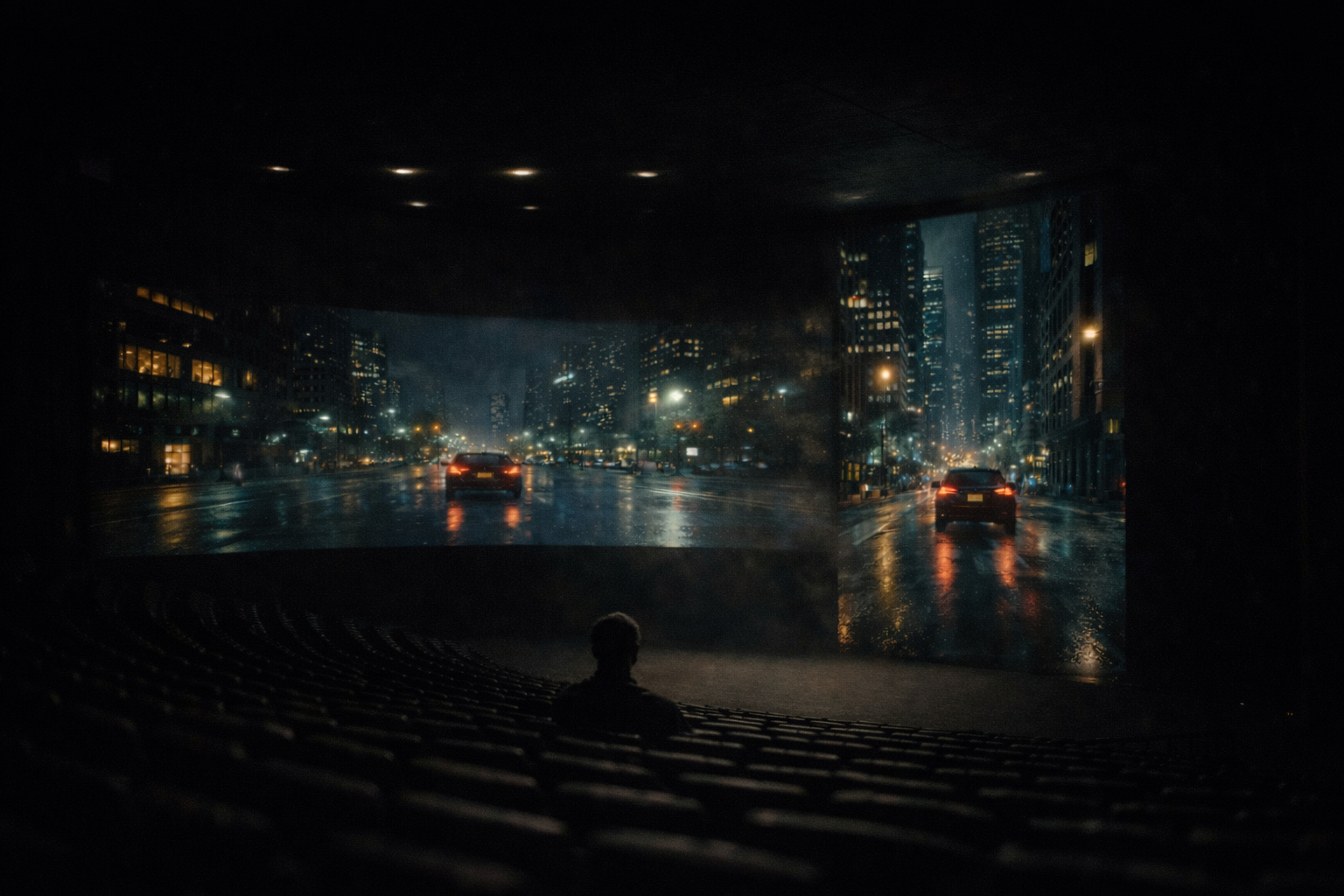
Look at Sinners. Shot simultaneously on Ultra Panavision 70 and 15-perf 65mm IMAX film, it does not resolve into a single format. It operates across them. Extreme width. Extreme height. Two visual grammars coexisting inside one film. Depending on the theater, the experience changes—not cosmetically, but structurally. Aspect ratios shift. Space reorients. The image reorganizes itself.
The film is not being resized for different screens.
It is being interpreted through them.
This is not a marketing idea. It is authorship.
Because what’s being built is not just an image, but a system of images—a film that accepts the reality of modern exhibition and embeds variation into its core. You are not simply watching Sinners. You are encountering a version of it, shaped by where you sit.
Now place that against Avengers: Doomsday and the introduction of “Infinity Vision.” The language suggests expansion, immersion, a new way of seeing. But what it actually does is more precise. It names the system that surrounds the image and presents that system as the event.
This is not a technological breakthrough.
It is a linguistic one.
Because the image has flattened. Not in quality, but in differentiation. Spectacle is no longer rare. Scale is no longer enough. When everything arrives at the same level of visual intensity, the advantage shifts—not to the camera, but to the explanation.
IMAX once carried that explanation on its own. “Shot in IMAX” implied a version of the film that could not be replicated elsewhere. It signaled scarcity. It signaled intention. But that clarity fractures when access is shared, when release windows compete, when a film like Dune: Part Two occupies the format with such precision that it redefines what “IMAX-worthy” looks like. Not every blockbuster can claim that same relationship to the screen.
So the strategy evolves.
If a studio cannot fully control where you see the film, it begins to control how you think about seeing it. “Infinity Vision” steps in as a replacement for what IMAX once guaranteed. It tells you the experience is elevated regardless of the environment. It stabilizes perception when the physical conditions can’t be exclusive.
The spectacle is no longer confined to the image.
It exists in the system that frames the image.
Naming becomes part of the experience. Positioning becomes part of the experience. The making of the film becomes inseparable from the meaning of the film—not because the tools are new, but because the audience now requires a reason to care.
This is where the distinction sharpens.
Some films are built for IMAX.
Some films are sold for IMAX.
One relies on composition.
The other relies on persuasion.
Sinners does not ask you to imagine a better version of itself. It creates multiple real versions, each tied to a physical condition of viewing. The difference is not described. It is experienced.
Doomsday, through “Infinity Vision,” ensures that wherever you sit, you feel as though you are accessing something premium. The experience is stabilized through language.
One builds the experience into the image.
The other builds the experience around the image.
Both are responses to the same reality: an audience that no longer defaults to spectacle.
But they lead to two different futures.
One trusts the image to carry the weight.
The other ensures the weight is carried, whether the image can do it alone or not.
And in that split, a quieter truth settles in—one that sits beneath every ticket decision now being made:
The screen used to be the proof.
Now the proof is whatever you’re convinced you’re seeing.
Related Posts

MM6 Maison Margiela and SALOMON Unveil the X-Alp: A Stylish Fusion of Urban and Outdoor Footwear
MM6 Maison Margiela and SALOMON Unveil the X-Alp

Universal Music Latino Is Using Streamer YaBoyyWill to Find Reparto’s Next Artists
From Stream to Studio
VertTV Shows That Hollywood Is Building the Next Generation of Television
A filmmaker-led studio built for the vertical era
The Barrier to Production Is Falling: The Barrier to Taste Is Not
Attention matters more than production

Marriott Bonvoy and Starbucks Launch New Loyalty Program Collaboration
Starbucks and Marriott Bonvoy Collaboration Unlocks Exclusive Benefits

Kansas City Chiefs Launch “Back-to-Back Greatness” Campaign to Celebrate Consecutive Super Bowl Wins
Kansas City Chiefs Launch "Back-to-Back Greatness"