

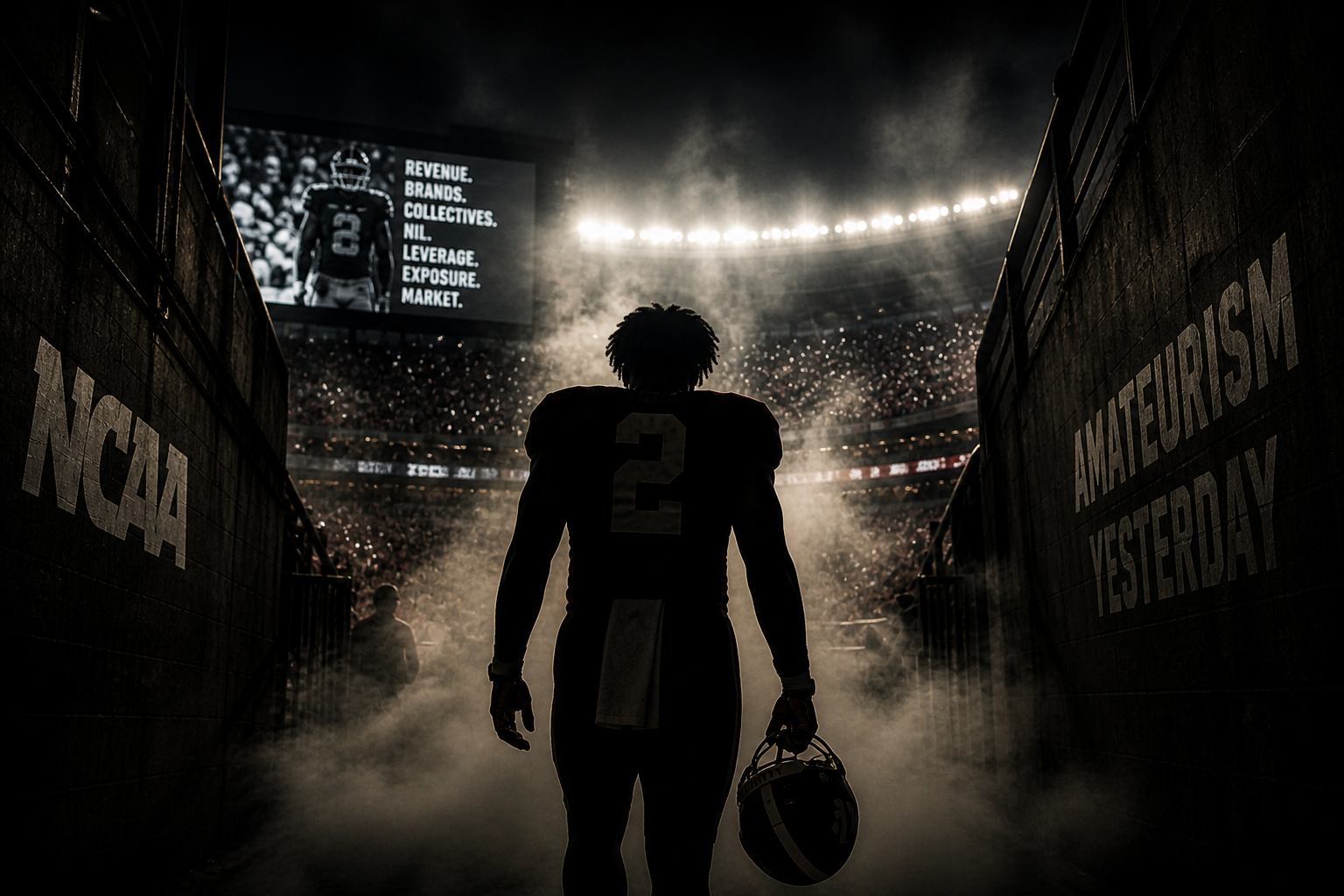
The NCAA Doesn’t Run College Football Anymore
By Terry Jackson
For decades, the NCAA sold a story.
Not just competition. Control.
Not just sport. Structure.
Amateurism wasn’t a philosophy. It was an operating system.
It decided who could be paid.
It decided how value moved.
It decided who held authority.
That system is over.
Not debated. Not evolving.
Over.
What replaced it didn’t arrive all at once. It didn’t announce itself. It didn’t need to. It came through pressure—legal, cultural, economic—until one day the structure that held everything together simply didn’t.
And now we are watching something else form.
Not college football as tradition.
College football as a market.
And the NCAA is no longer in control of it.
The break was legal.
The shift was economic.
The NCAA didn’t step aside. It was pushed. Court decisions stripped its ability to enforce the very thing that defined it. Name, Image, and Likeness wasn’t just a correction—
It was a breach.
Because the moment athletes could earn, even indirectly, the system had to reorganize around a new truth:
Value wasn’t theoretical anymore.
It was extractable.
And once value becomes extractable, it becomes competitive.
That’s when a system stops being governed.
And starts being traded.
To the outside, this moment feels unstable.
Transfers tied to money.
Collectives moving in gray zones.
Programs leveraging resources in uneven ways.
Deals that blur the line between endorsement and salary.
It looks like chaos.
It isn’t chaos.
It’s construction.
A system building itself without a central architect.
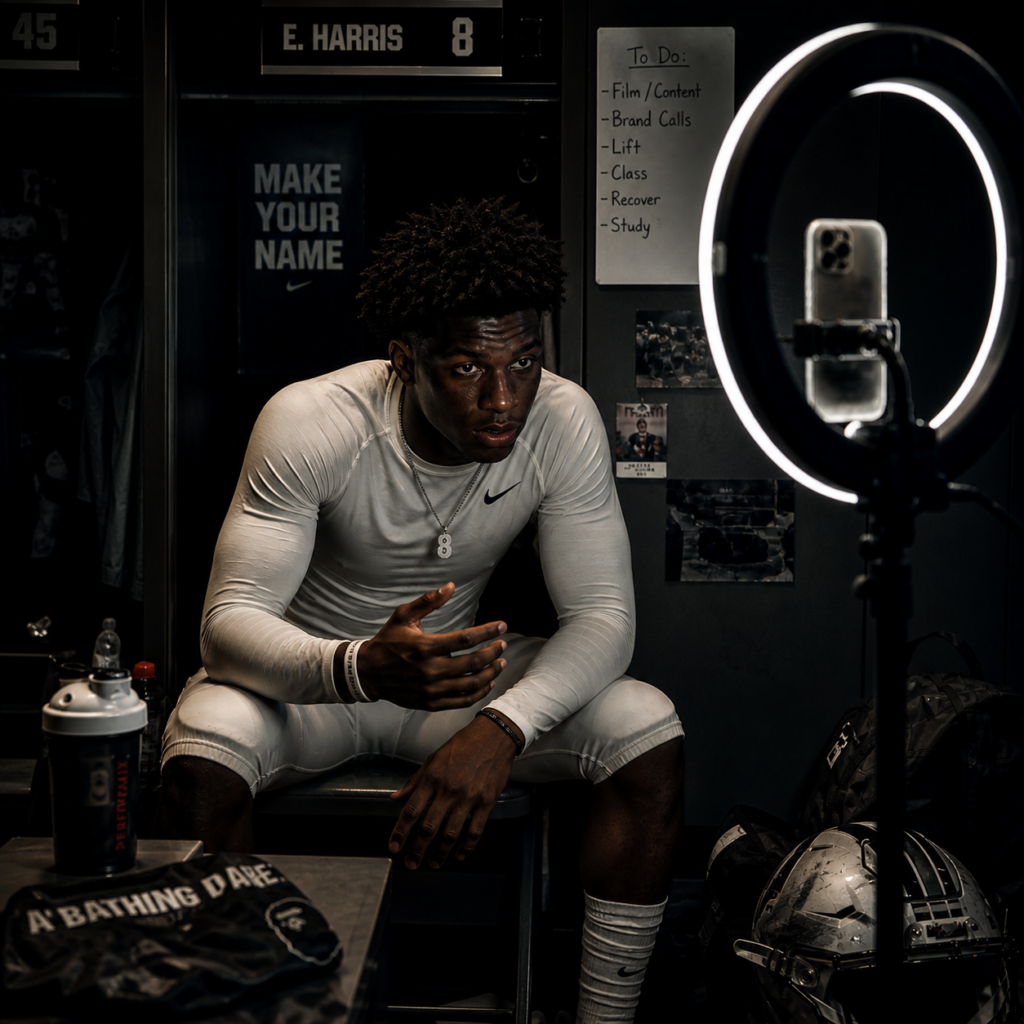
Athletes are independent economic actors.
Programs are marketplaces.
Collectives are financial engines.
Exposure is currency.
And the NCAA?
It’s issuing guidance to a system that no longer requires its permission.
That’s not dysfunction.
That’s displacement.
Authority didn’t disappear.
It moved.
For generations, the athlete created value but didn’t control it.
Performance flowed outward—into television deals, sponsorships, institutional prestige. The player was essential, but never central to the economics.
Now he is.
He walks into the system with agency.
He asks:
Where can I be seen?
Where can I be paid?
Where does my value compound?
Movement is no longer just loyalty.
It’s valuation.
And that shift rewires everything.
A transfer becomes a negotiation.
A program becomes a platform.
A season becomes a marketplace.
Once those meanings change—
The structure follows.
The NCAA is still trying to define the rules.
What is fair compensation?
What crosses into pay-for-play?
What preserves balance?
But those questions are arriving after the behavior.
Because markets don’t wait.
They move where value already exists.
Right now, that value moves through collectives, through brand deals, through visibility, through leverage.
The NCAA can respond.
It cannot reset what has already moved.
Authority sets terms.
Influence reacts to them.
The NCAA still has influence.
It no longer has authority.
And here’s the part the system is still avoiding.
College football is not becoming professional.
It already is.
It just hasn’t admitted it yet.
No contracts.
No salary structure.
No collective bargaining.
No long-term protection.
Revenue has scaled.
Mobility has scaled.
Compensation has scaled.
But infrastructure hasn’t.
Which creates the contradiction no one wants to sit with:
This is a professional economy—
Without professional responsibility.
Players can earn more than ever.
They can also lose everything just as fast.
Injury still ends careers.
Turnover is still ruthless.
Value is still short-term.
The system took the upside.
It left the protection behind.
And every system like that eventually breaks.
Because once athletes understand their value, the question changes.
Not what can I earn.
What is guaranteed?
And when that question spreads—really spreads—the system will have to evolve again.
Toward contracts.
Toward structure.
Toward accountability.
Not because the NCAA wants it.
Because the market will demand it.
Because the market always does.
Moments like this get reduced to individuals.
A player.
A headline.
A number that feels too big.
But the individual is never the story.
He’s the signal.
The real story is the system that made him possible—
And the one that comes next.
Related Posts

Chameleon Unveils Upcoming Cold-Brew Coffee Varieties Inspired by Girl Scout Cookie™ Flavors
Chameleon Organic Coffee®, renowned for its consciously crafted bottl
ESPN Thinks SportsCenter NEXT Can Become a Lifestyle Brand: Kaleena Smith and Beckham Black Are the Bet
The apparel matters, but the identity is the real product
Red Sole Evolution: Jaden Smith Named Christian Louboutin’s First Men’s Creative Director
A New Era of Luxury
Brioni Makes Its Soccer Debut with Como 1907 Partnership — A Historic Moment for Italian Luxury and Football Culture
From Sartorial Elegance to the Stadium:

Brett Landin The Company We Keep, The People We Outgrow
Durability Over Noise

Yasmin Kassim Is Creating the Stories She Once Needed to See
Making room for more voices to be heard