
The Industry Lost Timing, Not Audience
By Bryce Wilson
Culture didn’t fragment.
It lost its timing.
There was a period when attention moved together. Not because people agreed on what to watch, but because the system required them to arrive at the same moment. Television had a schedule. Film had an opening night. Music had a release window that unfolded collectively. To participate meant to be present when it happened.
That structure didn’t evolve.
It disappeared.
Streaming removed the clock. Algorithms personalized the feed. Everything became available at any time, in any order, on any device. What used to be shared became continuous, and in that continuity, something subtle but critical broke.
We didn’t stop watching.
We stopped arriving together.
And without arrival, there is no moment—only content.
The industry treated this like a volume problem. More shows. More releases. More access. But access was never the issue. The system lost its ability to coordinate attention. It could distribute endlessly, but it could no longer gather.
That’s the difference between consumption and presence.
Consumption is individual.
Presence is collective.
One fills time.
The other defines it.
A moment only becomes a moment when people experience it together. Not eventually. Not through clips. Not through recaps. At the same time, with the same uncertainty, with the same stakes. That simultaneity creates weight. It turns events into memory, and memory into culture.
Without it, everything feels smaller—even at scale.
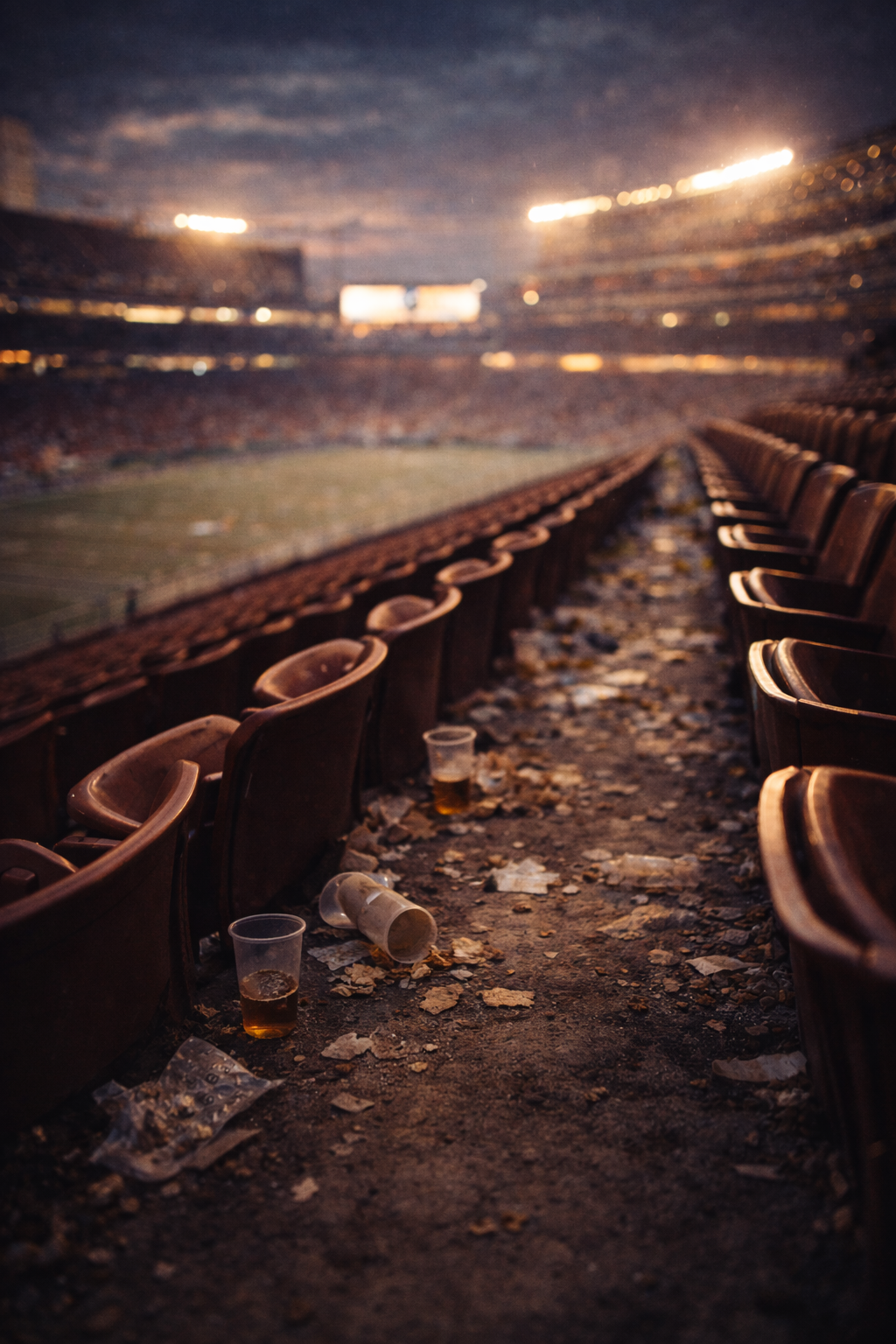
This is why certain environments still feel disproportionately powerful. Not because they produce better content, but because they still operate on fixed time. They require arrival. They don’t wait for the audience to catch up. The audience has to meet them there.
That condition changes behavior.
It forces presence.
And presence is now the rarest resource in culture.
Because everything else can be delayed.
You can watch it later.
You can scroll past it.
You can come back to it when it’s convenient.
But the moment itself doesn’t wait.
And once it passes, it cannot be reconstructed in the same way.
That’s the asymmetry.
It’s not about what happened.
It’s about when you experienced it.
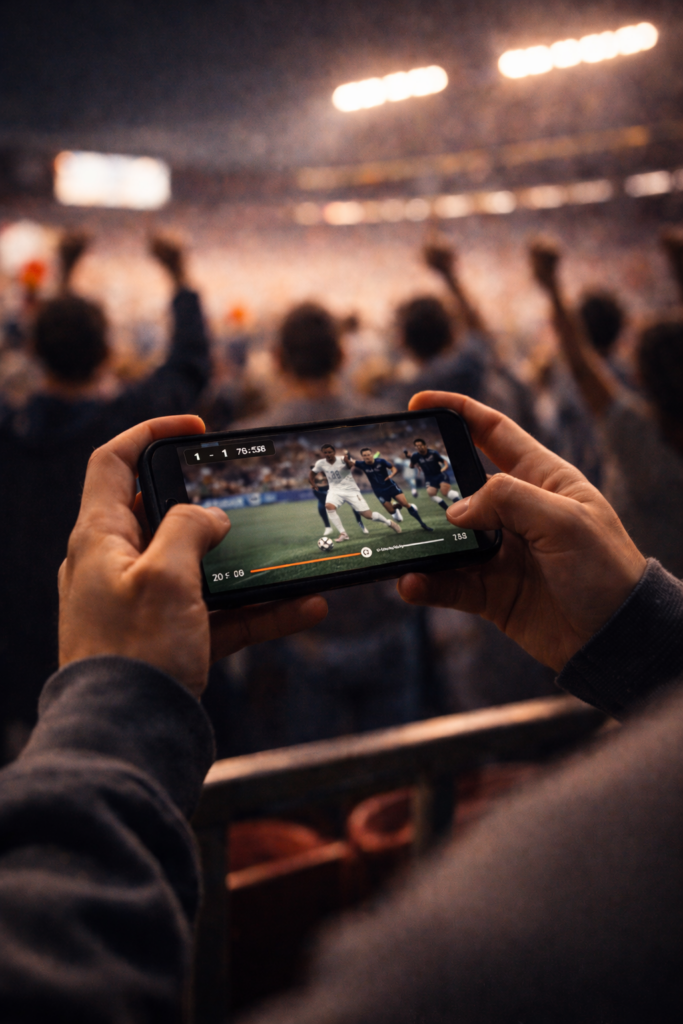
You can feel this shift in small ways. A crowd reacting in real time while someone watches the same play seconds behind on their phone. The image is subtle, but the implication is clear. You are physically present, but temporally removed. Close enough to see it, but not aligned enough to feel it as it unfolds.
That gap is where culture is slipping.
Not disappearing—slipping.
Because culture is not built on access. It’s built on shared time. And when time fractures, culture loses its density. It becomes quieter, even when millions are engaged.
What’s emerging now is not a return to the past.
It’s a reconstruction.
Moments are no longer forming naturally. They are being designed. Structured. Engineered to create the conditions that once existed by default. Fixed windows. Live releases. Events that punish absence. Systems that make people feel the need to show up—not eventually, but immediately.
Not everything will operate this way.
But the systems that do will define what culture feels like going forward.
Because in a world where everything is available, the only thing that retains value is what cannot be experienced the same way twice.
Not the content.
The timing.
Related Posts

Kicking Tradition Forward: PUMA x KidSuper Celebrates Football’s Legacy in Style
Distressed, Dynamic, and Distinct
Bad Bunny Isn’t Selling Puerto Rico — He’s Distributing It
The Platform Gets Bigger. The Message Stays the Same.

Marvel’s New X-Men Series Puts the Mutants in Charge of Protecting Earth
Mutants Become Earth’s Defenders

The Quiet Calculation: Pregnancy, Power, and the Cost of Womanhood in Sports
When Biology Meets the Balance Sheet

Bang & Olufsen Unveils Cutting-Edge London Boutique: A Futuristic Tech Haven
Danish electronics giant Bang & Olufsen is setting its sights on an ex