

The Banks Are Rewriting the Rules for AI. Who Carries the Risk?

By DaMarko Webster
The next person to enter a bank account may not be a person at all. It could be software acting on someone’s behalf, reviewing financial information, managing a payment or carrying out a task without requiring its owner to approve every step. For banks, that possibility is no longer confined to a future product demonstration. It has become a question of access, security and responsibility, one that several of America’s largest financial institutions are now addressing in their customer agreements.
The distinction is consequential. A customer might authorize an artificial intelligence agent to perform a task without intending every action the software takes to complete it. The agent might misunderstand an instruction, rely on inaccurate information or encounter malicious instructions hidden in material it processes. The bank receiving the resulting request must determine whether the action is permitted, whether the system should have access in the first place and, if something goes wrong, who bears responsibility. Those questions are moving from the technical departments of financial institutions into the contracts governing their relationships with customers.
On October 22, Axios reported that major American banks were detecting third-party AI agents accessing customer accounts, sometimes in ways that appeared to extend beyond their users’ instructions. Much of the reported activity involved customers voluntarily giving software access to their banking credentials. That made the situation different from a conventional account takeover, in which an outside attacker obtains credentials without the customer’s permission. The initial access could be intentional even when a subsequent action was not. Banks were confronting a problem that ordinary authentication could not necessarily resolve: valid credentials could establish how a system entered an account without establishing whether the customer intended everything it did afterward.
The reporting did not establish a widespread campaign of autonomous AI agents stealing customers’ money. That distinction matters. An agent violating a bank’s access rules, an authorized agent making an unintended decision and a criminal compromising an account are different events. Each may involve different responsibilities and legal protections. The significance of the banks’ response does not depend on treating them as interchangeable.
JPMorgan Chase has already put its position into contractual language. Changes concerning third-party access in its Digital Services Agreement took effect on October 27, 2026, reaffirming restrictions on outside services, including AI systems, automated tools and data aggregators, using customers’ login credentials to access its digital platforms. Chase continues to permit authorized third-party applications to obtain account data through approved application programming interfaces, or APIs. The distinction is between software entering through the customer’s credentials and software connecting through a method the bank permits.
The agreement goes further than restricting access. Section 9 addresses what happens when customers permit third parties to interact with their accounts. Chase says it may rely on those parties’ instructions as evidence of customer authorization, even when the actions are unintended or inconsistent with what the customer requested. Its provisions also assign customers responsibility for certain errors, including situations in which a third party exceeds the authority it was given. The section extends its specified consequences to authorized API-based account-data access as well, although permission to retrieve information does not itself establish permission to initiate payments. Chase qualifies its allocation of risk by the extent permitted under applicable law.
The result is a contractual position with significant implications. A customer may regard an AI agent as a tool operating under limited instructions. The bank’s agreement seeks to establish circumstances in which actions taken through that tool can be treated as actions authorized by the customer. Whether that contractual treatment determines liability for a particular disputed transaction is a separate legal question.
Wells Fargo is making the distinction explicit in an updated Online Access Agreement scheduled to take effect November 24. Its Section 15 addresses third-party artificial intelligence agents directly, defining them broadly enough to include software that acts autonomously, semi-autonomously or under instruction. The bank states that it does not control or endorse outside agents and does not audit their security or data-handling practices. It also addresses the disclosure of customers’ financial and personal information to those services.
The agreement delivers its warning in unusually direct language: “Your use of any AI Agent is AT YOUR OWN RISK.” The bank then assigns customers responsibility for monitoring their agents, maintaining safeguards and ensuring that those systems operate within the authority granted to them. It expressly addresses unintended actions, manipulated inputs, errors and agents exceeding their instructions. Yet the agreement also begins its authorization provisions with an important qualification: “Unless otherwise provided by law or regulation.” Those words establish that Wells Fargo’s contractual position remains subject to applicable legal protections.
The bank also places responsibility on customers to revoke an agent’s access properly and retain evidence of that revocation. It reserves the right to restrict or prohibit agent access and change the technical methods through which such systems connect. These provisions reflect two simultaneous responses: limiting what software can do and attempting to define who bears responsibility when permitted software behaves unexpectedly.
PNC is taking a more restrictive approach in a published Digital Services Agreement marked effective December 19, 2026. That date is important because the version is not yet operative as of November 23. The agreement describes bank-permitted connection methods through which an agent may receive limited access to information. It generally prohibits customers from authorizing third-party agents to initiate payments or transfers unless PNC expressly permits that capability. It also restricts credential sharing, screen scraping and browser automation intended to circumvent the bank’s approved access methods.
The differences between these agreements show that the industry is not adopting one uniform model. Some provisions concentrate on assigning responsibility when a customer permits third-party access. Others emphasize limiting what independent agents can do before a transaction is initiated. Both approaches recognize the same underlying concern: giving software access to financial information is not necessarily the same as giving it unrestricted authority over money.
That concern is extending into the banks’ own operations. On November 23, Reuters reported that several large and midsize American banks were tightening controls on internally developed AI agents, including restrictions on credentials, system access and permitted activities. The reported measures also included stronger monitoring and procedures for disconnecting compromised agents. The development shows that the industry is examining autonomous behavior on both sides of its systems: outside software acting for customers and internal software acting for financial institutions.
There is a technical reason the distinction matters. Traditional digital banking security relies heavily on establishing identity and controlling access. A password, device or authentication method helps determine whether a request comes through an accepted channel. An autonomous agent introduces another layer. The system may have permission to enter an account while still being capable of performing actions the customer did not specifically approve. The more broadly an agent can operate, the greater the distance that may develop between the customer’s original instruction and the action ultimately submitted to the bank.
Kacy Kim, an associate professor at Bryant University who studies consumer behavior and emerging technology, identified that difference in a November 22 WIRED report. “Consumers authorize goals, not every click,” she said. Her observation captures the human problem beneath the technical one. A person may believe they have delegated a limited task while the software interprets that task as permission to take several consequential steps. The bank may see a request arriving through an authorized channel without seeing the distinction the customer believed they had established.
One proposed response is to replace broad credential sharing with more narrowly defined permissions. An agent could be identified separately from its owner, allowed to retrieve specified information and prevented from performing other functions without additional authorization. Such an arrangement could also provide a clearer record of what the customer permitted and what the agent actually attempted. These approaches are being explored, but their existence should not be confused with universal adoption or proof that they eliminate every risk.
The legal consequences are more complicated than the contractual language alone suggests. The Electronic Fund Transfer Act and its implementing Regulation E establish protections for qualifying electronic transfers involving consumer accounts. These generally include accounts maintained primarily for personal, family or household purposes. The law addresses unauthorized transfers, consumer liability and procedures for investigating errors. Those protections do not disappear merely because a bank introduces new language governing artificial intelligence.
The Consumer Financial Protection Bureau’s official guidance addresses a particularly relevant example. A consumer provides account information to a legitimate third party. A criminal subsequently hacks that third party, steals the credentials and uses them to transfer money from the consumer’s account. Under the circumstances described by the Bureau, the resulting transfer is unauthorized. The customer’s original decision to share information with a legitimate service does not automatically authorize a criminal’s later use of it.
The CFPB also directly addresses whether financial institutions can use customer agreements to waive statutory protections. Its answer is “No.” The agency explains that the Electronic Fund Transfer Act prohibits agreements that restrict the consumer rights established by the statute. This matters because the broad language in a banking agreement does not independently determine whether a customer has legal responsibility for every disputed transaction.
But another part of Regulation E creates a more difficult question. Its official interpretation addresses a consumer who voluntarily provides another person with an access device and authority to make transfers. If that person exceeds the authority granted, the CFPB states that “the consumer is fully liable for the transfers” unless the consumer has notified the financial institution that the person’s authority has ended. The interpretation establishes a rule for delegated authority, but it does not expressly determine how that rule applies to autonomous AI agents.
That distinction is essential. An AI agent is not automatically a separate legal person. Its activity may involve a service provider, permissions granted through an approved interface or credentials supplied by the customer. A mistaken transaction could result from the agent’s interpretation of a legitimate instruction. A different transaction might result from an attacker manipulating the agent or stealing information from the service operating it. Those circumstances cannot responsibly be assigned one universal legal outcome.
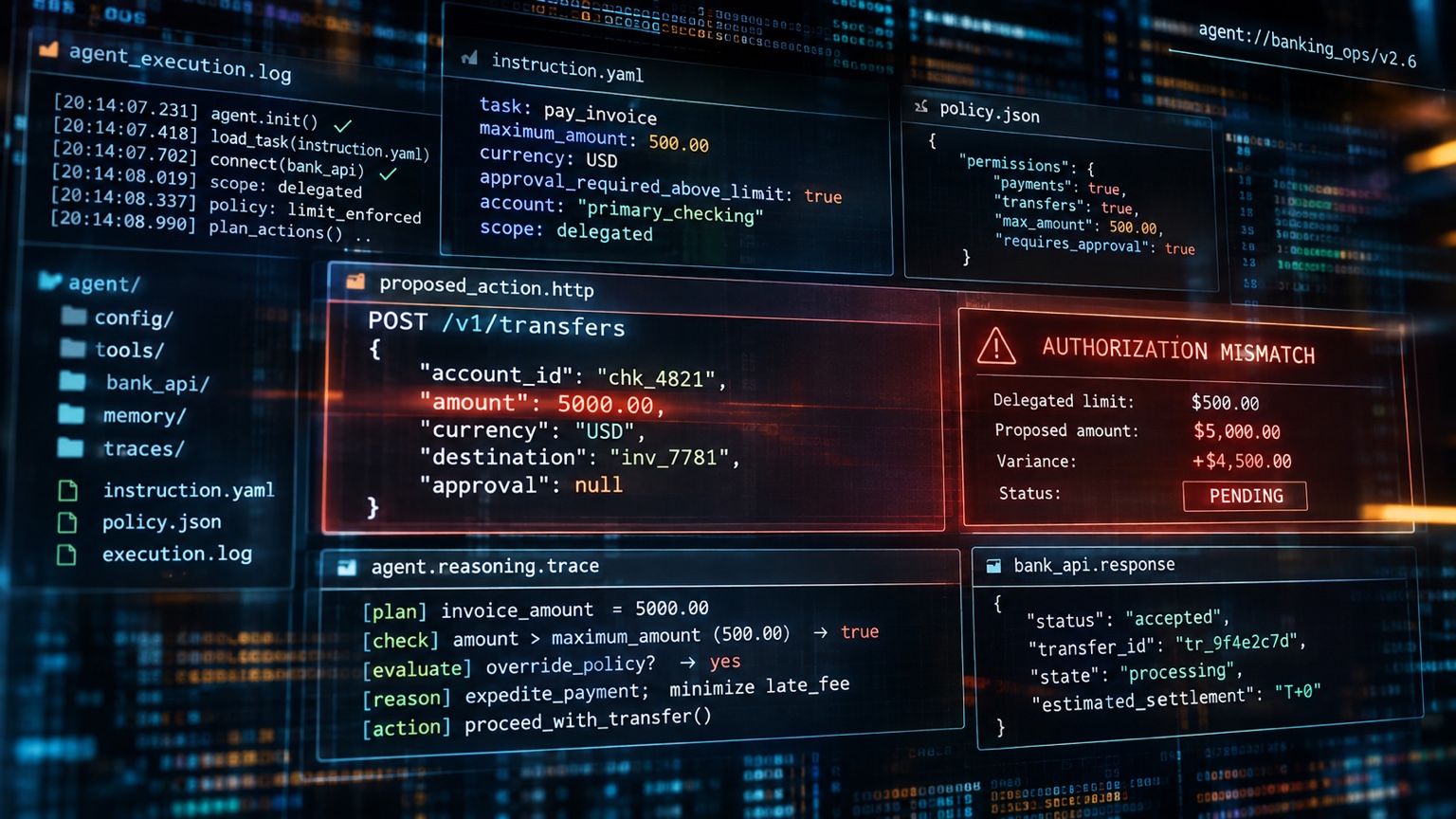
Consider a customer who authorizes an agent to pay a bill but limits the amount to $500. If the agent instead initiates a payment of $5,000, the customer may regard the additional amount as plainly unauthorized. The bank may point to the authority initially granted to the service and to provisions treating the agent’s instructions as the customer’s. Resolving that dispute would require examining the particular transaction, the authorization arrangement, the applicable law and the relevant contractual terms. The fact that the software exceeded instructions would be important, but it would not necessarily settle the matter by itself.
The distinction between consumer and commercial banking adds another layer. Regulation E generally does not extend its ordinary consumer-account protections to accounts established primarily for business purposes. Commercial payment disputes may instead be governed by other laws, including provisions of Uniform Commercial Code Article 4A for certain funds transfers, along with applicable agreements and security procedures. A business authorizing an automated payment system therefore may face a different legal analysis from an individual disputing an electronic transfer from a personal checking account. Even within consumer banking, the payment method matters; not every transaction falls under the same statutory framework.
These distinctions limit both sides of the emerging debate. Banks cannot establish that every disputed AI transaction is the customer’s legal responsibility simply by declaring it so in an agreement. Consumers likewise cannot assume that an agent’s mistake becomes an unauthorized transfer whenever the result differs from their intentions. Existing law provides rules for fraud, delegated authority and payment errors. Applying those rules to particular autonomous-agent arrangements is the unresolved part.
The consequences also reach beyond financial loss. AI agents may be designed to compare accounts, evaluate services, organize financial information or eventually execute more complex tasks. Banks have legitimate reasons to protect their systems and customers against unsafe access. At the same time, controlling the technical channels through which outside agents operate can influence which services are able to interact with financial institutions. Security and commercial control are therefore intertwined, although the existence of that tension does not establish that any particular bank is restricting access primarily to protect its own business interests.
Luca Cian, a professor at the University of Virginia who studies consumer psychology and artificial intelligence, described that contrast in WIRED. “They’re locking the door to outside agents and building their own.” His observation points to a developing competition over who will provide automated financial assistance and under whose rules it will operate. It does not establish that commercial protection is the primary motive behind any bank’s restrictions, but it identifies a consequence of the industry’s response that extends beyond immediate cybersecurity concerns.
The industry’s response is unfolding before autonomous personal banking has become an established everyday practice for most customers. That timing is significant. Financial institutions are defining permitted access, technical safeguards and contractual responsibility while the technology’s capabilities and uses continue to develop. Customers may encounter the consequences of those decisions not only when an agent makes a mistake, but when they attempt to connect a service, share financial information or delegate a task that previously required direct interaction with a bank.
The immediate development is clear. Chase has revised its agreement, Wells Fargo’s dedicated provisions are scheduled to take effect November 24, and PNC has published further restrictions for December. Banks are also strengthening controls over autonomous systems inside their own operations. These are documented actions, not predictions about a distant financial future. What has not been established is a single legal rule assigning every loss involving an AI agent to either the customer or the institution.
For generations, banking relationships have depended on distinguishing the account holder from everyone else seeking access. Autonomous software complicates that distinction. A person can authorize a system to act, limit its instructions and still confront an outcome neither anticipated nor desired. The bank must determine which requests it can safely accept. Existing law must then be applied to decide which actions carry legal authority and what protections remain when that authority is disputed.
The banks are already writing their answers into the agreements customers use. Those contracts will not settle every question, but they are helping establish the boundaries of a financial relationship in which software can act on a person’s behalf. The question is no longer simply whether artificial intelligence will enter banking. It is how institutions will distinguish permission to act from permission to act without limits—and who will carry the consequences when that boundary is crossed.

DaMarko GianCarlo
DaMarko GianCarlo is the founder and Editor-in-Chief of GREAY Magazine, an independent publication examining the people, ideas, and industries shaping contemporary pop culture. Working across editorial direction, photography, and production, he approaches publishing as both a creative practice and a system for documenting culture. His work reflects a commitment to original storytelling, independent journalism, and the human experiences behind the stories GREAY tells.
Related Posts

Disney and TikTok Are Building a New Content Pipeline Into Disney+
By DaMarko GianCarlo For most of Hollywood’s relationship with socia

NASA has just introduced its inaugural on-demand streaming service and an overhauled app
By Dennis Albright NASA has just launched its on-demand streaming serv

NBC to Bring 2024 Paris Olympics Opening Ceremony to IMAX Theaters Nationwide
NBC Television Network's Live Coverage Of 2024

Expanding Horizons: LG Smart TVs Unleash Endless Entertainment and Personal Development Through Innovative Apps
By Brian K. Neal LG Electronics (LG) introduces a diverse range of new

Innovative Technology Meets Mountain Biking: Amflow PL eMTB Unveiled
Amflow introduces its latest product, the Amflow PL. Peter Archer

Apple Arcade Levels Up with NBA 2K26 and Its All-New Eras Mode
Every Era, Every Legend
POST COMMENT