


Swatch Is Teaching Luxury How to Circulate
By Duncan Truex
There was a time when luxury watches were designed to stay distant.
Not impossible to see. Impossible to touch.
The modern luxury watch industry was built on controlled scarcity, waiting lists, dealer relationships, inherited access, and the psychological architecture of exclusion. The point was never just to own the object. The point was to enter the room around it.
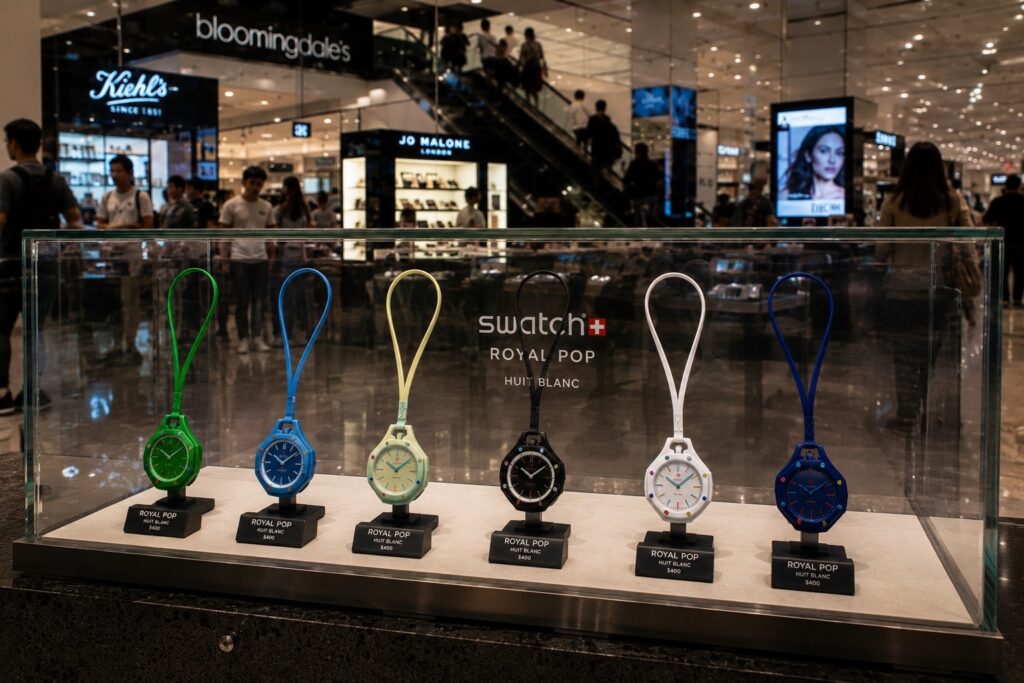
That is why the Swatch × Audemars Piguet collaboration matters.
Not because it is a pocket watch.
Not because it is colorful.
Not even because it carries Royal Oak DNA into a lower price category.
It matters because one of the most protected symbols in modern luxury just stepped into mass culture on purpose.
For decades, the Audemars Piguet Royal Oak represented a specific kind of industrial prestige. Not loud wealth. Structured wealth. The watch became associated with founders, athletes, executives, collectors, and people who wanted to communicate fluency rather than spectacle.
The Royal Oak was never simply a product.
It was admission control.
Then came the era of cultural circulation.
Luxury stopped living exclusively inside boutiques and began living inside feeds, moodboards, paparazzi photos, podcasts, TikToks, resale platforms, airport lounges, NBA tunnels, YouTube wrist checks, and celebrity close-ups. The object itself became less important than its visibility infrastructure.
That shift changed everything.
Because once luxury becomes infinitely visible, the old model starts to weaken. Distance no longer creates mystique by itself. The internet already dissolved distance. Everyone can see the watch now. Everyone knows the references. Everyone understands the codes.
So luxury brands are facing a new problem:
How do you maintain aspiration in a world where the image is already public?
The answer increasingly looks like controlled participation.
That is what the Swatch partnership actually is.
Swatch does not have the mythology of Audemars Piguet. What it has is cultural distribution. Accessibility. Scale of visibility. Familiarity. Swatch understands how objects move socially once they leave the boutique.
The collaboration is not really about horology.
It is about circulation.
The same thing already happened in fashion.
Luxury houses once protected themselves through separation. Then they realized that younger audiences were not building relationships with brands through private salons anymore. They were building them through sneakers, collaborations, capsules, pop-ups, and internet participation.
Access became the new advertising.
That is why the collaboration feels emotionally confusing to parts of the watch community. To traditional collectors, the Royal Oak symbol was supposed to remain structurally elevated. Once the visual language enters broader culture, some fear the mythology weakens.
But culturally, the opposite may be happening.
Because modern luxury no longer survives through secrecy alone.
It survives through relevance.
A generation raised on algorithmic culture does not always aspire through distance. They aspire through proximity. They want to feel adjacent to the world, even if they cannot fully enter it yet.
The Swatch × AP collaboration understands that psychology perfectly.
It gives consumers something incredibly important in 2026:
participation without full admission.
And that may become the defining business model of modern luxury.
Not ownership.
Not exclusivity.
Managed access.
The object becomes a passport stamp into the mythology.
That is why this collaboration feels bigger than watches. It signals a broader transformation happening across luxury itself. Cars are becoming subscription ecosystems. Fashion is becoming collaborative media. Hospitality is becoming social identity infrastructure. Even technology companies now sell emotional belonging as much as hardware.
The industries are different.
The system is becoming the same.
The old luxury model said:
“You are either inside or outside.”
The new luxury model says:
“You can enter the atmosphere before you enter the room.”
And culturally, that may be far more powerful.
Related Posts

Jordan Fuller of the Los Angeles Rams Partners with RADical Hope for Student-Athlete Support
By Brett Reiner Los Angeles Rams safety and team captain Jordan Fuller

Carlos Sainz Joins Williams: A New Chapter in His F1 Career
Carlos Sainz Has Officially Signed with Williams F1 Team.

Speedo Unveils the Vanquisher 3.0: A Game-Changer for Swimmers
SPEEDO LAUNCHES NEW & IMPROVED #1 TRAINING & RACING GOGGLE.
Monster Energy Returns as the Official Energy Drink Partner of the BIG3
MONSTER ENERGY BACK AS THE OFFICIAL ENERGY DRINK OF THE BIG3

The Middle-Class Actor Is Being Engineered Out
Proof now matters more than performance

Audi and Inter Miami CF Announce Multi-Year Premium Partnership
Audi is the Premium Automotive Partner of Inter Miami CF