

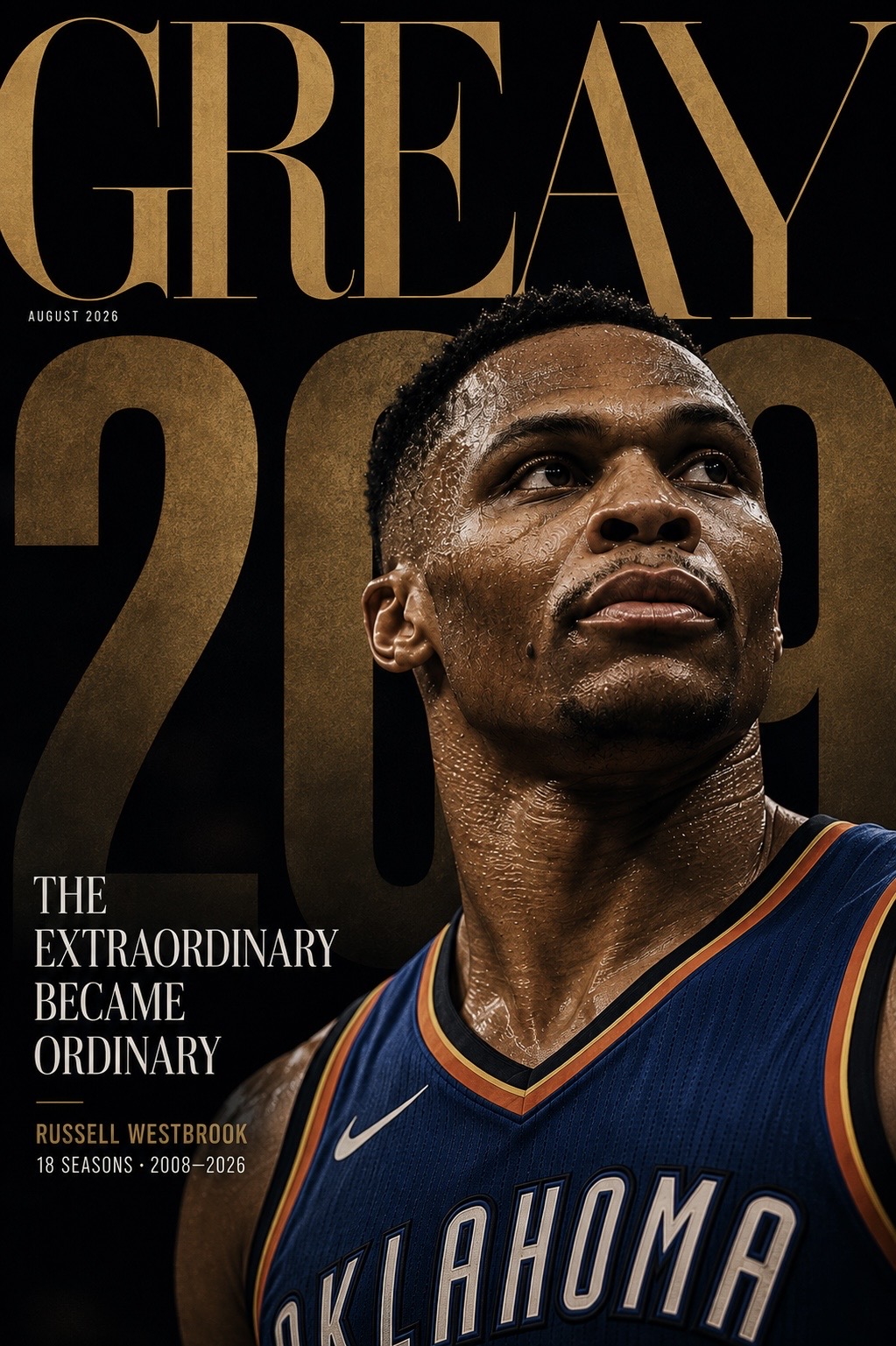
Russell Westbrook Did the Extraordinary Until Basketball Started Calling It Ordinary
By Benjamin Salamandor
There is something strange about the way greatness disappears when we become accustomed to seeing it.
At first, it interrupts us. Then it impresses us. Eventually, if it happens often enough, we begin expecting it.
Russell Westbrook spent 18 NBA seasons moving through that cycle.
When his career ended in August 2026, the numbers were so enormous, and by then so familiar, that it was possible to read them without fully processing what they meant. More than 27,000 points. More than 10,000 assists. More than 9,000 rebounds from a 6-foot-3 guard. Nine All-Star selections. Nine All-NBA teams. Two scoring titles. Three assists titles. An MVP.
And 209 triple-doubles.
More than anyone who had ever played in the NBA.
Those numbers are enough to build a conventional retirement tribute.
Westbrook’s career deserves something more complicated.
Because for much of the past decade, watching Russell Westbrook meant participating in an argument about Russell Westbrook.
There was the basketball player, and then there was the conversation surrounding the basketball player. Eventually, the two became almost impossible to separate.
Was the pace brilliance or recklessness? Did the rebounds represent a point guard expanding the possibilities of his position or a system helping manufacture numbers? Were the triple-doubles evidence of complete basketball or statistical excess? Could a championship team be built around him? Could his game survive the decline of his athleticism? Could he play without controlling the ball? Did the inefficiency undermine the production, or had the production become so historically unusual that efficiency alone could never adequately describe it?
Basketball kept asking.
Westbrook kept playing.
But Westbrook’s career was unfolding alongside another transformation that would become essential to understanding how we remember him.
He became a superstar during the period when the machinery surrounding professional sports learned how to turn every possession into evidence.
The conversation no longer ended with the game.
A missed jumper could become a clip before the next timeout. A turnover could travel independently of the 47 minutes surrounding it. Advanced statistics gave us increasingly sophisticated ways to measure efficiency and impact. Social media gave millions of people somewhere to prosecute those numbers. Debate television, podcasts, highlights, memes and basketball communities capable of examining individual possessions created something previous generations of stars experienced differently.
The permanent referendum.
A player no longer simply had a bad night.
The bad night could become an argument about his entire career before he played again.
Westbrook may have been uniquely suited to thrive as a basketball player inside that environment while becoming one of its most polarizing basketball ideas.
Because subtlety was never his game.
Russell Westbrook played loudly.
His brilliance was loud. His mistakes were loud. His dunks were loud. His turnovers were loud. His celebrations were loud. His missed jumpers were loud.
There were players whose inefficiencies could disappear inside the rhythm of a game.
Westbrook’s rarely did.
And while everyone was arguing about what those imperfections meant, something genuinely extraordinary happened.
One of the most statistically improbable careers basketball had ever produced began to feel ordinary because Westbrook produced its extraordinary parts so often.
Before him, the triple-double belonged partly to basketball and partly to mythology.
Oscar Robertson averaged 30.8 points, 12.5 rebounds and 11.4 assists during the 1961–62 season. Then basketball waited 55 years for someone to average a triple-double again. Robertson’s 181 career triple-doubles stood as the NBA record for decades.
Those numbers seemed to belong to another version of the sport.
Then came 2016–17.
Westbrook averaged 31.6 points, 10.7 rebounds and 10.4 assists. He recorded 42 triple-doubles and became the first player since Robertson to average one across an entire season. He was named the NBA’s Most Valuable Player.
That should have been the kind of season that existed alone.
Westbrook averaged a triple-double the following season.
Then again.
And after leaving Oklahoma City, he did it once more in Washington.
Four times in five seasons.
Something happened to us while he was doing it.
Greatness is often understood through scarcity. Something feels extraordinary partly because we almost never see it. Records become mythology because generations approach them and fail.
Westbrook disrupted that relationship.
He didn’t merely reach what basketball considered unreachable.
He returned there so frequently that the accomplishment gradually lost some of its ability to astonish us.
The triple-double did not become easier.
Russell Westbrook changed our definition of normal.
And the season that began that transformation meant considerably more than its averages.
Kevin Durant left Oklahoma City for Golden State in the summer of 2016. James Harden had already been traded years earlier. The young trio that reached the 2012 NBA Finals and once appeared capable of defining the next decade of basketball was gone.
Westbrook remained.
Oklahoma City had lost more than Durant’s scoring. A franchise that had spent years believing it understood what its future looked like suddenly did not.
Westbrook became its continuity.
And then he played as though responsibility itself could be converted into velocity.
The rebounds mattered because he didn’t wait for someone else to begin the possession. He grabbed the basketball and became the transition offense himself. The assists mattered because enormous portions of Oklahoma City’s offense depended upon his ability to create something. The scoring mattered because there were nights when the Thunder simply needed him to generate enough force to change the direction of the game.
It wasn’t always elegant.
It wasn’t always efficient.
Sometimes it wasn’t sensible.
But it was unmistakably alive.
At his peak, Westbrook played basketball with a physical urgency that statistics have never completely captured. Defensive rebounds became fast breaks before defenses could organize themselves. Openings that appeared too small became driving lanes. Ordinary regular-season possessions occasionally carried the emotional intensity of elimination games.
He attacked the rim as though hesitation were an opponent.
That style created his greatness.
It also created his limitations.
Any serious accounting of Westbrook has to allow both things to remain true.
He was never a consistently efficient perimeter shooter. His decision-making could become reckless. Turnovers accompanied the creation. As NBA offenses increasingly reorganized themselves around spacing, three-point shooting and efficiency, constructing lineups around a ball-dominant guard who could not reliably stretch defenses became increasingly complicated.
Age did not invent those contradictions.
It exposed them.
Nowhere were they exposed more publicly than Los Angeles.
Putting Westbrook beside LeBron James and Anthony Davis on the Lakers assembled extraordinary résumés without necessarily assembling complementary basketball. When the experiment struggled, every missed jumper, turnover and awkward possession became capable of traveling beyond the game itself.
The clip became evidence.
The meme became analysis.
The nickname became judgment.
And gradually something more consequential happened.
The older Westbrook began rewriting the public memory of the younger one.
A missed jumper in Los Angeles became evidence about Oklahoma City.
A turnover became evidence about the MVP.
A difficult fit late in his career became evidence that perhaps the triple-doubles had never meant what people thought they meant.
That is one of the cruelties of watching athletes age publicly in the modern sports ecosystem.
Decline doesn’t merely follow the prime anymore.
Sometimes it edits it.
The most recent version of an athlete becomes the easiest version to remember because it is the version producing today’s clips, today’s statistics and today’s arguments.
Westbrook stayed in the NBA long enough for his decline to begin competing with his own mythology.
And then he did something that deserves more attention than it received.
He stayed.
The MVP became a role player.
The franchise centerpiece came off the bench.
The player whose identity had once been built around controlling possessions had to discover ways to influence games without owning every one of them.
There is something profoundly human inside that transition.
Professional athletes experience decline in public. Most people are allowed to become less capable at something without thousands of strangers comparing today’s performance with what their body could do ten years earlier. Athletes do it beneath arena lights, surrounded by cameras, statistics and increasingly precise measurements of everything they can no longer do quite as easily.
Eventually, every superstar encounters some version of the same question:
Who are you when the thing that made you exceptional no longer arrives as easily as it once did?
Westbrook’s answer wasn’t perfect.
But he kept showing up.
That belongs to the career too.
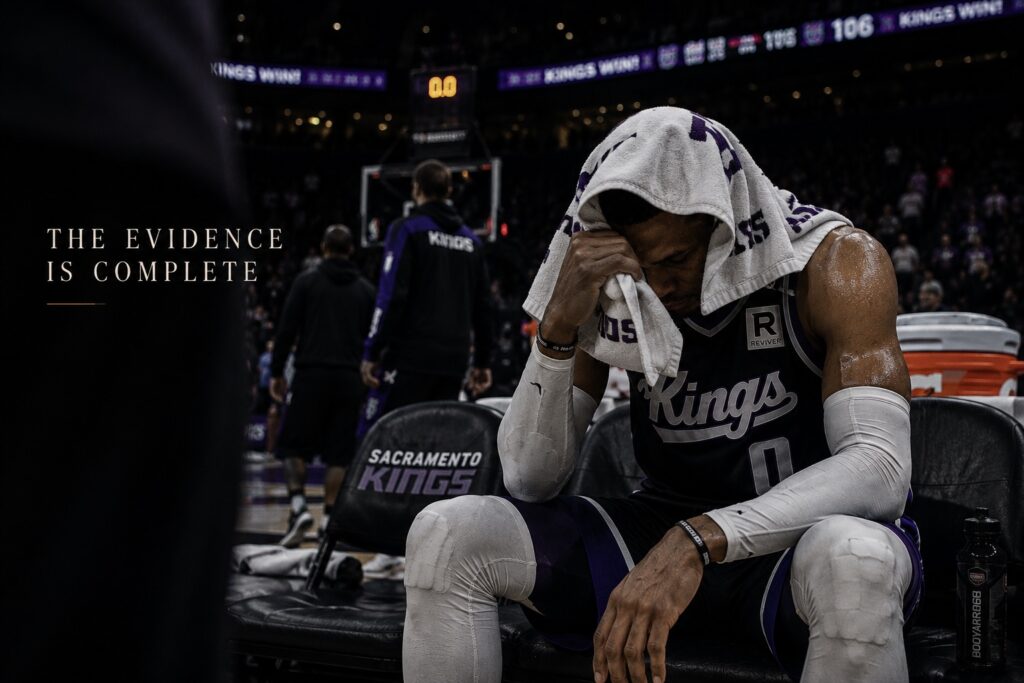
Sacramento became the final stop.
There is something almost poetic about that ending because the player who once seemed incapable of slowing down ultimately had to confront the one opponent no amount of acceleration could outrun: time.
And now the daily referendum is over.
There will be no next Westbrook possession to litigate.
No missed three-pointer capable of circulating as proof of something larger. No lineup combination to diagnose. No trade machine. No argument about whether he should start. No box score tomorrow morning capable of changing what someone believes happened yesterday.
For the first time in 18 seasons, Russell Westbrook’s NBA career has stopped moving.
The evidence is complete.
And when a career stops producing new evidence, history can finally begin organizing what is already there.
What is there is enormous.
More than 27,000 points. More than 10,000 assists. More than 9,000 rebounds. Scoring titles and assist titles. An NBA Finals appearance. Olympic gold. An MVP. A generation of Oklahoma City basketball carried through one of the most emotionally complicated franchise transitions of the modern era.
And 209 triple-doubles.
The championship is not there.
That matters.
Winning championships is part of how professional basketball measures greatness, and Westbrook spent 18 seasons pursuing one without reaching it. Pretending otherwise would make his story less honest, not more generous.
But somewhere along the way, championship culture began doing something strange to the way we discuss individual careers.
A team achievement became an individual sorting mechanism.
Ring or no ring.
Winner or loser.
Validated or unfinished.
That framework is useful until it becomes the only framework we possess.
Basketball is simultaneously an individual craft and a five-person game played inside organizations controlling coaching, contracts, teammates, trades, injuries and roster construction. No player exists independently of those systems.
Championships matter.
They simply cannot explain everything.
If they could, basketball history would have no adequate language for players who altered positions, expanded possibilities, carried franchises or changed what audiences believed the sport could look like without ultimately holding the trophy.
Westbrook’s career asks us to hold a more complicated idea.
A career can be incomplete without being diminished.
He didn’t accomplish everything.
Almost nobody does.
But for a period of NBA history, Russell Westbrook expanded what seemed physically and statistically possible from a point guard.
Perhaps the clearest evidence of his influence is what basketball looks like after him.
Nikola Jokić has pushed triple-double production toward territory once occupied almost exclusively by Westbrook and Robertson. Luka Dončić has produced enormous multidimensional box scores. The modern NBA increasingly contains stars for whom scoring, rebounding and playmaking are not responsibilities separated neatly by position.
Westbrook did not create that evolution by himself.
Basketball never moves because of one person.
But he became one of the players who stretched our imagination before the new reality felt normal.
And influence isn’t always someone copying the way you play.
Sometimes influence is changing what no longer surprises people.
That may ultimately become the most invisible part of Westbrook’s legacy.
A generation that grew up watching him may never experience a triple-double with the same disbelief that surrounded the achievement before him.
He changed the reference point.
Records themselves are vulnerable. Someone may eventually pass 209. Someone will eventually do something that makes another supposedly impossible number feel temporary.
That is what sports are supposed to do.
But if the next impossible accomplishment feels slightly more imaginable when it happens, part of the reason is that Russell Westbrook already made basketball watch the impossible become routine.
Which brings us back to the strange problem of greatness.
We assume extraordinary achievement will always announce itself as extraordinary.
Sometimes it doesn’t.
Sometimes we watch it happen on Tuesday, then Thursday, then Saturday.
Eventually we stop interrupting our lives for it.
The historically unusual becomes another notification.
The impossible becomes another box score.
And the athlete who changed our understanding of what could happen becomes vulnerable to the cruelest consequence of sustained excellence:
expectation.
Westbrook’s legacy was never going to become more truthful by sanding away its contradictions.
He was brilliant and reckless.
Historic and inefficient.
Overwhelming and sometimes difficult to build around.
An MVP who eventually became a bench player.
A superstar who never won a championship and still accomplished things basketball had never seen before.
All of it belongs.
For years, the conversation around Russell Westbrook kept asking us to choose which version was real.
Retirement offers a better answer.
They all were.
And perhaps that is why this moment is larger than another great player leaving basketball.
Westbrook’s career unfolded during an era that gave us unprecedented access to greatness while simultaneously making greatness increasingly difficult to appreciate.
We could watch every game.
Replay every mistake.
Measure every possession.
Extract every clip.
Compare every statistic.
Debate every weakness.
And in gaining the ability to examine everything, sometimes we lost the ability to recognize what was happening directly in front of us.
Russell Westbrook played 18 NBA seasons.
He became an MVP. He scored more than 27,000 points. He became one of the most prolific passers in league history. He averaged a triple-double across four different seasons.
And 209 times, he finished an NBA game with double figures in three statistical categories, more often than anyone who came before him.
Yet for much of the final third of his career, the conversation became increasingly consumed by everything he had failed to do rather than the improbability of what he had already done.
That may tell us as much about the way we consume greatness as it does about Russell Westbrook.
Retirement gives him something his career rarely possessed while it was happening.
Distance.
Distance from the missed shots.
Distance from the contracts.
Distance from the memes.
Distance from the roster construction.
Distance from the championship debate.
Distance from whichever possession happened last.
Enough distance, finally, to see 18 seasons at once.
Russell Westbrook leaves basketball without every argument about him settled.
He doesn’t need them to be.
The career has stopped moving.
The numbers have stopped changing.
The evidence is complete.
Russell Westbrook spent 18 seasons forcing basketball to reconsider what was possible.
In retirement, the more revealing question may be how quickly we forgot that he had.
Related Posts
LAY’S NAMED OFFICIAL SPONSOR OF FIFA WORLD CUP 26™ & FIFA WOMEN’S WORLD CUP 2027™
Lay’s Teams Up with FIFA for World Cup Sponsorship
Hollywood Isn’t Searching for Better Stories—It’s Searching for a Better Business Model
The Financial Decisions Behind Every Greenlight

Jordan Coleman Knows the Quiet Days Matter
The Work No One Sees
Denon Launches PerL Wireless Ear Buds Campaign Featuring Katy Perry
Denon taps Katy Perry to launch Perl earbuds.

Godzilla Returns: Minus Zero Targets November 2026 Global Takeover
The Monster Returns

Tory Burch Unveils Sublime: A Fragrance That Embodies Sensuality and Strength Starring KENDALL JENNER
KENDALL JENNER IS FACE OF NEW FRAGRANCE