

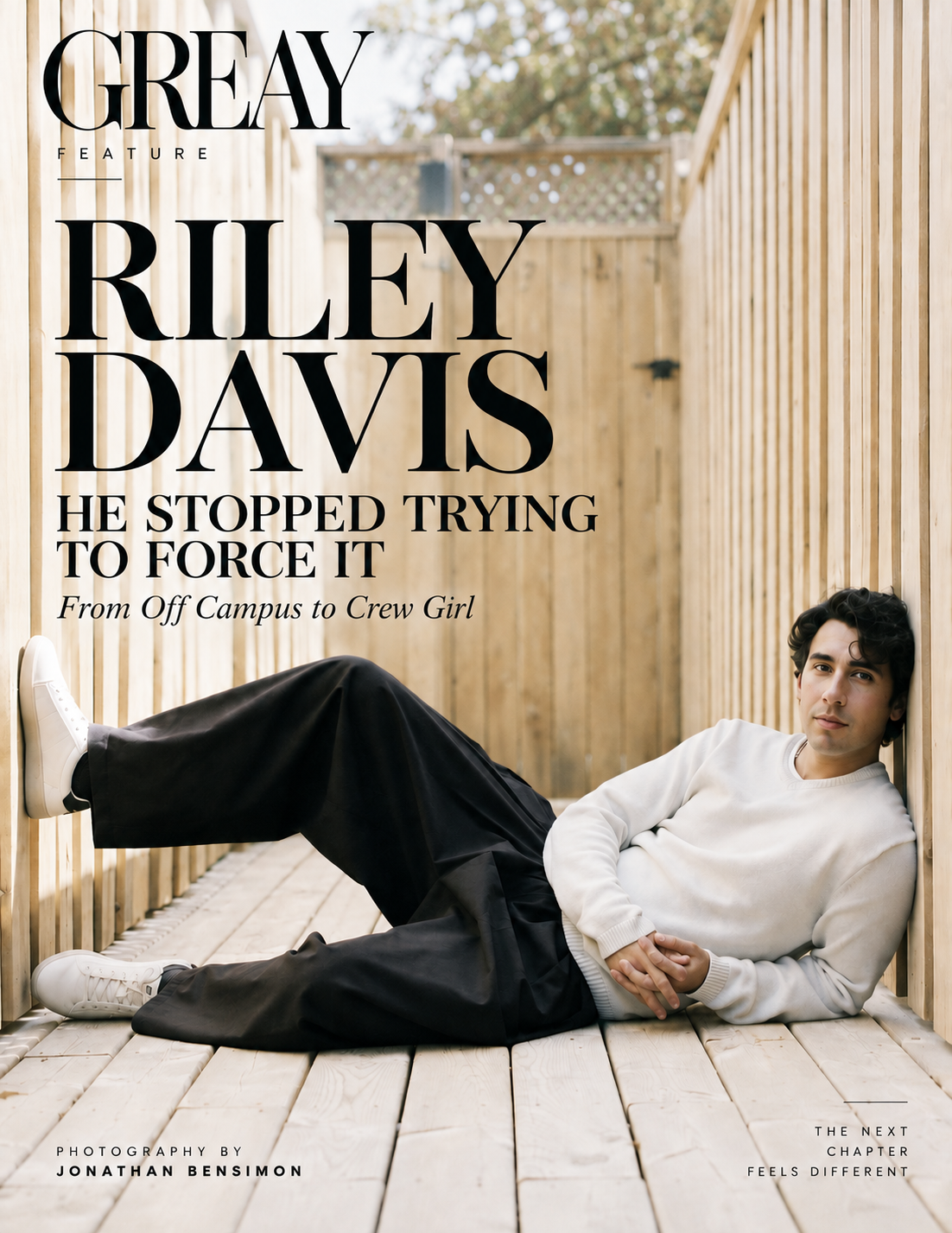
Riley Davis Learned What Happens When You Stop Forcing the Dream
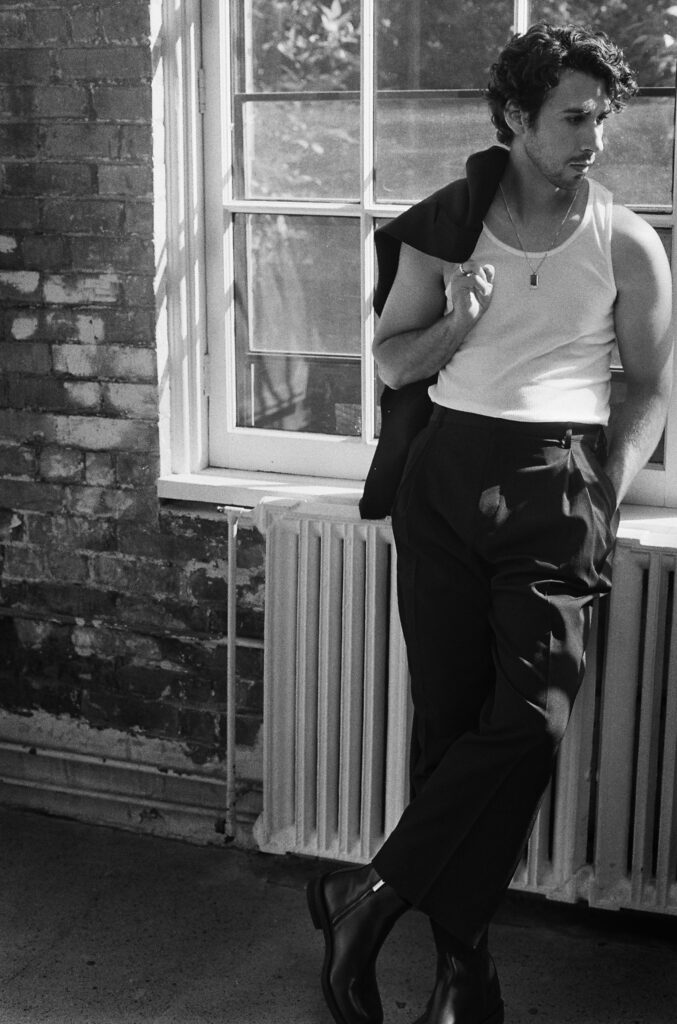
Words Kyra Greene
There is a particular kind of patience required to want something for a decade without knowing whether wanting it will ever be enough. Riley Davis started auditioning and taking acting classes when he was around fifteen, long before there was an Off Campus, a Crew Girl, or a stretch of projects that could make his career look inevitable from the outside. There were years of auditions, waiting, getting close and beginning again. There was restaurant work, cleaning up vomit for minimum wage, and the private pressure that comes from believing the thing you love most might also be the thing that never quite happens for you. Davis admits there was a time when he wanted acting so badly that the wanting itself became an obstacle. That makes this moment in his life more interesting than a simple story about an actor whose career is beginning to move. After spending years trying to force open the door, Davis is arriving somewhere harder to manufacture: comfortable enough in himself to walk through it without needing the room to prove that he belongs there.
GREAY: Off Campus introduced you to an audience that already had years of opinions about these characters before you ever played Sean. What’s interesting about Sean is that he doesn’t necessarily have to be a bad boyfriend for the relationship with Allie to have reached its end. When you were building him, did you approach Sean as someone desperately trying to save a relationship he loves, or as someone who hasn’t yet accepted that love sometimes isn’t enough to keep two people together?
Riley Davis: Sean definitely hasn’t accepted that love isn’t always enough to keep people together. Sean loves Allie deeply, but he just doesn’t understand her. He knows what he wants and the type of life he wants to build, and he can’t understand why they can’t make it work despite his best efforts. I think that’s why Sean stirs up so much debate online; he loves Allie and feels heartbroken that she can’t see things the way he does.
GREAY: Sean and Allie arrive on screen with a history the audience hasn’t actually witnessed—you and Mika Abdalla have to make us believe there were good years before we’re watching the difficult ones. Did you and Mika build any private history for them? Little memories, habits, inside jokes, even things that never made it onto the screen but helped you understand why Sean is holding on so tightly?
Riley Davis: Mika and I spent a good amount of time together on set because most of the Sean scenes really only take place with Allie. There was an organic process of getting to know each other and connecting, as well as spending some time hanging outside of work that I think influenced our dynamic on screen. That said, Mika is a total pro and such an amazing scene partner — when they called action, it was never a struggle to turn on the Sean/Allie dynamic. Both of us also relied on Elle Kennedy’s books for some deeper context about who Sean and Allie are and what their patterns have been the last few years. I don’t want to speak for Mika, but I know that both of us have been in long term relationships in the past, so I think that coloured both of our understandings of where Sean and Allie are in season 1.
GREAY: There’s an unusual challenge in playing Sean because part of the audience knows where Allie’s story ultimately goes. You’re essentially walking into a romance where some viewers may already be waiting for your character to get out of the way. Did you ever catch yourself thinking about whether people would like Sean, or did playing him require you to completely stop protecting yourself from the audience’s judgment?
Riley Davis: I never thought about the audience liking Sean. It’s not really for me as the actor to worry about. Sean wants love and he wants a stable life with a family. He knows who he is and who he isn’t. And because he has such a firm grasp on himself, he doesn’t quite compute how Allie could want to explore new things and find other parts of herself.
My job is to make that as real as possible. Having said that, I know from conversations with Louisa and Gina, our incredible showrunners, that there was an effort to make show Sean a bit more likeable than book Sean. I remember when we were shooting the shower scene in episode 3, Cheech Manohar, one of the writers on the show, and Sam Bailey, our director, kept telling me to smile through the lines about Allie giving up on her dream. As an actor, there was something sort of diabolical about telling a fictional actor to give up acting and move to Vermont.
GREAY: Now you’re moving from Sean into Noah Bainbridge in Crew Girl, and there’s an interesting contrast between them. Sean is trying to hold onto something emotionally, while Noah has been described as serious, sophisticated and book-loving—a character who seems much more contained. When you met Noah on the page, what did you recognize in him immediately, and what part of him felt furthest away from Riley?
Riley Davis: Noah was a bit of a puzzle early on and changed a bit from the early drafts of the scripts. I immediately connected with the humor in some of the scenes, especially the first draft of episode 6, the murder mystery episode. I understood that Noah, like Sean, has love for his teammates, but can’t quite always express it in a way that the other understands.
GREAY: Rowing is such an unusual sport dramatically because everyone can be individually talented and the boat can still fail if they aren’t moving as one. Acting in an ensemble isn’t entirely different. After spending that much time training, filming and moving as a crew, did rowing change the way you thought about listening to another actor or understanding your place within an ensemble?
Riley Davis: Great question. I wouldn’t say it changed the way I thought about acting with an ensemble. If anything, it cemented those beliefs. You’re right — rowing is a total metaphor for acting!
The beautiful thing about acting is that you can’t always practice it alone — it really connects and ties you to others, and there is something scary, yet profound, in that. Some days I’ll come to set with five ideas I want to try for a scene, but someone else may have an amazing idea on the first take that just works so well that we may not be able to use the other ideas I had. So, there’s always a balance between being prepared and focused for a scene or for your character but then being completely open to what your teammates or scene partners may bring. Always doing what’s best to serve the scene and the story is important.
GREAY: There’s something interesting across your work: you don’t always play the person demanding the room’s attention. Sean, Noah and even some of your earlier supporting work require you to exist inside an ensemble and make smaller moments matter. Have you learned to become comfortable with stillness on camera—the idea that sometimes the strongest choice is not trying to prove you’re acting?
Riley Davis: I think there are actors, directors, cinematographers, production designers, and lots of other creatives who want to see themselves in some way on screen. They want to see their big crying scene or their great complicated camera move or whatever their moment is, but in reality, great craft is serving the story to a point where you may not even notice it’s there. If I can live truthfully in the moment and tell the story, I’m good. In a big ensemble, it can be really satisfying to carve out little moments that aren’t in the script, and to play and fill those, without controlling or blocking the function of a scene.
GREAY: Noah being a reader made me curious about Riley away from a set. When nobody needs anything from you—there’s no audition to prepare for, character to understand or career decision to make—what do you naturally disappear into? And is there a part of your life that you’ve intentionally kept completely separate from acting?
Riley Davis: I’ve been boxing very consistently since Covid. That’s one of my best escapes. It’s very hard to be thinking about your day or what’s going to happen next in life when you are in the ring getting punched in the face. Boxing, sort of like acting, forces you to be in the moment and abandon all else. It’s very meditative.
I’m also blessed to have some amazing friends and a very supportive home life, so hanging out with friends and family is also something I like to disappear into. Turning my phone off and watching a game is another one.
GREAY: Your next stretch of work is almost strangely varied: Off Campus, a romantic sports drama with Crew Girl, the JFK-era world of November 1963, a Blumhouse horror-thriller, and then an ’80s parasitic horror film with Lice. When opportunities begin arriving quickly, there’s probably a temptation to simply keep saying yes. Are you already developing a sense of the actor you want to become, or are you deliberately allowing yourself not to know yet?
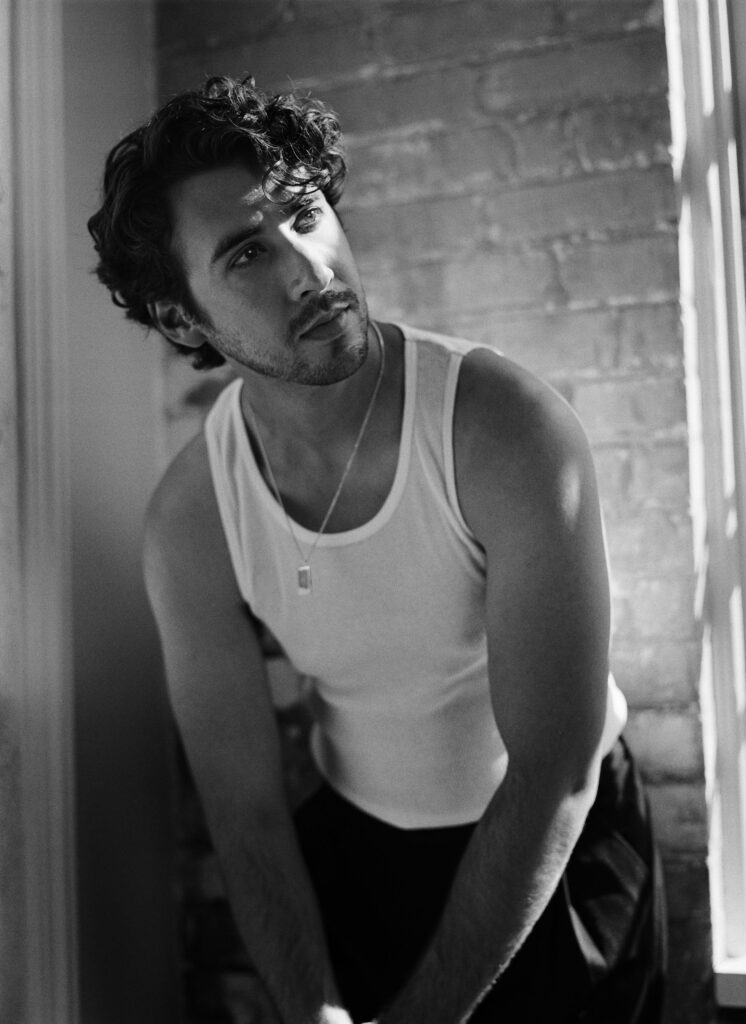
Riley Davis: Wow, thank you for such thoughtful questions. I have a strong sense of the actor I want to become, but that is sometimes at odds with the realities of our industry and the other factors that show up sometimes in life. I look up to actors that have a broad range, that can play in different genres, do different things, and bring us characters we haven’t met before. That’s what I’m building towards.
GREAY: November 1963 puts you alongside actors with decades of experience, including John Travolta, Mandy Patinkin, and Dermot Mulroney, inside material connected to an event people have studied for generations. When you’re the younger actor walking onto a set like that, how do you balance being curious enough to absorb what’s happening around you with having enough confidence to remember that you were hired because you belong there too?
Riley Davis: Yeah, freedom for me is everything. I need to be relaxed and impulsive enough on set to lean over and spit on my scene partner’s shoes if that’s what the scene calls for. I’m kidding, but I’m also not. There’s no room to be intimidated or shy when you’re in a scene. But what made this easy for me is that John Travolta, Jefferson White, and all the actors on November 1963 care as much as I do. From the first rehearsal between John and I, I knew we would be good together because we geeked out hard over acting. We actually became close friends on the film, and it really began during that first rehearsal.
At one point, John, the writer Nicholas Celozzi, and I were going over some questions about a particular scene. John and Nicholas went back and forth for a while, which meant that things were at a bit of a standstill. But then, I spoke up with an idea that John loved. And I think that was the moment he trusted me as an actor and not just as some kid in these scenes with him. And from my perspective, I was blown away by John’s work ethic, specificity, and overall curiosity. I could be here all day talking about how much I learned from those actors, and our director Roland Joffé, on that set.
GREAY: And then Lice sounds almost like permission to throw some of that restraint away—a high school, the 1980s, military lockdown, parasitic lice and people essentially unraveling around each other. After playing characters who can be fairly controlled, was there something freeing about entering a world where things are allowed to become ugly, physical and a little unhinged?
Riley Davis: So freeing! Lice was one of the most creative and collaborative sets I’ve ever been on. I can’t wait for that film to come out. There were days on set where we would block the scene as written in the script and then end up with something totally different. Sometimes a scene that was sort of nothing would become super intense and emotional. It was exhilarating. Never knew quite the way things would happen, and the result was a process that was very organic and alive. Sort of a paradise for an actor. There was even a moment late in production when a particular scene wasn’t quite working in rehearsal, and Kevin Connolly, as well as the creative team, let me get out the final draft and take a crack at rewriting it. It was awesome.
GREAY: We can look at your credits now and make the progression appear very clean—Hallmark films, Fire Country, Off Campus, Netflix, and these upcoming movies. But careers don’t feel like IMDb pages while you’re actually living them. Was there a period before this run when you were auditioning, waiting, getting close and wondering whether the version of an acting career you imagined was actually going to happen? What did Riley during that period have to learn about himself?
Riley Davis: Yes. Like ten years of that. Every day, man. I started auditioning and taking acting classes when I was like fifteen, so it’s been a long time.
Acting is funny because it is so intertwined with who you are, for better or for worse. Sometimes growth or improvement happens outside of the set or an acting class. An experience, a lesson, a kick in the nuts from life. I had to learn how to be more comfortable in my own skin. To own who I was a bit more. To relax and stop forcing myself onto things. I wanted it so badly, it was almost an obstacle sometimes. The pressure I would put on myself. I don’t have any family connections in the industry or anything; I used to clean up vomit in a restaurant for minimum wage. For a long time, acting meant everything to me. And it’s so hard to have any measure of success in it. I felt like I needed to do everything I possibly could and work as hard as I could 24/7, 365 days, and that mentality has helped me from a work perspective, but it also takes a toll on your spirit. Finding that balance between work and taking care of yourself is something I’m always negotiating.
GREAY: There’s going to be more attention around you if these projects connect the way people expect them to. More people knowing your face, more opinions, more opportunities and probably more people telling you what you should do next. At this particular moment—before you know exactly how big any of it becomes—what about the person you are right now do you hope success never changes?
Riley Davis: I hope I can always stay humble enough to serve the story and not my own ego. I hope I can always laugh at myself and carry myself with grace and kindness.
Maybe that is the real distance Riley Davis has traveled. Not from one credit to another, or from cleaning restaurant floors to sharing scenes with John Travolta, but from believing he had to give everything he had to acting to understanding that acting cannot be everything he has. The younger version of Davis measured his commitment by how relentlessly he could pursue the next opportunity. The person speaking now sounds more interested in remaining whole enough to meet whatever opportunity comes next. Davis cannot control which rooms open from here. What he can control is the person who arrives when someone calls action. He hopes to remain capable of laughing at himself, moving through the world with grace and kindness, and staying humble enough to serve the story rather than his own ego. After spending so many years wondering whether there would ever be a place for him in this business, perhaps the most meaningful thing about Riley Davis right now is that he no longer seems willing to disappear into the pursuit of one.
Photography Jonathan Bensimon @jonathan.bensimon
Related Posts

Sampha’s Resounding Return to Tiny Desk
Celebrating the enchantment of Lahai, Sampha graced NPR Music's Tiny D

Deadpool Crashes Gotham: Marvel & DC Unleash a Wild Crossover Decades in the Making
The Bat, The Merc, and the Multiverse

Parris Goebel breathes the essence of dance into the Nike Dunk Low Parris Goebel Quick Strike
By Sammantha Renee Parris Goebel joins forces with Nike to introduce t

Haley-Grace McCormick Writes Against the Clock
Slowness as Strategy

EBU’s New Track and Field Guidelines Advocate for Great Sports Coverage Without Objectification
The Evolving Ethics of Sports Broadcasting
POST COMMENT