

Paramount+ Is Trying to Turn Streaming Into a Daily Habit

By DaMarko GianCarlo
For most of the streaming era, the competition was relatively easy to understand. Build the strongest library. Make the biggest shows. Convince people to subscribe. Give them enough reasons not to cancel.
Paramount appears to be preparing for a different competition.
Internal plans reported by Business Insider show Paramount+ exploring a collection of features that, considered separately, could look like ordinary product experiments: short serialized microdramas, free programming, interactive advertising, comments, user-generated content and artificial-intelligence tools that could help turn longer programming into shorter clips. Some projects connected to its free offering have been targeted internally for late 2026 and early 2027, although the roadmap remains fluid and Paramount has not announced firm launch dates for many of the features.
Put them together, however, and something larger begins to come into focus.
Paramount is experimenting with changing the reason someone opens Paramount+.
Streaming services have traditionally been destination products. A viewer decides they want to watch a movie, an episode of a series or a live event and then opens the application. Social platforms operate differently. People routinely open YouTube, TikTok or Instagram before they know exactly what they want to watch. Discovery happens after arrival.
That distinction increasingly matters because the competition for entertainment is no longer only about who can secure a subscription. It is also about who can earn another few minutes of someone’s day.
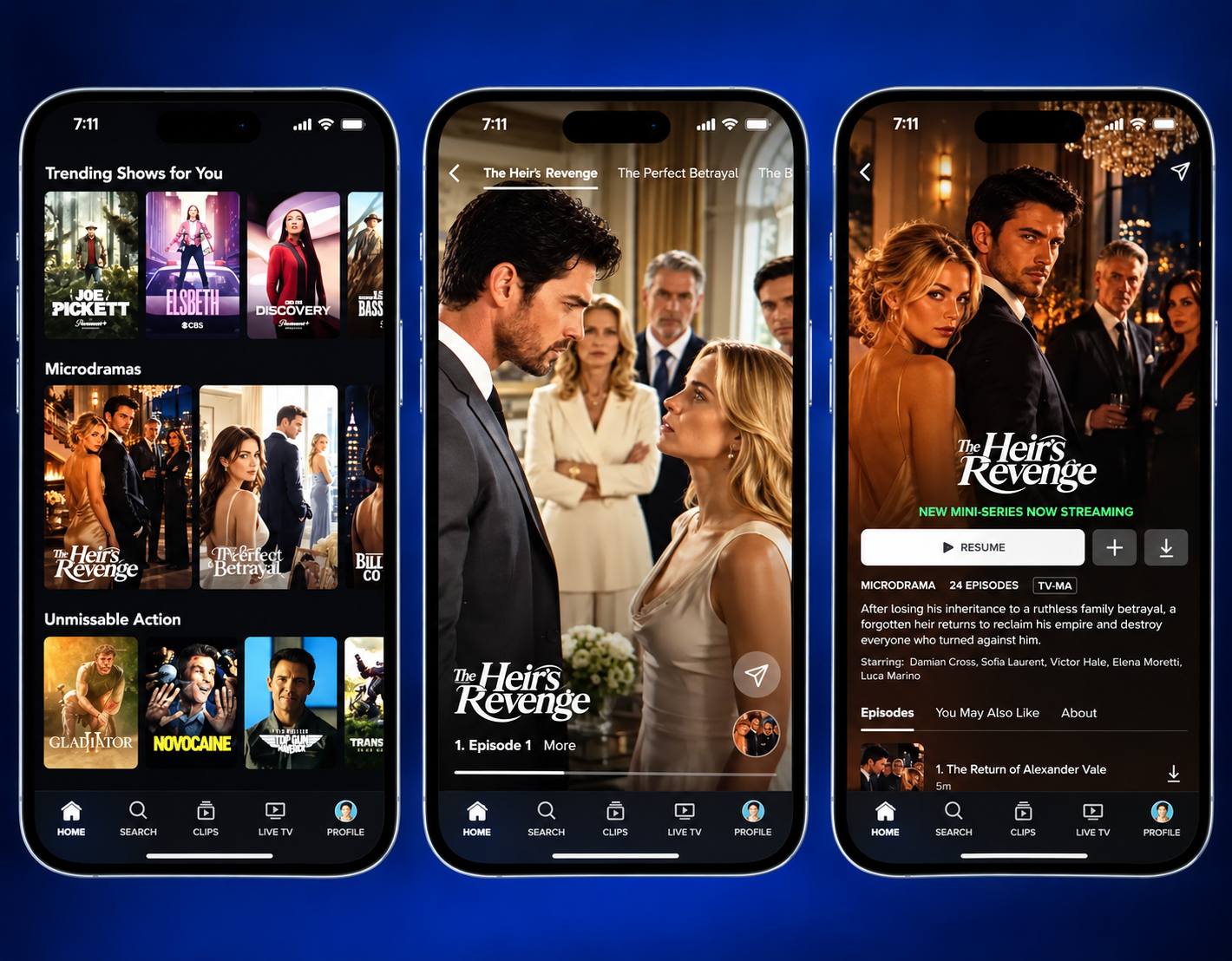
Paramount has already started building toward that behavior. In April, the company introduced Clips, a vertical short-form experience inside Paramount+. Its own first-quarter shareholder materials described enhanced mobile experiences and short-form video as being designed to “deepen engagement and increase frequency.” CEO David Ellison described the broader direct-to-consumer strategy as a multiyear effort to build a portfolio capable of driving growth and engagement.
Frequency is the important word.
Someone can remain subscribed to Paramount+ without opening it every day. They may return when a particular series premieres, when the NFL is playing, when UFC has an event or when a movie they want arrives. That is a valuable subscription relationship, but it is different from the behavioral relationship audiences have developed with social platforms.
Paramount’s interest in microdramas makes more sense inside that distinction.
Microdramas compress serialized storytelling into short, mobile-first episodes built around quick narrative turns and cliffhangers. For Paramount+, their importance may be less about replacing traditional television than filling the spaces between it. A viewer does not need forty-five minutes, a television or even a decision about what show to start. A few minutes on a phone becomes enough time to enter Paramount’s entertainment environment.
Earlier reporting on Paramount’s microdrama plans indicated that the company was preparing to test the format specifically to increase visit frequency and keep audiences engaged longer. That makes the experiment fundamentally different from simply adding another genre to the Paramount+ library.
The larger roadmap now makes that intention easier to see.
Business Insider reports that Paramount is leaning further into vertical video, adding more video podcast segments and considering comments within its TikTok-style feed. The company is also exploring user-generated content and using AI to assist with clipping video. A person familiar with Paramount’s strategy said the product initiatives are organized around two broad objectives: increasing engagement and improving monetization.
Those objectives are connected.
More frequent viewing gives Paramount more opportunities to show advertising to customers on ad-supported plans. Longer engagement can make a subscription more useful and potentially harder to cancel. Short-form programming creates additional surfaces for discovery. And a free viewer creates an audience relationship before that person has paid Paramount anything.
That last piece may be one of the most important.
Internal documents show Paramount experimenting with what amounts to a free entrance into Paramount+. Users would register with an email before accessing free programming, allowing Paramount to establish an identity and relationship with someone who has not yet become a paying subscriber. The company believes that identity could “become the connective tissue between the broader Paramount Ecosystem.” The strategy would eventually introduce limits intended to move some registered users toward paid subscriptions. As one internal document put it, “The goal is to create timely urgency that nudges registered users toward converting to a paid subscription.”
That changes the traditional subscription funnel.
The person who refuses to pay for Paramount+ no longer necessarily has to remain outside Paramount+. They can enter for free, encounter programming, establish viewing behavior and potentially become more valuable to Paramount over time.
Pluto TV makes that architecture more consequential.
Paramount has rebuilt Pluto TV on the same technology foundation as Paramount+, the largest technology investment in Pluto’s twelve-year history. Paramount describes the move as part of a convergence strategy connecting technology, data and capabilities across both services while keeping their consumer identities distinct. The company says the shared foundation will allow its teams to “build capabilities once, apply them across services” and ultimately create “a more unified experience across our streaming services.”
That means Paramount is not simply operating one paid streamer and one free streamer next to each other.
It is increasingly building a connected streaming system.
Pluto can remain free. Paramount+ can remain premium. Short-form clips can provide another point of entry. Free Paramount+ programming can capture registered users. Advertising can monetize people who never become premium subscribers. And the technology and data underneath those experiences can increasingly work together.
This direction did not begin with the latest roadmap. David Ellison previously described Pluto TV as the “top of the funnel” for attracting new Paramount+ customers. Paramount’s newer product experiments extend that logic deeper into the Paramount+ experience itself.
The company is effectively creating more places for a relationship with Paramount to begin.
That is where comments and user-generated content become particularly interesting. Neither is necessary to operate a conventional streaming service. Netflix built its business without turning the viewing screen into a public conversation. HBO did not need its subscribers to create content. Traditional television has historically maintained a clear distinction between the people making entertainment and the audience consuming it.
Platforms weakened that distinction.
YouTube became an entertainment giant partly because watching, discovering, reacting and creating could happen inside the same environment. TikTok compressed those behaviors even further. Paramount does not have to become either company for their influence on entertainment behavior to matter.
It only has to recognize what they taught audiences to do.
The economic pressure behind that recognition is also visible. Business Insider reported that nearly 6 percent of Paramount+ subscribers canceled in August, citing Antenna data, while more than a third of users were classified as light viewers in an earlier Antenna report. Media analyst Rich Greenfield described the larger streaming competition simply: “It’s a war for time spent.”
That may be the most useful way to understand Paramount’s experiments.
A streaming service once competed primarily for the monthly subscription. Increasingly, securing the subscription is only the beginning. The service still has to compete against every other screen capable of taking the subscriber’s attention after they have paid.
That helps explain why premium television, UFC, NFL games, movies, microdramas, vertical clips, podcasts and free programming can coexist within the same strategy. They do not need to serve the same viewing occasion. They need to give Paramount more opportunities to occupy one.
There are limits to how far the evidence can take us. Internal roadmaps change. Features being explored may never launch. A comments section does not turn Paramount+ into a social network, and short-form video does not mean audiences will suddenly open Paramount+ with the frequency they open YouTube. Paramount is experimenting with these behaviors; it has not proved that premium streaming and habitual short-form consumption naturally belong together.
Paramount itself is still learning what the architecture can do. Its latest Pluto overhaul was described by Chief Product Officer Dane Glasgow as “just the first step” toward a more connected streaming ecosystem.
That uncertainty is precisely why the strategy matters now.
For years, streaming companies fought to become the place where audiences watched their favorite shows and movies. The next phase may require them to become something broader: a place audiences enter even when they have not decided what they want to watch.
Paramount does not need to turn Paramount+ into TikTok for that shift to matter.
It only needs to make opening Paramount+ a habit.
And that would change what a streaming service is competing to own.
Related Posts

Meet Geeker: A Fresh Peer-to-Peer Marketplace Offering Instant Access to On-Demand Tech Support by Live Experts
Geeker, the on-demand tech support marketplace, has officially launche
Epic Games Unveils Trailer for The Weeknd’s Fortnite Festival Concert
Epic Games has officially unveiled a trailer for its collaboration wit
Littlebird Connected Care Unveils the Littlebird Marlon: The Apex of Digital Health Wearables for Kids
Littlebird Connected Care proudly unveils a groundbreaking achievement
Introducing ‘Hedgehog’: A Platform Fostering Genuine Conversations and Community Engagement
'HEDGEHOG', A PLATFORM FOR REAL CONVERSATION

Snap Doesn’t Want to Sell You Glasses. It Wants to Replace the Smartphone.
Specs Aren't a Product Launch. They're a Platform Launch

LG Introduces TONE Free T90S: Advanced Earbuds for Superior Listening Experience
LG’s New TONE Free Wireless Earbuds With Pure Graphene
POST COMMENT