

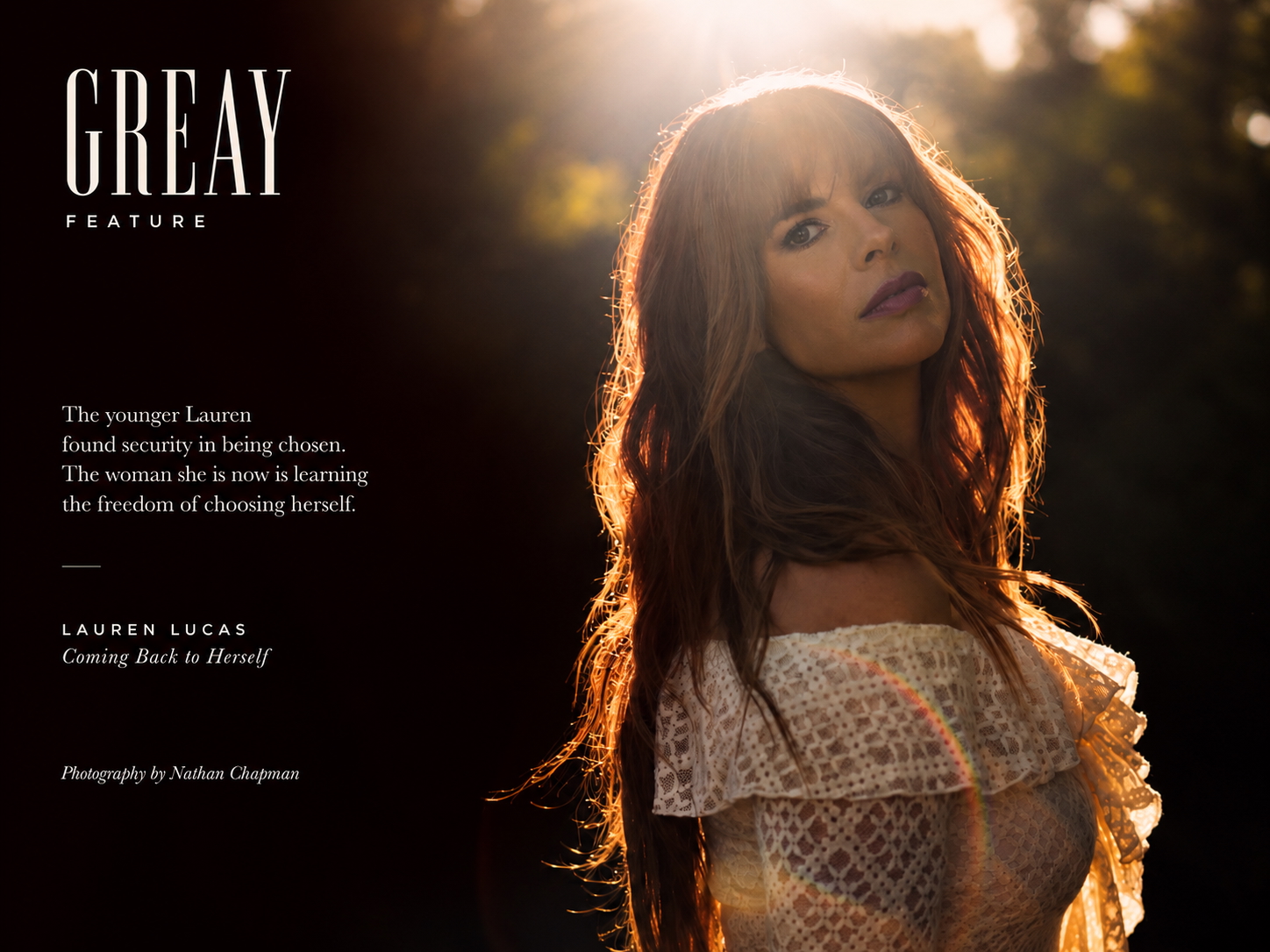
Lauren Lucas Is Coming Back to Herself
By Kyra Greene
There is a particular kind of freedom that comes when an artist stops asking whether there is still time. Lauren Lucas has spent most of her life inside the music business—getting her first record deal at fourteen, eventually signing with Warner Bros., touring, writing, losing deals, finding new ones, becoming a mother, and continuing to work through the years when the résumé sometimes looked more successful than the life behind it felt. At 45, she has not outgrown ambition. If anything, she understands its pull more clearly. Lucas describes herself as having a “can’t-stop-achieving problem,” the familiar cycle of reaching something, feeling satisfied for a moment, then needing whatever comes next. What has changed is that achievement no longer seems to be the only evidence she accepts that her life is moving forward. Motherhood has made her time more precious. Experience has made her writing wider. And her Southern Soul sound—drawing from blues, gospel, Americana and the musical language of the South—feels less like a reinvention than a return to something the industry did not always know where to place. Now, as she writes songs for artists she once considered heroes, composes for Netflix’s Leanne, releases music of her own and allows motherhood, grief, home, addiction and ordinary life into her work, Lucas is doing something more complicated than beginning again. She is learning how to keep wanting more without allowing what comes next to determine the value of what she already has.
GREAY
You have described this chapter as reclaiming your dreams after 40. What did you have to reclaim them from—the expectations of the music industry, the responsibilities of adulthood, or an earlier version of yourself who believed success had to happen on a certain timeline?
LAUREN
Yes, yes and yes. I’m reclaiming myself from my perceptions of all of that. When I got my first deal at 14 years old, I had nothing but runway. With youth and time on my side, it was a given that anything was possible. Through several cycles of losing and gaining deals, growing older, becoming a mom, and major industry changes, the definition of “possible” started to look a little different. I got way too focused on the outcome. I got scared that I was aging out, or becoming a parent would stunt my opportunities. I doubted what was actually possible for me, until I fell back in love with the process, learned new skills like production and engineering, and stopped trying to shape-shift to be what anyone else wanted me to be. Now, at 45, I’m writing songs for my hero’s albums and composing music for Netflix shows. I definitly didn’t have any of that on my bingo card. It’s taught me that I was actually the one limiting myself.
GREAY
You entered the industry young, earned major-label opportunities, contributed to Broadway, toured extensively, and built a career as both a performer and songwriter. Were there moments when the résumé looked more successful from the outside than the life actually felt from within?
LAUREN
I’ll be honest, when I was signed to Warner Bros. as an artist in the early 2000’s, that felt successful. I had won the prize and I’d worked hard. I had already been passed on for several years, and finally got a yes from a major record label. I made my album, I went on tour, I attended a few award shows, and I had a plan laid out before me. That felt secure and awesome. Whew, little did I know what a false sense of security that was. Then, there was the “lost decade.” I bounced around from publishing deal to publishing deal, got a few small cuts, a few placements, and a divorce. Made some independent EP’s and tried to figure myself out. I just kept my head down and worked. The thing is, no one can take away the credits you earn. So, the resumé can still look good, even when the months and years feel rough. I’m so glad I pushed through those years, though. I’m enjoying career moments I’m most proud of now and I’m grateful to have the work.
GREAY
At 45, you are not discovering that you are an artist—you have already spent decades becoming one. What are you finally allowing yourself to express now that the younger Lauren may have softened, edited, or kept private?
LAUREN
When I was young, I only cared about two things: a flashy version of success and being in love. Sounds so shallow now, and I cringe at how painful it must have been to co-write with me at 18, 22, 25. I’ll still write a relationship song, but my world has opened up so much. I write about motherhood, about loss and grief, about wholeness and addiction. I show up that way online, too. There’s a whole big world out there and it all inspires me as an artist/writer.
GREAY
You describe your current sound as Southern Soul, bringing together blues, gospel, Americana, and the musical language of the South. Does this feel like a new direction, or like returning to something that was always underneath your music?
LAUREN
It for sure feels like returning to something that was always there. In my twenties, a lot of Music Row didn’t know what to do with me because I wasn’t straight down the middle. I’ve completely leaned into that as an artist in the past few years, and certainly in all of my song releases this year.
GREAY
“Hole in My Soul” explores a longing that refuses to disappear. What interested you about writing from that emotional place at a time when your life is also full of family, collaboration, and creative momentum?
LAUREN
I tapped into my own experience for this one. I wrote about it in one of my latest blogs. I’m not addicted to pills. I don’t have a drinking problem. I have a can’t-stop-achieving problem. Chase it → feel good for a minute → need more. That’s what I was thinking about when I co-wrote this song with Kenny Greenberg. It’s true, my life is full of family, creative momentum, lots of good things. And there’s always a shadow lurking. Life is messy and complicated that way. That’s why I love writing about all of it and putting it out there.
GREAY
Motherhood is often framed as something women must balance against ambition. Has becoming a mother changed the size of your ambition, or has it made you more selective about the work that is worthy of your time away from home?
LAUREN
I credit motherhood in large part to the success I’m having now. I posted something about this just the other week. I had my son in the first few days of Covid lockdowns. He was a preemie, so we were in the NICU for a few weeks, then we basically didn’t leave the house for two years. I learned very quickly that I was not cut out to be a stay-at-home-mom. Bless women who have that temperament. It is not me. My brain started dreaming up all kinds of creative projects, ways to connect with my fans, and I even made a self-produced full length album in my bedroom with two of my dear friends during that time.
But becoming a mom has also streamlined me. I can’t miss a delivery deadline on music cues, and I also can’t miss swim lessons. So, my time and energy are incredibly precious. I have to stay laser focused on what I really want and trim the fat. That has helped me succeed in my career, and as a parent. I also love that my son gets to watch me work hard towards my dreams. I think that’s important.
GREAY
Motherhood has become part of the emotional world surrounding your music. What has raising your children revealed about you—not only as a mother, but as a woman and an artist?
LAUREN
I didn’t know for a long time if I wanted to have kids. Now that I am a mom, I’ve learned that I’m much more nurturing than I realized. I didn’t recognize that in myself before. Becoming a mom has also certainly given me more to write about. I think this is because the human condition seem even clearer now that I’m a mom. You have nowhere to hide from yourself as a parent. Your 5-year-old doesn’t understand your intentions when you are barking at them to get in the car (guilty!). They just see your impatience. All is revealed, like it or not.
GREAY
You helped create the musical world of Netflix’s Leanne and perform its main-title theme. What is emotionally different about hearing your voice become part of another person’s story rather than using it to introduce your own?
LAUREN
I love it! As much as I enjoy releasing my own music into the world, I really love helping other people tell their stories. That could be writing a song for an artist’s album or the title theme for Leanne. I also help compose the instrumental cues between scenes on Leanne. I enjoy the whole process of getting direction, executing, getting feedback, and crafting it to be what they need. And I’m thrilled to no end that people come up to Leanne Morgan in parking lots singing “Leaaaannnnne!” To know I have a small part in shaping how her show is presented to the world… how cool is that?!
GREAY
Your recent work places you in conversation with artists such as Keb’ Mo’ and Taj Mahal, whose music carries history without becoming trapped by it. What have those collaborations shown you about using the blues as a living language rather than simply honoring its past?
LAUREN
I think a perfect example of blues being a living language is how Keb’ asked me to sing on the TajMo Room on the Porch album. He invited me over to just hang out in the studio while he and Taj were making the album. This is before we had written anything together, or worked on Leanne together. I was just there hanging out, eating lunch, and sitting in the back of the studio observing. They pulled up “My Darling, My Dear” to see what other overdubs it needed. Keb’ looks at me and says, “Well, now we just need the background singer in there.” Just like that. That’s what I learned about the blues from Keb’ and Taj. It’s not a strict rigid template or a genre preserved under glass. It’s a living, breathing thing.
Now don’t get me wrong. They certainly respect and revere the genre’s history. I literally have a custom playlist in my library titled “Mo’ School” with songs Keb’ has turned me onto like, “Walking the Backstreets and Crying,” and “Deep Down in Florida.”
GREAY
Your blog brings recipes, home, motherhood, gardening, and everyday rituals into the same world as your music. Was there ever a time when you believed those parts of your life made you appear less serious as an artist, and what changed enough for you to begin sharing the whole life?
LAUREN
Yeah, I’ve had this fear that I’ve now decided is pretty stupid, honestly. I feel like I have two sides of my career: the public-facing artist who releases music into the world and sometimes shares stuff about her life, and the behind-the-scenes writer/composer who helps other people tell their stories. I haven’t always felt comfortable weaving them together. I overthink it, like “Is this music supervisor going to wonder why I’m sharing about the argument I’m having with my tomato plants?” At the end of the day, no one is really paying that much attention. We really can do whatever we want, and I like the creative outlet of my blog. I love talking with other women about what’s on their dinner tables that their kids are eating, or why in the world are my cucumbers coming in completely round instead of oblong (true story this year)? It’s also been a great place to share deeper about the songs I release and the stories behind them.
GREAY
There is a tendency to describe renewed visibility for a woman in her 40s as a comeback. Does that word feel accurate to you, or does it overlook the writing, caregiving, teaching, performing, and personal becoming that continued during the years when the wider public may not have been paying attention?
LAUREN
The word “comeback” might feel right to some women based on their experience. “Reinvention” is also a big buzzword for women these days. For me, I don’t care for either description. I have been working my butt off all along, largely feeling overlooked or invisible. But I’ve also realized that I may have done some of that to myself. I can look back and see where I played small. But I don’t think of myself as having a career comeback. If anything, the “comeback” is me coming back to myself.
Perhaps that is the distinction that makes this chapter of Lauren Lucas’s career feel different. The industry loves a comeback because a comeback creates a clean story: someone disappears, something changes, and they return transformed. Lauren’s life is messier—and more interesting—than that. She never stopped working. She wrote, performed, taught, composed, became a mother, learned production and engineering, survived the uncertainty between opportunities and kept creating during periods when she felt overlooked. And she has not emerged on the other side without the old hunger. She still wants things. She still chases. She still knows how quickly one accomplishment can become a reason to reach for another. But she also has a five-year-old who does not care about the résumé, swim lessons that exist alongside music deadlines, songs that now hold grief and motherhood alongside love, and a creative life increasingly large enough to contain all of her instead of only the parts that seemed easiest to sell. The younger Lauren found security in being chosen. The woman she is now is learning the freedom of choosing herself. So perhaps “comeback” really is the wrong word. Lauren Lucas did not return to the career she once imagined. She kept living long enough, working long enough and becoming honest enough to build one that finally looks like her.
Perhaps that is the distinction that makes this chapter of Lauren Lucas’s career feel different. The industry loves a comeback because a comeback creates a clean story: someone disappears, something changes, and they return transformed. Lauren’s life is messier—and more interesting—than that. She never stopped working. She wrote, performed, taught, composed, became a mother, learned production and engineering, survived the uncertainty between opportunities and kept creating during periods when she felt overlooked. And she has not emerged on the other side without the old hunger. She still wants things. She still chases. She still knows how quickly one accomplishment can become a reason to reach for another. But she also has a five-year-old who does not care about the résumé, swim lessons that exist alongside music deadlines, songs that now hold grief and motherhood alongside love, and a creative life increasingly large enough to contain all of her instead of only the parts that seemed easiest to sell. The younger Lauren found security in being chosen. The woman she is now is learning the freedom of choosing herself. So perhaps “comeback” really is the wrong word. Lauren Lucas did not return to the career she once imagined. She kept living long enough, working long enough and becoming honest enough to build one that finally looks like her.
Related Posts

Christian McCaffrey Named Madden NFL 25 Cover Star
San Francisco 49ers running back Christian McCaffrey covers Madden NFL

Janhvi Kapoor Fronts a New Chapter for New Balance in India
A New Balance in India

Marvel Unlocks New ‘Psylocke’ Solo Comic Series
Alyssa Wong and Vincenzo Carratù's 'Psylocke' begins this November.
Young, Fearless, and Unstoppable: The Rise of Reagan To
Dancing Through Hollywood

Get ready for the chilling preview of ‘Strange Academy: Blood Hunt’ #1 as it unleashes a vampire horde upon the streets of New Orleans!
BLOOD HUNT looms over the Marvel Universe

Chad Stahelski, Director of the John Wick Franchise, Acquires Rights to Jonathan Maberry’s Joe Ledger Novels for TV Adaptation
Chad Stahelski Adapting Joe Ledger Thriller Novels for TV.