

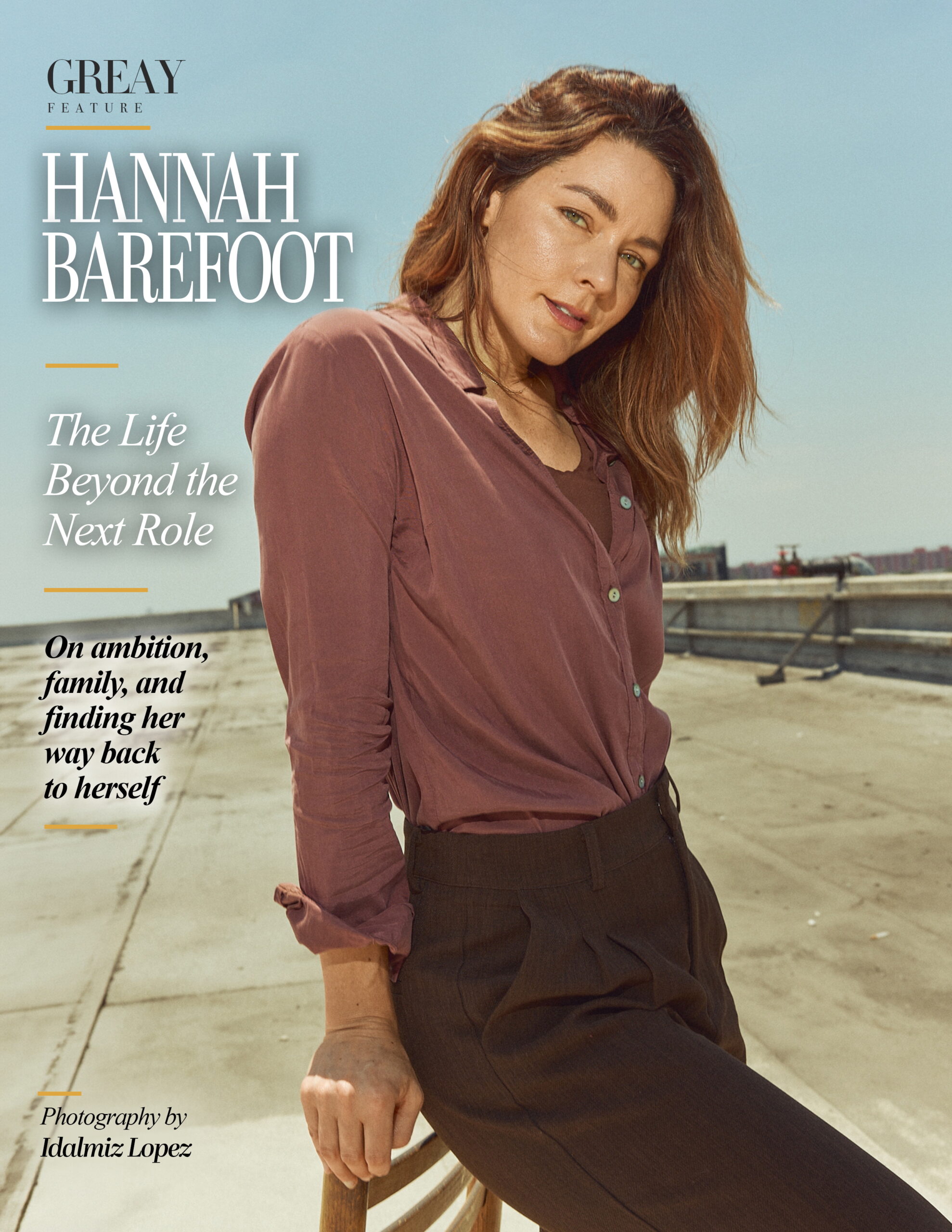
Hannah Barefoot and the Courage to Begin Again
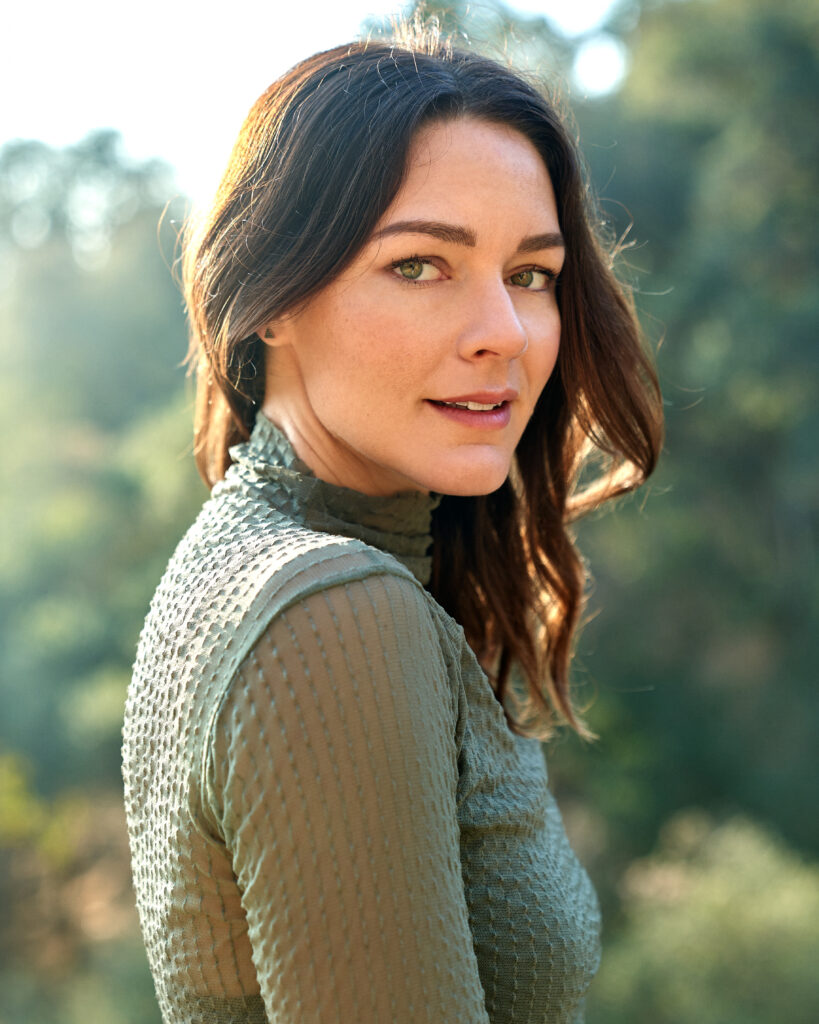
By Kyra Greene
There was a time when Hannah Barefoot believed that loving something meant giving everything she had to it. Growing up in Cody, Wyoming, performing had been one of the great joys of her childhood. She remembers discovering the feeling of making an audience laugh during a sixth-grade play, a small moment that helped shape a lifelong desire to connect with people through storytelling. But as she grew older, that love became tangled with the pressure to do more, work harder, and never turn down an opportunity. Eventually, the demands she placed on herself became too much, and she walked away from acting. Years later, while raising her young son in Portland, something about watching him discover the world awakened the part of her that still wanted to perform. She returned to the profession with a different understanding of herself, although learning to protect her time, her family, and her well-being would take years more. Today, audiences may recognize Barefoot from NCIS: Origins, The Chosen, and The Rookie, but the story behind those appearances is considerably more personal. It includes jobs outside the industry, years of uncertainty, a marriage and family she has learned to make room for, and the difficult realization that a career she loves should not require her to lose herself in the process. In conversation with GREAY, Barefoot speaks with warmth and remarkable openness about those experiences, the people who have helped shape her, and the kind of life she hopes to keep building. Hers is a story about returning to something you love and slowly learning how to make room for everything else you love, too.
GREAY: You grew up in Cody, Wyoming, where performing was part of your life long before Hollywood entered the picture. When you think about that little girl putting on shows and discovering the excitement of an audience, what did performing give you emotionally? And how much of that feeling are you still searching for today?
Hannah Barefoot: Such a great question. Even as a kid, nothing has ever filled me with more joy than telling a story somehow. And I wasn’t great at it right off the bat – I had to learn a lot but even when I was just getting started, I immediately felt at home on a stage acting, singing, and dancing. I’ll never forget the first time I made people laugh in a sixth grade play. I hadn’t thought I was a particularly funny person, but in this comedy, suddenly people were laughing at me – in the best way. I’ve been chasing that ever since – not necessarily making people laugh, but connecting with people more and more truthfully in a way that makes them a part of the story. It’s such a process of learning to truly be yourself in front of an audience, and it’s one I’ll be pursuing for the rest of my life.
GREAY: You’ve spoken openly about burning out while studying theater at the University of Wyoming and eventually walking away from acting for several years. Looking back, was that experience more about losing your passion for performing or losing your sense of yourself within it? And what did that period teach you about the difference between loving something and allowing it to consume you?
Hannah Barefoot: It’s all hindsight, right? Had I to do it again, I wouldn’t have walked away from acting, I would’ve just changed how I was doing it. I would’ve slowed down and put more boundaries in place. Then, as a 20 year old, I didn’t know how to say no. I was involved in every play year round (including summer-stock theatre), was double-minoring in dance and vocal performance, and simultaneously jumped into the lead role in a play in a town an hour away from where I lived. I was so excited to have my first professional job that I didn’t stop to recognize that I simply didn’t have time to do it – I just made time, even if it meant getting home at 2 am every day. Because I was either in rehearsal or production every day of the week, I didn’t have time to rest, to be a part of my church, to spend time with friends. I developed an eating disorder, which was my way of trying to get some control over my life.
That’s a great sentence – learning the difference between loving something and allowing it to consume you. That’s exactly what this was. I never stopped loving acting, I just didn’t have the boundaries in place or the knowledge that I could say no to an experience and still have a future. I felt I had to say yes to everything, and now I know that saying no to certain things is the only way to a long-lasting career.
GREAY: Your return to acting wasn’t a traditional Hollywood beginning. You were living in Portland, working outside the entertainment industry, and building an adult life. Do you remember the moment when acting stopped feeling like something you used to do and became something you needed to pursue again? What was different about the woman making that decision the second time?
Hannah Barefoot: Yes, completely. I was living in Portland with my husband, had gone back to school for drawing and painting, had worked in a bank, an insurance agency, and a U-Pick berry farm, and was now raising a two year old son. I remember watching this beautiful little human, becoming so aware of how I wanted him to experience everything, and something in that re-awoke the desire to act. And I felt like I had missed the boat already – so many of my former classmates had gone on to move to LA or New York or were working on cruise ships, and here I was living in Oregon with a baby working at a berry farm. But I just started investigating my options, stumbled into an acting class, found an agent, pretty quickly started working on non-union local commercials and films, and pretty quickly after that, in national commercials and union TV shows and films.
I think the difference in the 27 year old then and the 20 year old before was a new sense of authority. Honestly, even as a 27 year old I was still learning my boundaries, but I did have a stronger sense of purpose and authority that, yes, this is something I want to do and I’m going to do what it takes, even in a small market and as a mother.
GREAY: You’ve built a career while navigating marriage, motherhood, and the uncertainty that comes with working in entertainment. How has being a mother changed the way you think about ambition and the sacrifices you’re willing to make? And what have you learned about maintaining a sense of yourself beyond the roles you play, both professionally and personally?
Hannah Barefoot: Being married and raising a kid have changed everything about the way I pursue this career. It didn’t early on – when I initially returned to acting, I returned with such a vengeance, trying to make up for lost time. Once again, I said yes to everything, things I knew weren’t good for me, my marriage, or my family. And thank God, I came out on the other side of that season, but not without some scars.
Now, several years after that second dark season (I’ve historically learned lessons slowly), I do make decisions differently. I turn down projects all the time if they’re in conflict with my values or my family. I turned down the lead role in a film that was going to take me away from my family from before Thanksgiving to Christmas Eve, which would’ve been hard on my then-13 year old son. I turned down a recurring role in a series opposite an actor I deeply respect because it required nudity and sex in every episode, which isn’t helpful for my marriage. I love acting, but every job ends. Family lasts.
GREAY: You’ve spoken about taking jobs outside acting while building your career. Hollywood often celebrates perseverance once someone has a recognizable résumé, but the years of uncertainty rarely receive the same attention. What was the hardest part of continuing to believe in your future when there was no guarantee the next opportunity would come?
Hannah Barefoot: Yes, being a working actor in Hollywood is an expensive endeavor, especially when you have a family to support. I’m so blessed to have a husband with a job outside of the industry, but even so, we’ve had fat years and lean years. There have been years when I’ve worked a ton and others when I’ve hardly worked at all (I’m looking at you, pandemic and strike years), so picking up side-jobs has been an important part of our family economy. I’ve worked in restaurants, as a personal assistant, and even drove Lyft for a time. One of the funniest moments came when I booked a Lyft commercial while simultaneously working as a driver for them (I always got 5 star ratings, I’ll add :)).
There’s never a guarantee of what the next opportunity is, no matter what stage of your career you are. And there is a blessing in having a side job. I certainly haven’t loved every one that I’ve had, but they have taught me more about humility, service, and the opportunity to bring my best self into it even when it’s not what I ultimately want to be doing. And that’s a good thing.
GREAY: In a previous interview, you made an important distinction between being famous and being a working actor. With a career that now spans numerous film and television productions, has your understanding of success changed? Is there a point where professional consistency begins to feel like security, or does being an actor mean continually learning to live with uncertainty?
Hannah Barefoot: Being an actor 100% means continually living with uncertainty. I heard Sally Field talk about how few opportunities came her way even after she won two Oscars. And I do think my view of what a successful career in this industry means has changed since my earlier years. I’m honestly not chasing fame or awards. It might be nice in some respects, and I can see how they open doors for better work with gifted artists and bigger budgets. Ultimately, though, I want to be a fruitful human, whether at home or on set. I want to use the gifts God has given me not just to tell a great story but also to provide for my family. I want to be present with the people I love. I want to raise my son well and be best friends with my husband. So while I’m not denigrating fame, I’m pretty satisfied being a working actor who can go out to dinner unrecognized. I’m very grateful to be here.
GREAY: NCIS: Origins takes audiences back to the beginning of a television universe they’ve spent more than two decades getting to know. When you entered that world as FBI Special Agent Josephine Swanson, did you feel any pressure to honor the franchise’s established history while helping tell a story about its beginnings? And how did you find the creative freedom to make Josephine your own?
Hannah Barefoot: I have loved working on NCIS: Origins so much. Prequels are love letters on “becoming” the story audiences already know and love, and I definitely wanted to honor the journey that Origins takes to becoming the OG NCIS series (that I had actually worked on as a different character 10 years ago). That said, my character in Origins, Senior FBI Agent Josephine Swanson, does not exist in the mothership series, which allows me complete freedom to flesh her out however feels right to me. The writers did such an incredible job creating her on the page, and my job is to simply take their framework and put life and breath into her. She’s one of my favorite characters I’ve ever had the honor of playing.
GREAY: The relationship between Josephine Swanson and Mike Franks has developed into an interesting part of NCIS: Origins, and the show’s creators have spoken positively about the chemistry between the characters. When you first approached Josephine, did you imagine that relationship becoming such an important part of her story? And what do you think Josephine recognizes in Franks that she might not be willing to admit to herself?
Hannah Barefoot: The relationship between Josephine and Franks is already legendary (fans have dubbed it #Swanks, which I love). Swanson comes into the NCIS office and Franks is immediately put off by her – he’s expecting the new FBI agent to be a man, and he’s certainly not prepared to be told what to do by a woman who is his equal in every respect. She’s also put off by him – his unapologetic, brash mannerisms are in direct contrast to her ordered, ultra-professional ethic. While Joey acts tough, and truly is tough, she’s also incredibly feminine and has real vulnerability, which we’ll see more of as time goes on. I think what has drawn her to Franks is his authentic masculinity and genuine goodness underneath that blustering exterior. They’re just such a good foil for each other.
When I auditioned for this role, I honestly didn’t know where they were going to take this character. My audition for Joey was a one-episode guest star that would possibly recur. I could tell from the audition scenes (essentially what you saw in my first episode, Season 2 Episode 9) that they were setting up a beautiful conflict between Franks and Swanson that would hopefully unfold into something more, but I truthfully had no idea what was coming. I definitely look back at that audition and thank God that it landed in my inbox. It’s been the hugest blessing.
GREAY: You’ve worked across very different television worlds, including The Chosen, The Rookie, and NCIS: Origins. Each production has its own history, audience, and expectations. When you enter an established series, how do you approach building a character who feels like a complete human being rather than someone who exists simply to move another character’s story forward?
Hannah Barefoot: I’ve loved having the opportunity to work across so many genres and worlds in tv and film, and I prepare the same for every role, whether its a one-episode guest star or the lead in a film. I get to know the woman I’m playing and create a past, present, and future for her based on the script that is given me. And sometimes, especially if you are entering into an established series, your purpose there literally is to move one of the main characters’ story forward. But that doesn’t mean I can’t still be a full human and serve the greater good of the show myself. It’s about understanding that each person has dignity in real life, so each person has dignity in a story, even if they only appear for a short time onscreen.
GREAY: You’ve spoken about wanting to be part of The Chosen before joining the production as Livia. There’s a difference between accepting a role and pursuing a project because something about its storytelling speaks to you personally. What drew you toward that world, and did your experience working on the series change anything about how you approach your craft or choose future projects?
Hannah Barefoot: I did want to be a part of The Chosen long before I auditioned for it. I am a Christian, and in my opinion, The Chosen is the best depiction of the greatest story ever told. I’ve not gravitated toward faith-based film and television before, but the quality of The Chosen is undeniable. I loved being a part of that series. It’s a pretty remarkable show because you have people of all walks of life and faith who have worked together for seven seasons to tell this very Christian story, and doing it with such skill, kindness, and respect for one another. I’m very grateful to be a part of it.
GREAY: Beyond acting, you’ve increasingly moved into writing and producing, including developing Wyoming Christmas Carol. Was there a particular experience that made you realize you wanted greater ownership over the stories being told? And how has becoming a creator changed your relationship with an industry where actors often have very little control over the opportunities available to them?
Hannah Barefoot: I remember years ago feeling stuck in a cycle of playing “pretty nice girl next door” characters and being ultimately so bored with them. I knew that I was so much more interesting than these bland characters I kept getting called in for, so I wrote an action film for myself where I got to use my fighting skills, speak in an accent, and ultimately just play a really interesting, messy woman. It was so satisfying to take ownership like that. All of a sudden, sitting in film festivals with a filmmaker badge around my neck, I realized that nothing else had changed – I was still Hannah – but now I was also a filmmaker. For so long I had though, “Oh, directors and producers are different than me.” But now, having written and produced something that I was proud of, I realized that to become something you just have to put the work in to do it. It’s not easy – independent filmmaking is one of the hardest things I have ever done – but it’s possible.
GREAY: Wyoming Christmas Carol brings your filmmaking ambitions back to Cody, the community where your artistic life began. You’ve also spoken about wanting to contribute to Wyoming’s film industry. What does it mean to you to return home not simply as an actress who found work elsewhere, but as someone hoping to create opportunities there? And what would you want a young performer growing up in Wyoming today to see as possible?
Hannah Barefoot: I’m so passionate about making Wyoming Christmas Carol, which is a good thing because next to childbirth, this is the hardest thing I’ve ever done. I had no idea that making a feature film would be this tough – I thought, ‘Hey, I’ve been the lead of 13 movies, I know how to do this’. When the reality of raising money for an independent film apart from a studio with the vision of shooting on location in a state without a film incentive or established film industry set in, I realized there was a bit of arrogance in that assumption. It would’ve been a lot easier to make this film so many other places, but my vision has always been to film in my hometown during the winter off-season months, and we’re holding fast to that. It’s taken a lot longer to raise money this way, but it’s coming together.
My team is made up of champions and the local support for the film has been overwhelming. There traditionally hasn’t been legislative support for films in Wyoming, and there’s some skepticism of Hollywood there. So it’s been really important for me to spend a lot of time at home talking with people, sharing my vision that this film is a community effort that will hopefully give back to the people and places as much as it’s given me. I’m still a Wyoming girl at my core. My family still lives there, my father is buried there, and ultimately, my heart is still there.
GREAY: Music has remained part of your creative life, including writing songs with your husband, Andy. Acting asks you to interpret someone else’s words, while songwriting allows you to begin with your own emotions and experiences. Do those two forms of expression satisfy different parts of you? And is there something you’ve discovered about yourself through music that acting hasn’t been able to reveal?
Hannah Barefoot: I’ve been a singer for far longer than I’ve been an actor, but for me, one skill elevates the other. My father was an incredible singer and performer, and I learned the joy of music from him and my mom early on. Part of the gift of marrying my husband was that he was a professional musician when we met, which gave me the opportunity to step further into what I already loved. I had pretty much only focused on musical theatre before meeting Andy, but after we got together, we began writing and creating contemporary music together regularly. We do have a band, The Luminous Grey, and have released a couple albums and have written songs for several films I’ve been in (including all the upcoming original music for Wyoming Christmas Carol).
What I love about making music, and especially with someone I know as intimately as my husband, is that we read each other in the moment while we’re creating. It’s very improvisational, even when we have a road map of an already written song. He’s traditionally playing guitar and either singing with me or supporting me instrumentally, and we feed off of each other in real time to create moments that build the song beyond the basic words and music.
Singing and creating music teaches me to be fully present, to read my partner, to make space for my partner to add what only they can, even if it means I step back. It’s all in service of shaping the song to be the most beautiful. And it also teaches me to be bold and unafraid of my voice. It’s often the best storytellers who transcend in music, even if their voice might not make it on American Idol.
GREAY: You’ve experienced the excitement of discovering acting, the exhaustion of walking away, the uncertainty of returning, and the satisfaction of building a career over time. When you look at the woman you’ve become, what part of your journey are you most grateful you didn’t skip? And beyond the next role, the next production, or the next professional milestone, what does a meaningful life look like to Hannah Barefoot today?
Hannah Barefoot: I have walked through so many mountains and valleys in this career, and I am grateful for all of it. Every role and experience have shaped me and have made me who I am. The one thing I am most grateful for, though, is learning how not to compromise myself or my values in service to this industry. It’s far too easy to sacrifice too much of yourself, your time, health, money, and family to the god of success (which I think is true in any job, especially one that you love). And honestly, I still feel like I’m learning to have the boundaries that I need to continue to have a sustainable, long-term career. I don’t want to be a flash in the pan who burned hot for a time but also burned myself and everyone around me out. I’d rather take the long road and be a slow burn who still has my life intact well into my later years. A meaningful life looks like still being married to and happy with my husband, having a great relationship with my son, doing creative work that matters to me and challenges me creatively, and being a part of a deep community. And always making time to snuggle my dog.
There is something especially moving about the way Hannah Barefoot speaks of home. After years of building a career that has taken her into established television worlds and introduced her to audiences far beyond Wyoming, she is working to bring a film back to Cody, the place where her love of performing first took shape. Wyoming Christmas Carol has proven more difficult to bring to life than she anticipated, requiring patience, fundraising, and the support of a community she still considers part of herself. Her family remains there, her father is buried there, and she speaks about the town with an affection that makes clear how much of her life is connected to it. Perhaps that is what gives this chapter of her story its meaning. She is no longer the young performer who believed every opportunity had to be accepted, nor is she measuring her future entirely by the next role that comes along. She still wants to create, to challenge herself, and to tell stories that matter, but she also wants to be present for her husband and son, make music, enjoy her friendships, and have a life that remains full when the cameras stop rolling. She knows that balance is something she is still learning, and there is a refreshing humanity in her willingness to admit it. Near the end of the conversation, Barefoot says, “I’d rather take the long road and be a slow burn who still has my life intact well into my later years.” It is a beautiful way to understand the woman she has become. The little girl who once discovered the joy of making people laugh has never really stopped wanting to tell stories. She is still learning how to give her own life the same care and attention she has always given the stories she tells.
Photography Idalmiz Lopez @idalmizphoto

DaMarko GianCarlo
DaMarko GianCarlo is the founder and Editor-in-Chief of GREAY Magazine, an independent publication examining the people, ideas, and industries shaping contemporary pop culture. Working across editorial direction, photography, and production, he approaches publishing as both a creative practice and a system for documenting culture. His work reflects a commitment to original storytelling, independent journalism, and the human experiences behind the stories GREAY tells.
Related Posts

Versace Mercury Redefines Footwear Innovation
Versace Mercury takes footwear innovation to next level .

Usher Reveals Super Bowl Halftime Show Commercial: A 30-Year Journey Unleashed
Usher's Musical Journey Culminates at Apple Music Super Bowl Halftime

MLS and Jameson Forge Multi-Year North American Partnership, Making Jameson the Official Whiskey of MLS and the MLS All-Star Gameday Hospitality
Jameson® Irish Whiskey Named Official Whiskey of Major League Soccer.
AI Just Hired Hollywood
The migration from computation to collaboration.

Back in Blood: David Magidoff Talks Dexter, Love Stories, and Staying Grounded
David Magidoff is the kind of performer who makes chaos look charming.

The Quiet Calculation: Pregnancy, Power, and the Cost of Womanhood in Sports
When Biology Meets the Balance Sheet
POST COMMENT