

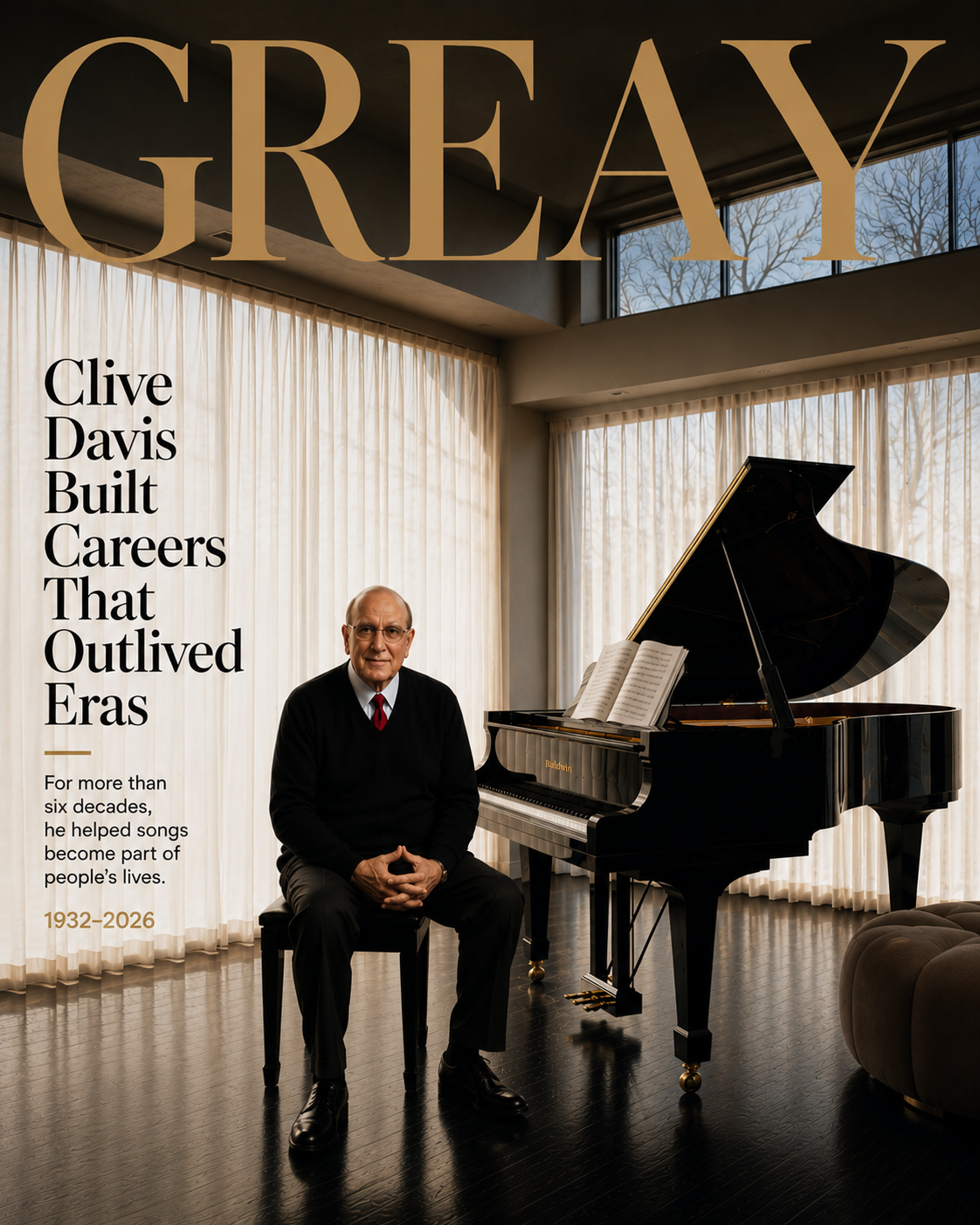
Clive Davis Built Careers That Outlived Eras
By DaMarko GianCarlo
When people heard that Clive Davis had died, most did not think about a record label.
They thought about a song.
A song that played at a wedding.
A song that carried them through heartbreak.
A song that reminded them of someone they loved.
A song that filled a family home on a Sunday afternoon.
A song that arrived at exactly the right moment and somehow never left.
That is the unusual thing about music.
We do not simply listen to it.
We carry it.
We attach ourselves to it.
We borrow it when words fail.
We use it to celebrate, mourn, remember, heal, escape, and understand ourselves.
Long after we forget where we first heard a song, we remember how it made us feel.
Music eventually stops belonging to the industry.
It stops belonging to the executive.
It even stops belonging to the artist.
It begins belonging to the listener.
For more than six decades, Clive Davis helped make that transfer possible.
That is why his death feels significant.
Not because a powerful executive has passed away.
Not because an extraordinary résumé has reached its final chapter.
But because few people spent more time helping music find its way into human memory.
The easiest way to tell the story of Clive Davis is through accomplishments.
The labels he built.
The artists he championed.
The records he helped bring into the world.
The honors.
The accolades.
The influence.
There is certainly enough material.
He rose through Columbia Records, transformed Arista into one of the most influential labels in the industry, launched J Records, and remained relevant through nearly every major shift in modern music. Entire companies rose and disappeared during his career. Entire formats came and went. Entire generations of artists arrived, peaked, and faded.
Yet Clive Davis remained.
But longevity alone does not explain his legacy.
Many people survive eras.
Few define them.
What made Davis extraordinary was not that he followed music.
It was that he never stopped listening to it.
That sounds simple.
It isn’t.
Most people eventually become loyal to their own tastes. They become attached to the music that shaped them and struggle to hear what comes next.
Clive Davis spent more than sixty years resisting that instinct.
Again and again, he remained open to possibility.
That may be the defining characteristic of his career.
He was never loyal to a genre.
He was loyal to excellence.
Look at the artists connected to his journey.
Janis Joplin.
Aretha Franklin.
Barry Manilow.
Patti Smith.
Lou Reed.
Gil Scott-Heron.
Whitney Houston.
Alicia Keys.
Santana.
TLC.
Outkast.
Usher.
The Notorious B.I.G.
Alan Jackson.
Brad Paisley.
At first glance, they seem to have very little in common.
Different audiences.
Different backgrounds.
Different sounds.
Different philosophies.
Different definitions of what music should be.
Yet Clive Davis heard something in all of them.
That is remarkable.
Because the America of Gil Scott-Heron is not the America of Barry Manilow.
The America of Patti Smith is not the America of Alan Jackson.
The America of Outkast is not the America of Whitney Houston.
Yet Davis continued finding artists who mattered to each of them.
He wasn’t simply listening across genres.
He was listening across versions of America.
That ability allowed him to move where others could not.
To hear possibility where others heard difference.
To recognize greatness before consensus arrived.
History has a habit of making success appear inevitable.
It rarely is.
Every legendary artist was once unknown.
Every iconic voice was once unproven.
Every enduring career began as a possibility that required someone to believe before there was evidence.
Again and again, Clive Davis became that person.
Perhaps that is why so many artists trusted him.
He understood that careers are not built in moments of certainty.
They are built in moments of belief.
Long before the public knew what a career would become, someone had to hear something worth investing in.
Someone had to listen.
Someone had to believe.
That work is rarely visible.
The public sees the hit record.
The sold-out tour.
The awards.
The headlines.
What they do not see are the countless conversations, meetings, demos, late nights, disagreements, instincts, and decisions that happen beforehand.
They do not see the work.
Yet the work is where everything begins.
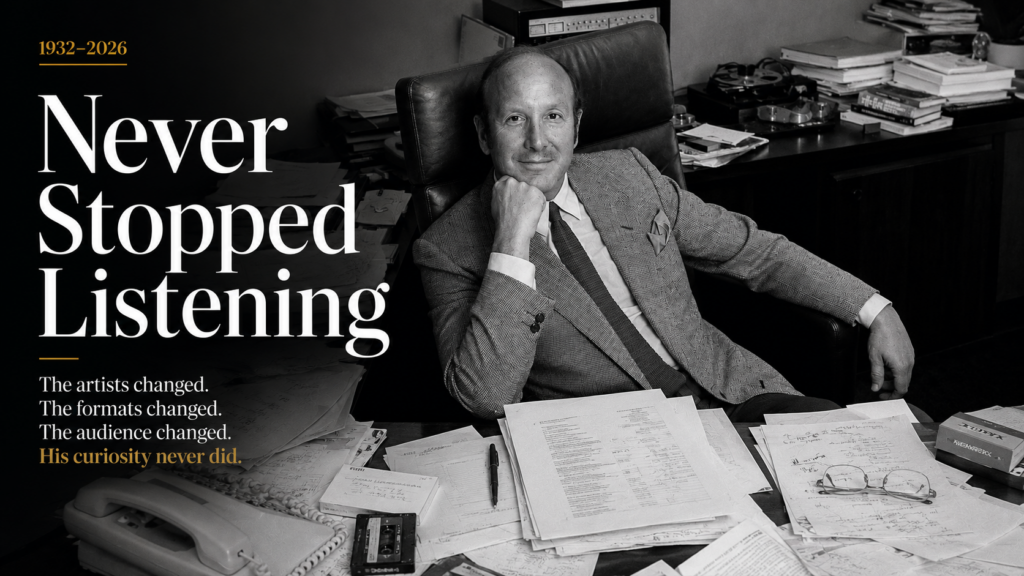
That truth becomes impossible to ignore when looking at photographs of Davis throughout his career.
Not standing on a stage.
Not celebrating an achievement.
But sitting behind a desk.
Surrounded by papers.
Surrounded by notes.
Surrounded by possibilities.
Listening.
Evaluating.
Thinking.
The image is a reminder that music history is not only built by performers.
It is also built by people willing to dedicate their lives to hearing what others miss.
Davis understood something that many people in business eventually forget.
Success is not a destination.
Curiosity is a practice.
The artists changed.
The formats changed.
The audience changed.
His curiosity never did.
That curiosity helped shape some of the most influential careers in modern music.
But perhaps his greatest contribution extends beyond any individual artist.
Because the truth is that Clive Davis was never really in the business of records.
He was in the business of connection.
The connection between a voice and a listener.
The connection between an artist and an audience.
The connection between a song and a memory.
That last connection may be the most important of all.
Most people will never know the details of the deals he negotiated.
They will never study the label structures he built.
They will never learn how meetings unfolded behind closed doors.
What they will remember is the song.
The voice.
The feeling.
The moment in their life that became inseparable from both.
A father dancing with his daughter.
A teenager sitting alone in a bedroom.
A family gathered around a table.
A couple driving through the night.
Someone finding comfort during a season when comfort felt impossible.
Clive Davis was not present for any of those moments.
He never met most of those people.
Yet his fingerprints were there all the same.
That is what makes his legacy so unusual.
Most people spend their lives affecting the people they know.
Clive Davis spent more than six decades affecting the lives of people he would never meet.
Through artists.
Through songs.
Through memories.
The industry will remember him as an executive.
Artists will remember him as a champion.
History will remember him as one of the defining figures in modern music.
But listeners may remember him differently.
Many will never know the details of his career.
Many may never fully understand the scope of his influence.
Yet they will continue carrying the music.
And perhaps that is the highest achievement anyone in music can hope for.
To spend a lifetime helping artists reach the world.
To spend a lifetime helping songs find the people who need them.
To spend a lifetime introducing people to voices they eventually mistake for their own memories.
Clive Davis built careers that outlived eras.
More importantly, he helped create music that outlived the moments in which it was first heard.
That music remains.
And through it, so does he.
Related Posts

Broadway Was Built Around Eight Shows a Week:Is the Industry Ready to Rethink the System Without Losing What Makes Broadway
Broadway's Hardest Tradition

Sanaa Lathan Takes Lead Role and Executive Produces in Legendary Entertainment’s ‘Miss Cleo’ Drama Series, Spearheaded by Sharon Hall
Sanaa Lathan executive produces Miss Cleo film.

Drake Unveils NOCTA Basketball Campaign Featuring Kevin Durant
Drake Unveils NOCTA Basketball Campaign

Universal Music Latino Is Using Streamer YaBoyyWill to Find Reparto’s Next Artists
From Stream to Studio
Travis Scott’s Paramount Deal Shows Hollywood Is Expanding Where Intellectual Property Begins
The business of building creative worlds

Marvel Unlocks New ‘Psylocke’ Solo Comic Series
Alyssa Wong and Vincenzo Carratù's 'Psylocke' begins this November.