

FIFA Isn’t Streaming the World Cup on YouTube — It’s Rebuilding Sports Discovery for the Algorithm Era
BY Louis Menzel
The World Cup used to begin with a television schedule. Now it begins with a recommendation algorithm.
For decades, sports broadcasting operated through a relatively stable ritual. Families gathered around a single screen. National broadcasters controlled distribution. Kickoff times shaped evenings. The match itself functioned as a centralized cultural event — one broadcast, one audience, one shared entry point.
But the modern sports ecosystem no longer behaves that way.
FIFA’s growing relationship with YouTube signals something much larger than a simple streaming partnership. It signals that the architecture surrounding global sports discovery is being rebuilt for an audience that no longer experiences culture through channels, but through platforms.
That distinction matters.
Because YouTube does not function like traditional television infrastructure. It functions like a behavioral engine — built around recommendations, algorithmic surfacing, clips, reactions, livestream fragments, creator ecosystems, and continuous audience circulation. In this environment, discovery itself becomes the product.
That is why selective World Cup streaming access on YouTube — whether limited live windows, highlights, or select matches — represents a much larger structural shift than most headlines suggest. FIFA is not replacing broadcasters. It is rebuilding the top of the sports-viewing funnel.
The old sports economy prioritized exclusivity.
The platform economy prioritizes discoverability.
That changes everything.
For most of television history, sports relied on scarcity. Access was controlled through cable bundles, regional licensing agreements, premium subscriptions, and appointment-viewing behavior. Fans organized their lives around the broadcast because the broadcast controlled the experience.
But younger audiences increasingly engage with sports differently:
through clips during lunch breaks,
through creator reactions,
through livestream snippets,
through vertical highlights,
through algorithmic recommendations surfacing between unrelated videos.
The modern viewer often encounters the event before they intentionally seek it out.
That is the infrastructure YouTube already understands better than nearly every legacy broadcaster on earth.
And FIFA understands something else: audiences no longer separate media formats the way previous generations did. To younger viewers, clips, livestreams, reactions, memes, podcasts, commentary, and full matches all exist inside one continuous ecosystem. The match no longer lives in isolation. It lives inside circulation.
That shift changes not only how sports are distributed, but how they are experienced socially.
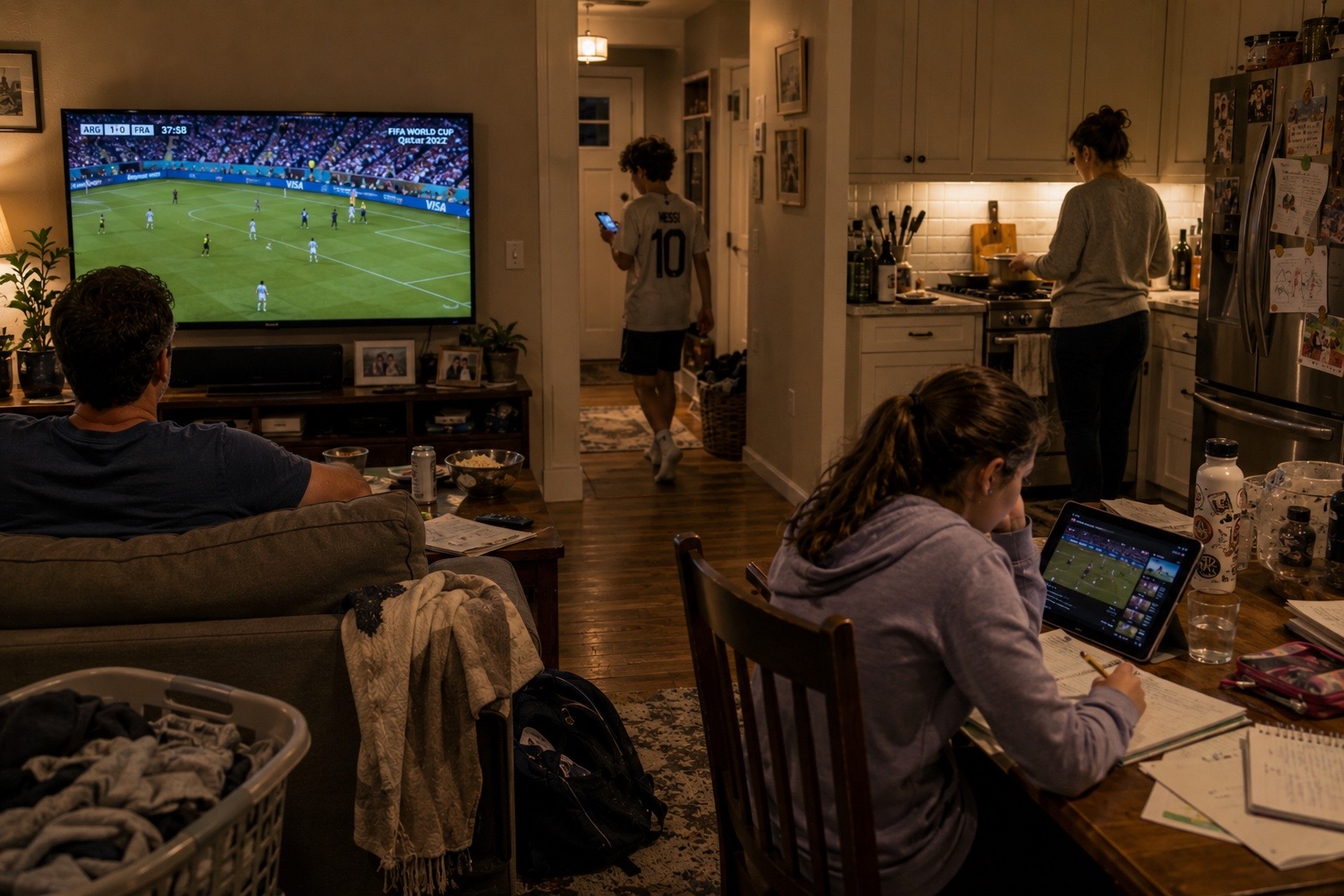
The World Cup used to revolve around one dominant screen inside the home. Today it flows through households differently. One person watches the main broadcast on television. Another catches highlights vertically on a phone while walking through the house. Someone else half-watches clips on a tablet while finishing homework at the kitchen table. The event still connects the household — but the viewing ritual itself has fragmented into simultaneous entry points.
The same thing is happening outside the home.
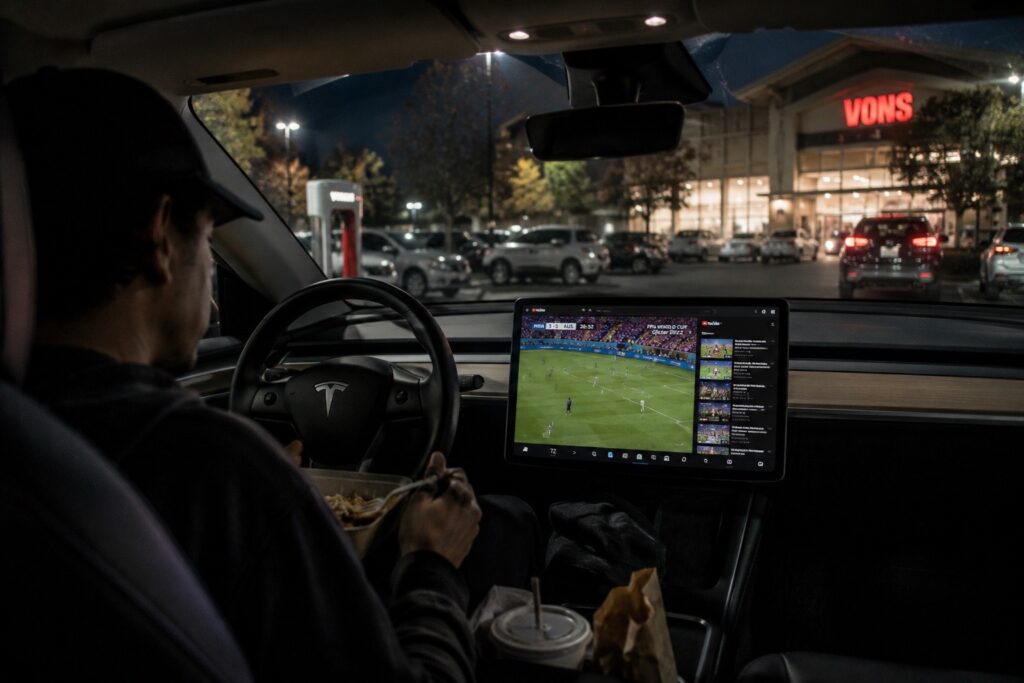
The modern sports experience now follows people through movement and labor. A rideshare driver parked outside a grocery store between trips watches match highlights on a center console screen while eating takeout in the front seat. A delivery worker checks livestream reactions while waiting for an order pickup. Sports no longer belong exclusively to living rooms or bars. They circulate through transportation systems, work schedules, parking lots, algorithms, and ambient digital environments.
The World Cup is becoming infrastructure.
That is the deeper meaning behind FIFA’s YouTube strategy.
The organization is not simply adapting to streaming culture. It is adapting to platform-native behavior — behavior shaped by feeds instead of schedules, discovery instead of destination, circulation instead of singular broadcasts.
And this is where the shift becomes much larger than soccer.
Because YouTube is no longer simply a video platform. It has quietly evolved into a hybrid media layer functioning simultaneously as:
- television network,
- search engine,
- recommendation engine,
- creator economy,
- livestream infrastructure,
- advertising system,
- and cultural archive.
In many ways, FIFA partnering with YouTube reflects a broader reality the entertainment industry is slowly being forced to confront: platforms now shape audience behavior more powerfully than the institutions distributing the content themselves.
That does not mean broadcasters disappear tomorrow. The economics of sports rights remain enormous. Territorial licensing still matters. Traditional networks still possess reach, production scale, and advertising infrastructure.
But the center of gravity is shifting.
The modern sports ecosystem increasingly depends on visibility loops rather than singular destinations. Discovery, circulation, and algorithmic amplification are becoming inseparable from the event itself.
The World Cup is no longer simply being broadcast.
It is becoming platform-native media.
And once global sports fully adapt to algorithmic distribution logic, every major league, broadcaster, streamer, and advertiser will eventually confront the same question:
What happens when the first screen is no longer the television — but the feed?
Related Posts
When Power and Consequence Can No Longer Be Separated
The End of Parallel Heroes
Ryan Coogler’s Creative Infrastructure
From film school collaborations to the Oscars

Stepping Back Into the Fog: ‘Return to Silent Hill’ Trailer Revives a Horror Classic
Horror Reborn

Walmart Is Redefining What a Retail Membership Can Include
wo Brands. One Membership.
Spike Lee’s “School Daze”: A Vital Piece of Black Cultural History
By DaMarko GianCarlo In the world of cinema, few directors have had as
FanDuel’s “Kick of Destiny 3” Brings Peyton and Eli Manning Head-to-Head in a Super Bowl Sunday Showdown
Peyton and Eli Manning Head-to-Head Super Bowl Sunday