

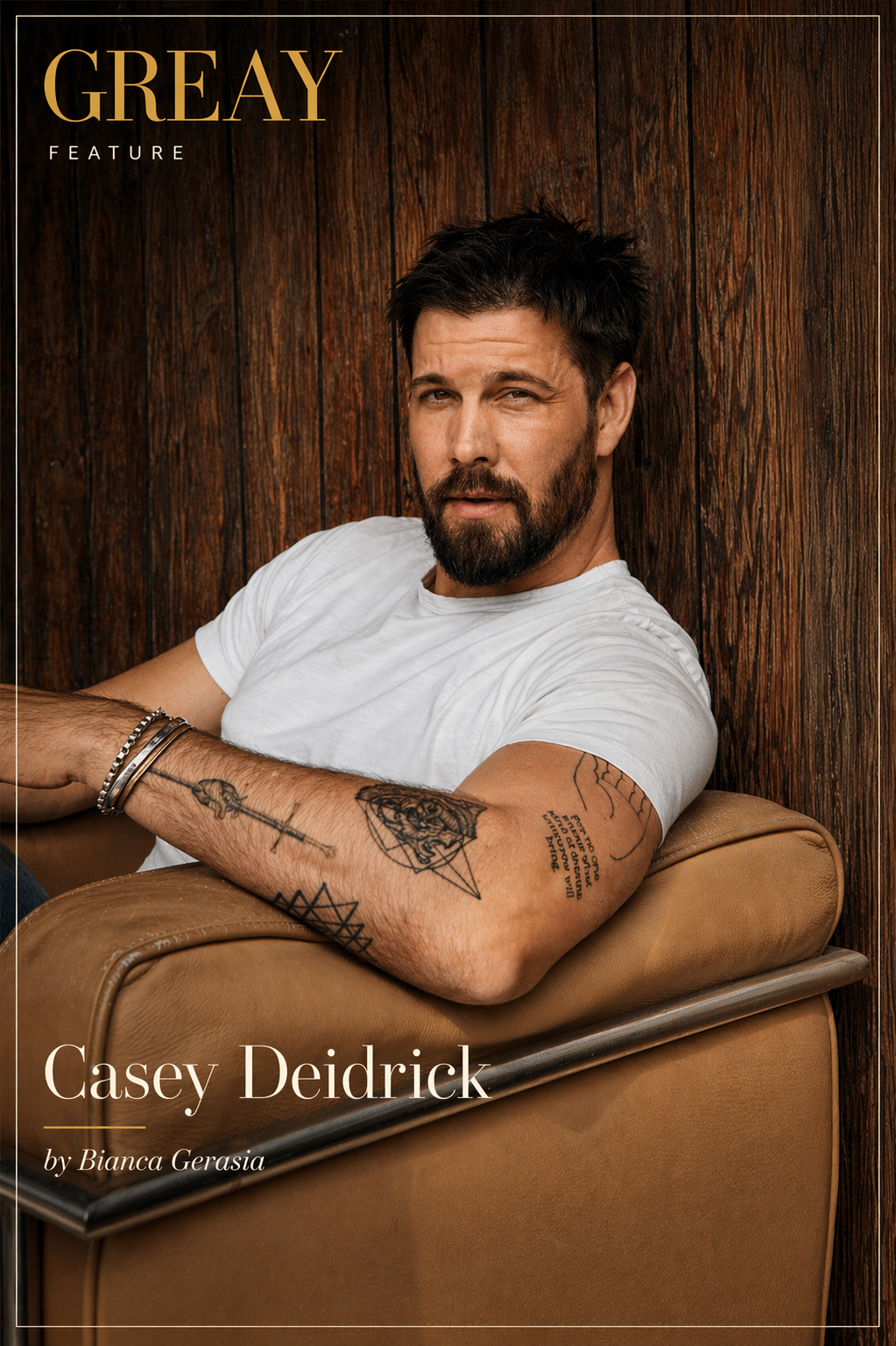
Casey Deidrick Is Done Confusing Movement With Meaning
By Kyra Greene
There’s a particular kind of stillness that settles in when momentum disappears—and in that silence, who you are becomes harder to avoid. Casey Deidrick has lived inside that space long enough to recognize it not as absence, but as clarity. Known for characters that hover between control and unraveling, he doesn’t chase resolution so much as he inhabits tension—men who carry weight without the promise of relief. Off-screen, that same philosophy has begun to shape his next chapter: less concerned with proving presence, more focused on defining intention. In an industry that often confuses movement with meaning, Deidrick is choosing something quieter—and far more difficult—the discipline of staying still long enough to understand what actually matters.
You’ve built a career playing characters who operate in moral gray areas—men carrying weight, often without resolution. What is it about that emotional space that feels closest to you right now?
I think that space feels honest to me right now because life doesn’t really wrap things up the way stories want it to. There isn’t always closure, and there isn’t always a clean version of who you are in a given moment.
I’ve definitely spent time trying to be the “good guy” in my own narrative, or trying to resolve things neatly.. and that’s just not how it works. Sometimes you’re carrying things you haven’t figured out yet, sometimes you’re the one who got it wrong, and sometimes both are true at the same time.
Those gray-area characters… they don’t get the luxury of pretending. They have to sit in it. And I think that’s what feels closest to me right now.. just being in a place where I’m not rushing to define everything or tie it off, but actually trying to understand it while I’m in it.
After a visible run on network and streaming projects, the industry shifted almost overnight. What did that moment actually feel like from the inside—not professionally, but personally?
From the inside, it didn’t feel like a shift.. it felt like silence.
When you’re in it, there’s this momentum… calls, meetings, people reaching out. And then suddenly that slows down, and you’re left alone with your own thoughts a lot more than you were before. That was probably the hardest part.. not the industry side of it, but what it forces you to sit with personally.
It makes you question things you didn’t have time to question before. Not just “Where is this going?” but “Who am I when it’s not moving?” And that’s uncomfortable, because you realize how much of your identity can get tied to the pace of it all.
But I think there was something necessary in that too. It stripped away a lot of the noise. It forced me to look at what I actually care about, what I want to build moving forward, and not just chase what’s in front of me.
So yeah, from the outside it might look like a career moment.. but from the inside, it was a personal one. It slowed everything down in a way I didn’t choose, but probably needed.
There’s a difference between momentum and direction. When everything paused, did it force you to confront what you actually wanted—or what you had been moving too fast to question?
Yeah.. because momentum can trick you into thinking you’re in control, when really you’re just keeping up.
When it stopped, I had to ask myself if I was actually choosing any of it, or just moving because it was moving. And that’s not a comfortable question.
But it’s a necessary one. Because once the noise is gone, whatever you do next is on you. It’s not momentum anymore.. it’s intention.
The Iron Door feels like a return to intensity, but also a recalibration. What did you recognize in that character that told you: this is the right re-entry point?
It wasn’t strategy.. it was more instinct.
I saw a guy who’s not just rough, he’s unraveling. He’s chasing something that’s probably making him worse, not better and that felt honest.
The world of the film forces that out of him. There’s nowhere to hide. And that’s what drew me in.
And on a personal level, one of my best friends was already part of it. Getting to work with him, to ride together in something like this.. it made it feel real in a way I couldn’t pass up.
It didn’t feel safe, which is exactly why it felt right.
You’ve played both heroes and anti-heroes, but your performances tend to live in the tension between the two. Do you see yourself as someone drawn to contradiction, or someone trying to resolve it?
I’m not trying to resolve it.. I think I trust it more than that.
People aren’t consistent. You can mean well and still do damage. That tension is the interesting part.
So I’m not chasing heroes or anti-heroes.. I’m drawn to the space where they blur. That’s usually where the truth is.
A lot of actors are navigating this post-strike landscape quietly. What have you had to unlearn about the industry in order to keep moving forward?
To be honest, I never thought the industry was fair.
What I had to unlearn was that effort guarantees outcome. It doesn’t.
You can do everything right and still end up in long stretches of silence. If you take that personally, it’ll eat you up.
So I stopped reading into it. I focus on the work, staying ready, and showing up the same way whether things are moving or not.
That’s the only part I can actually control.
There’s a physicality to your work—an awareness of the body under pressure. How much of your process begins emotionally versus physically?
For me, it’s very physical. That’s usually where I start.
I tend to immerse fully in the world of the character so it’s not just something I’m imagining.. it’s something I’m actually living in a practical sense. I’ve trained with military guys for roles, done weapons and movement work, spent time with people who live very different lives than mine so I can understand how they think and carry themselves. With prison or more confined environments, it’s about understanding the psychology of restriction, not just the idea of it.
Even something like motorcycles for The Iron Door.. that wasn’t something I had to create from scratch. It was already part of my life, so I leaned into that familiarity and let it inform the character naturally.
I don’t really separate physical and emotional preparation. The physical work tends to open the emotional door for me. Once I’m living in the behavior, the emotional truth usually shows up on its own.
At the core of it, I think I’m drawn to transformation. I like disappearing into something that isn’t me.. that’s the part of acting that feels most honest to me.
When audiences say they connect to your “brooding” presence, what do you think they’re actually responding to underneath that?
I don’t really think of it as brooding.
What people are probably responding to is restraint. I tend to play characters who don’t say everything they’re thinking, or who are holding things in instead of letting them spill out immediately.
There’s a lot happening underneath, but it’s not always externalized in a big way. I think audiences can feel that tension.. that something is there even when it’s not being explained.
And honestly, I think people relate to that more than they realize. Most people aren’t fully expressive all the time. A lot of life is internal. So when they see that kind of stillness or contained emotion on screen, it feels familiar.
So I don’t see it as brooding. I think it’s just… presence with something going on underneath it.
This next chapter feels less about visibility and more about intention. How are you deciding what’s worth your time now?
It’s less about visibility than it is about alignment.
Earlier on, you can end up saying yes to a lot of things just to stay in motion or stay present in the conversation. But at a certain point, you start to realize that not all momentum is meaningful.
Now I’m paying more attention to what actually feels grounded.. does the material challenge me, does the director have a clear point of view, and does it feel like something I can fully commit to, not just show up for.
It’s not about doing less for the sake of it. It’s about being more honest about what actually deserves my time and energy.
If it doesn’t feel intentional, I’m probably not the right guy for it anymore.
If your earlier career was about proving you belong, what is this next phase about?
Earlier it was about proving I belonged.
Now it’s about being intentional with what I choose to step into and not confusing movement with meaning.
I’m less interested in proving anything and more interested in making sure the work actually reflects me.
There’s a version of this industry that rewards consistency, and another that rewards reinvention. Right now, which one do you think is actually real?
I think both exist but neither is guaranteed.
Consistency matters, reinvention matters, but neither one is a formula.
The only thing that feels real is whether the work holds up when it lands. Everything else changes.
If everything you’ve built so far disappeared tomorrow—credits, recognition, momentum—what part of you would still know how to begin again?
I think it’s discipline.
Not credits, not momentum.. just the ability to show up, train, and build again from nothing if I have to.
If there’s a throughline to where he stands now, it isn’t reinvention or even return—it’s recognition. Recognition that the work only holds weight if it reflects something real, that discipline outlasts momentum, and that silence, however uncomfortable, can be its own kind of direction. Casey Deidrick doesn’t offer resolution because he doesn’t believe in it—not on screen, and not in life. What he offers instead is something more enduring: presence, restraint, and the willingness to sit inside the gray until it reveals what it needs to. And in a culture built on constant noise, that kind of clarity doesn’t just stand out—it lasts.
Photography by Bianca Gerasia @theglasscamera
1 Comment
Comments are closed.
Related Posts

The Jellicle Ball Was Never the Metaphor — It Was the System
Visibility and Judgment, Collapsing Into One Moment

Broadway Is Becoming the Stage Where Music Legends Live On—and James Brown Is Next
When an Artist's Story Becomes Cultural History
Disney+ Unveils Live-Action Reboot of ’90s Classic ‘Gargoyles’
Expanding on the universe established by the original Disney series th
The King of Cool: Usher Joins Ralph Lauren Fragrances as the Face of Ralph’s Club New York
Golden Nights, Modern Icons

PEPSI® KICKS OFF 2024 NFL SEASON WITH COLOSSAL CAMPAIGN INSPIRED BY PARAMOUNT PICTURES’ UPCOMING “GLADIATOR II”, STARRING MEGAN THEE STALLION AND NFL SUPERSTARS JOSH ALLEN, DERRICK HENRY, JUSTIN JEFFERSON, AND TRAVIS KELCE
Nearly two decades after the Pepsi® "Roman Empire" campaign, the bran
Television Is Starting to Feel Engineered
Entertainment Is Becoming Over-Optimized
Jill Gamlen
Casey you are a true Deidrick. Your interview was not only an imagine of who you are but your inner most thoughts. I am proud to say that I am your aunt .
With your beliefs you will continue to go far.