

Bad Bunny Isn’t Selling Puerto Rico — He’s Distributing It
By Carlo Hernandez
When Zara announced its collaboration with Bad Bunny, the conversation immediately turned to fashion. Was this a smart partnership? Was it authentic? Was it commercial? Was it inevitable?
Those are reasonable questions.
They are also the wrong ones.
Because the most interesting thing about the collaboration is not the clothing. It is the distribution.
For years, Bad Bunny has been building one of the most unusual careers in modern entertainment. Most artists use global success to move beyond where they came from. They become larger than their hometown, larger than their city, larger than their culture. The journey toward worldwide recognition has historically required a degree of distance from home.
Bad Bunny appears to be attempting something different.
Rather than using global platforms to escape Puerto Rico, he has repeatedly used global platforms to bring Puerto Rico with him.
The Zara collaboration is simply the latest example.
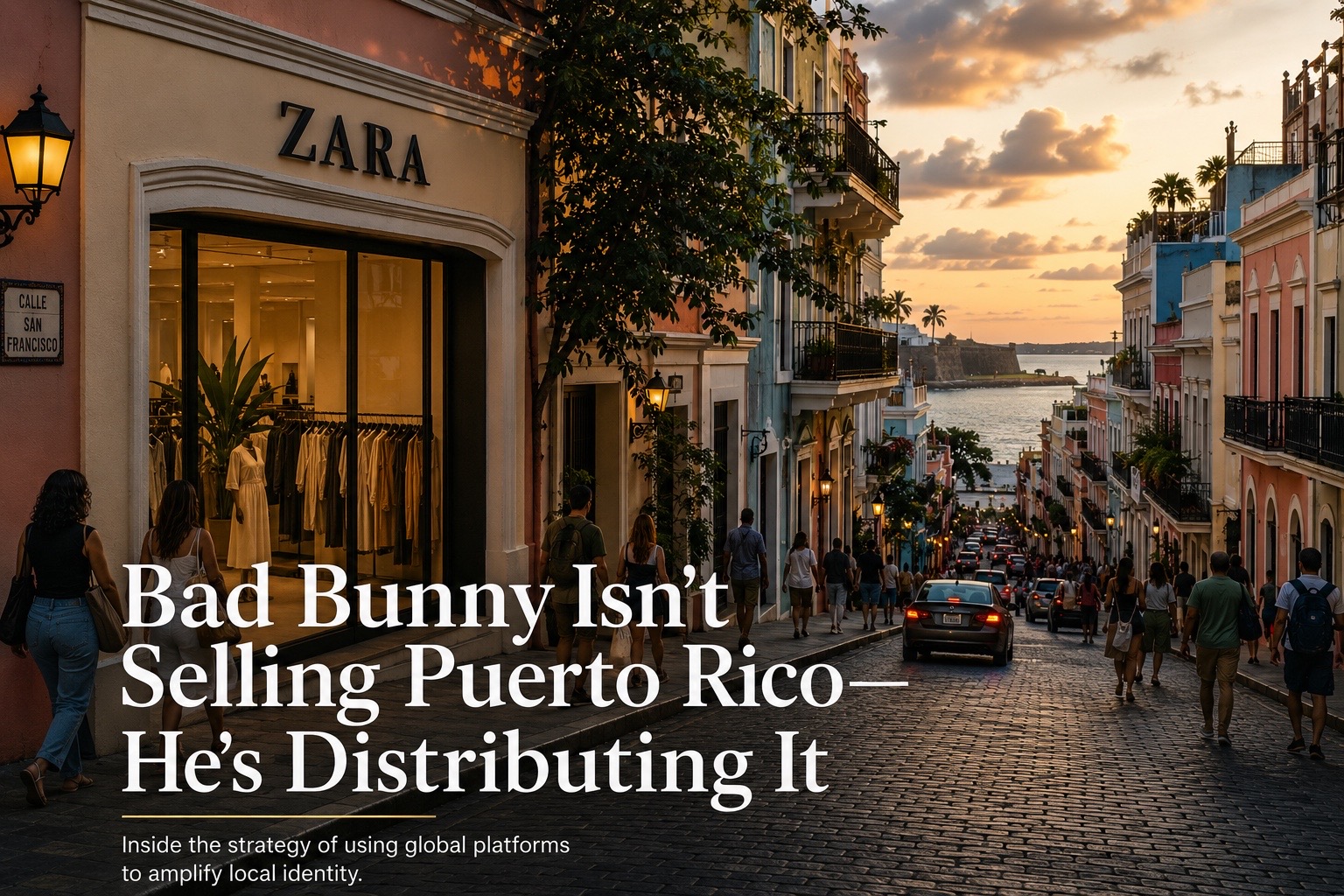
That is what makes the images surrounding the partnership so fascinating. One image shows a Zara storefront embedded within the streets of San Juan. The city stretches toward the ocean. Residents walk the cobblestone streets. Life continues as it always has. The global retailer is present, but it is not the story.
Puerto Rico is the story.
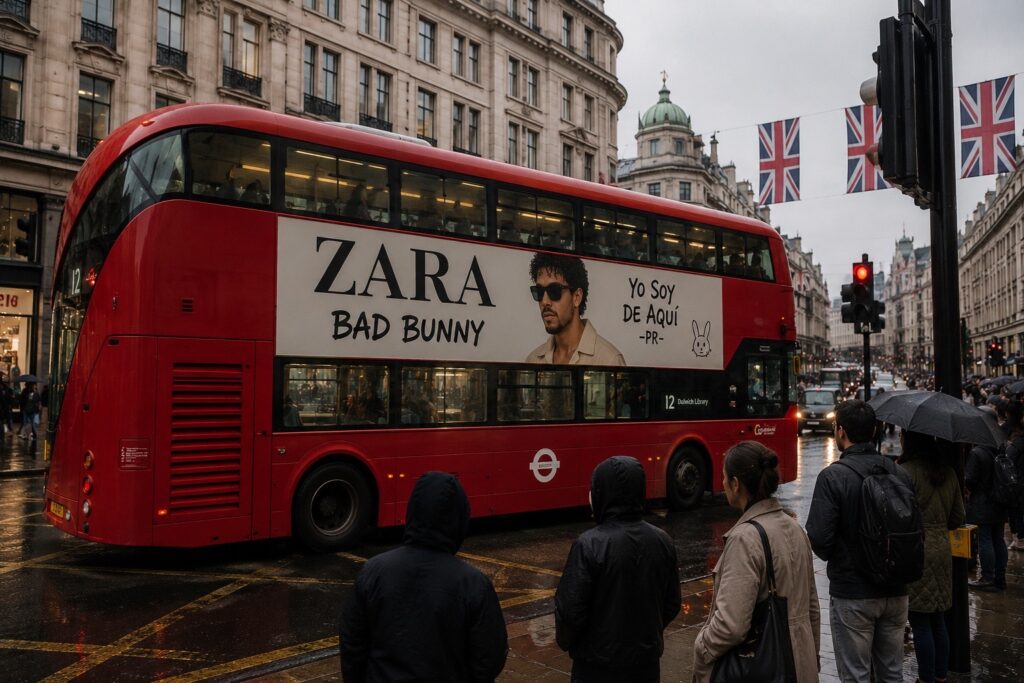
The second image tells the other half of the narrative. A red double-decker bus moves through a rainy London street carrying a Bad Bunny and Zara campaign. Thousands of miles separate London from San Juan. The architecture is different. The weather is different. The culture is different.
Yet Puerto Rico has arrived anyway.
That is the significance of Zara.
Fashion critics often evaluate collaborations through the lens of exclusivity. Luxury brands are treated as cultural validation. Smaller designers are seen as more authentic. Mass retail is frequently viewed as compromise.
But Bad Bunny has never built a career around exclusivity.
His career has been built around reach.
The evidence is difficult to ignore.
He became one of the world’s largest artists while continuing to perform primarily in Spanish. He turned Puerto Rican slang, references, and experiences into global cultural currency. He built a residency in Puerto Rico that encouraged people to travel to the island rather than away from it. He stepped onto one of the largest stages in entertainment and brought Puerto Rican identity with him. His partnerships with adidas and now Zara follow the same pattern.
The platform gets bigger.
The message stays the same.
That is why the Zara collaboration feels less like a fashion story and more like a story about infrastructure.
Zara operates one of the largest retail networks in the world. Its stores reach millions of consumers across continents. Its campaigns move through cities, airports, shopping districts, and digital platforms at a scale few organizations can match.
The question, then, is not why Bad Bunny partnered with Zara.
The question is why an artist whose career has been built around amplifying Puerto Rican identity would ignore one of the largest distribution systems on the planet.
Viewed through that lens, the partnership becomes remarkably consistent with everything that came before it.
The residency was infrastructure.
The stadium tour was infrastructure.
The Super Bowl was infrastructure.
adidas was infrastructure.
Zara is infrastructure.
The platforms change. The audience grows. The distribution network expands.
Puerto Rico remains at the center.
For decades, globalization often required assimilation. Success meant moving closer to the center of power. Local identity was softened so it could travel more easily across borders.
Bad Bunny’s career suggests a different possibility.
What if the goal is not to make Puerto Rico more global?
What if the goal is to make global platforms more Puerto Rican?
That is the question hiding beneath the Zara collaboration.
The clothing will eventually leave the shelves. The campaign will end. Another collaboration will take its place.
But the larger experiment will remain.
Can the world’s biggest distribution systems carry local identity without diluting it?
Bad Bunny’s career increasingly suggests that they can.
The Zara collaboration is not the story of a global artist leaving Puerto Rico behind.
It is the story of a global artist discovering just how far Puerto Rico can travel.
Related Posts
Miles Morales Isn’t Returning—He’s Being Repositioned
Being the Hero Is Simple. Keeping a Life Isn’t
Dior and A24 Are Taking Their Partnership Off Screen
More Than a Placement
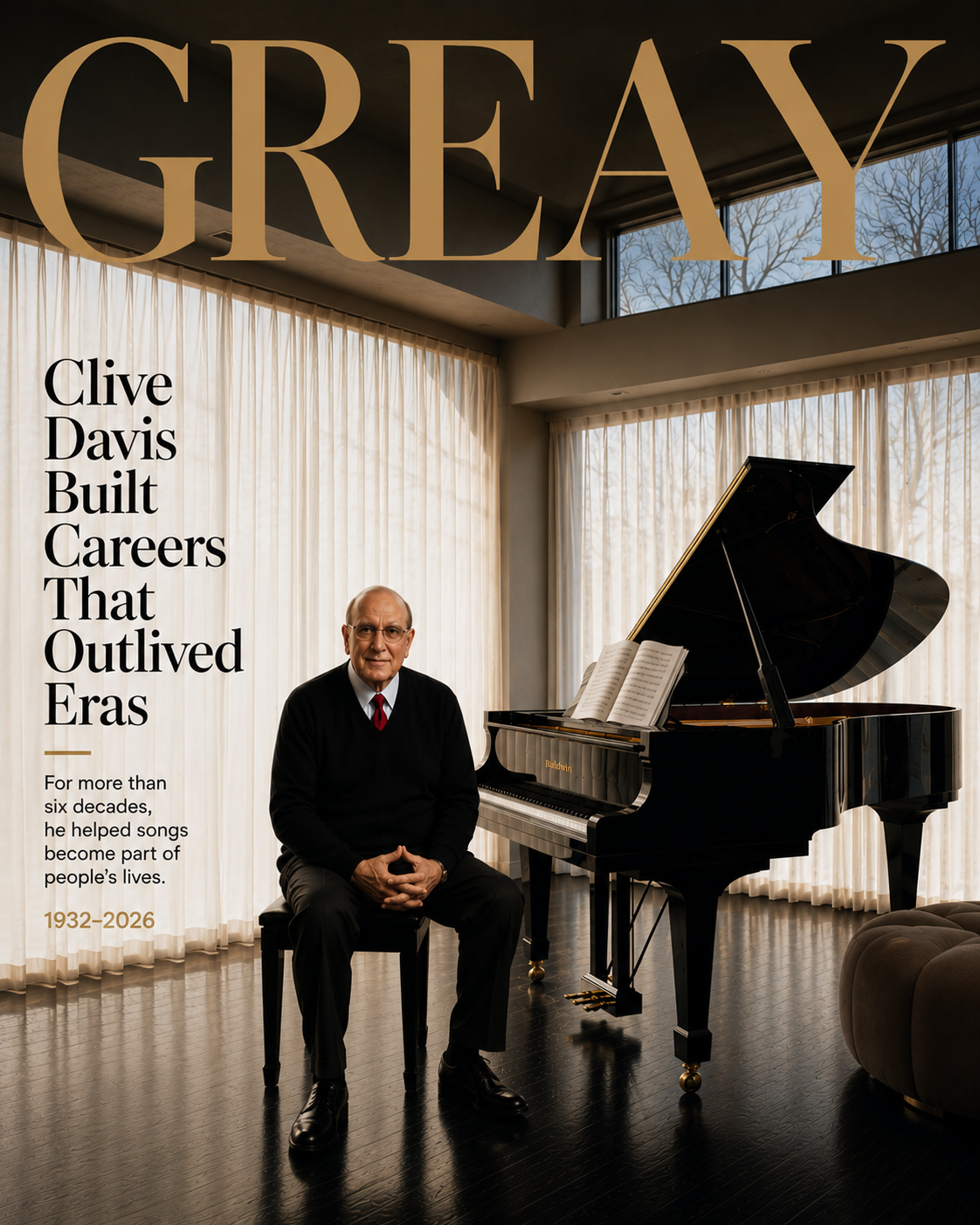
Clive Davis Built Careers That Outlived Eras
The artists changed. The formats changed. His curiosity never did.

The Sunset Strip After Relevance
The Place Is No Longer the Platform

The Beyoncé Renaissance Tour: A Cultural Milestone and Profitable Marvel for Live Black Music
BY DaMarko GianCarlo Beyoncé is more than just a global superstar; sh

Fox Isn’t Buying Roku:It’s Buying the Television
The next media war begins before viewers press play