

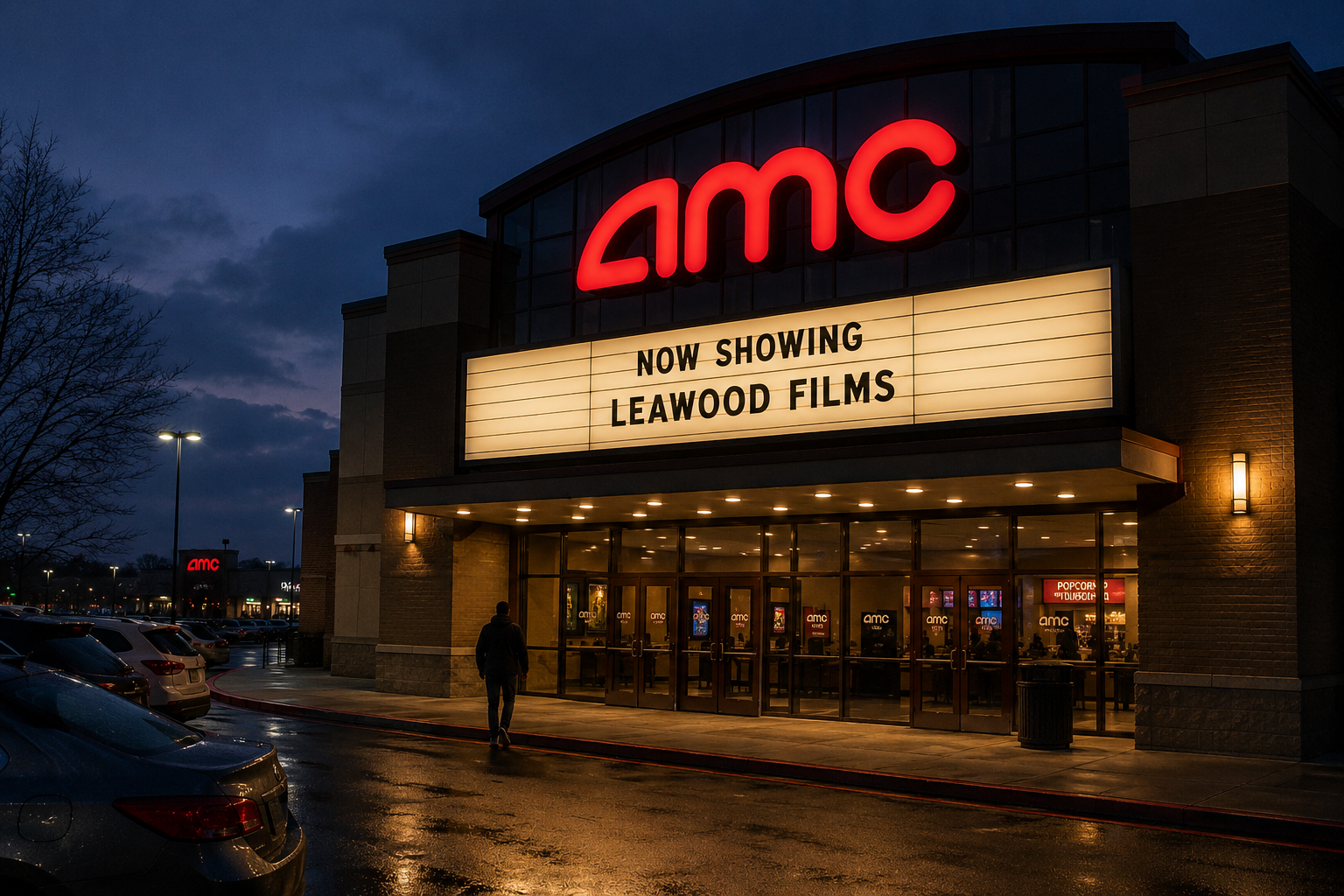
AMC’s Leawood Films Shows Why the Theater Chain Is Moving Into Distribution
By DaMarko GianCarlo
There is a strange thing happening inside the movie theater business: the movies can be enormous while moviegoing remains smaller. This summer, theaters in the United States and Canada generated approximately $4.4 billion between May and August 23, slightly ahead of the comparable period in 2019. On the surface, that looks like the kind of number that should settle years of conversation about whether movie theaters are coming back. Then you look at how that money was made. Ticket sales remain substantially below pre-pandemic levels. Through the first 30 weeks of 2026, estimated admissions were roughly one-third lower than during the comparable period in 2019. Even more revealing, just five movies generated approximately half of the summer’s domestic box office. Higher ticket prices have helped theaters generate more revenue from fewer visits.
Movie theaters aren’t disappearing, but Americans haven’t simply returned to their old moviegoing habits either. The theatrical business is increasingly dependent on fewer visits becoming more valuable and fewer movies becoming much bigger events. AMC Entertainment appears to understand the difference.
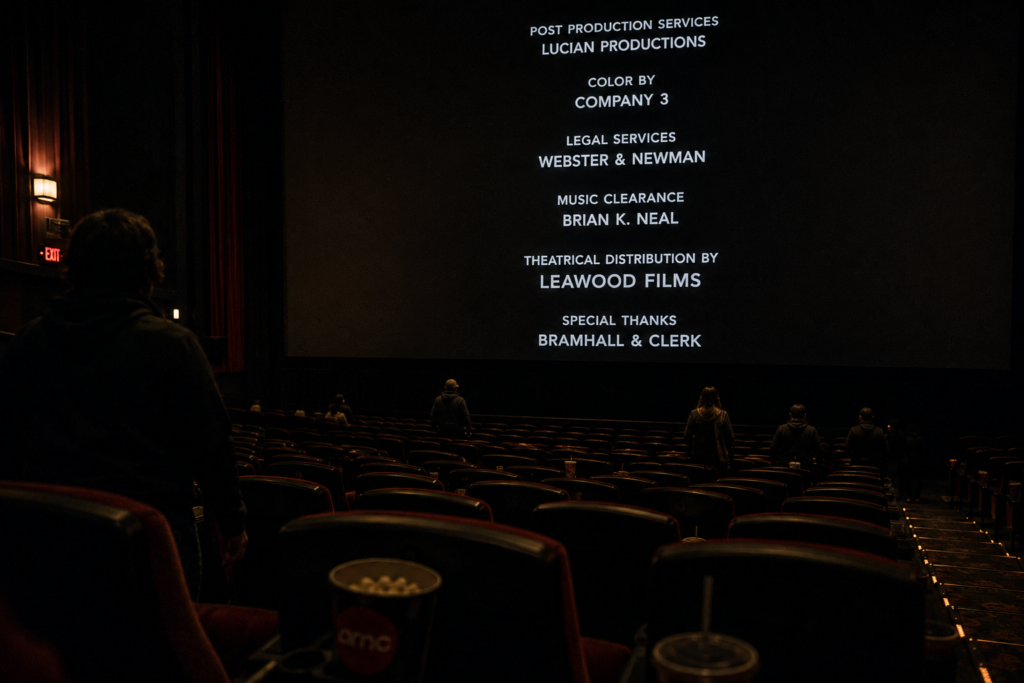
On August 31, AMC announced Leawood Films, a new theatrical distribution company designed primarily to bring fully financed or already completed small- and mid-budget movies into theaters. AMC assembled an advisory group that includes former Warner Bros. Pictures Group chairman Toby Emmerich, former Walt Disney Studios marketing president Ricky Strauss and former Paramount domestic distribution president Kyle Davies. The company doesn’t expect Leawood’s first releases until 2027 or 2028.
The announcement could easily be read as a movie-theater company expanding into another part of Hollywood, but the timing tells a more interesting story. For most of AMC’s history, its position inside Hollywood’s system has been relatively straightforward. Studios finance and produce movies. Distributors bring those movies into the marketplace. AMC provides the screens where audiences watch them. The exhibitor sits near the end of the chain. That relationship works extraordinarily well when Hollywood supplies enough movies people want to see. It becomes much more difficult when it doesn’t.
AMC said as much when it announced Leawood. CEO Adam Aron pointed directly to the substantial excess capacity that exists across the movie-theater industry and argued that getting even a few additional movies onto theatrical screens each year could create incremental business for AMC, its Odeon circuit and other exhibitors. That may be the most important part of the announcement. AMC isn’t launching Leawood because every auditorium is full. It is launching Leawood partly because they aren’t.
A movie theater has a peculiar inventory problem. A retailer can leave an unsold pair of shoes on a shelf until tomorrow. A warehouse can hold inventory until somebody buys it. A hotel can change tomorrow night’s room rate. An empty movie-theater seat, however, disappears. When a 7:30 screening starts with 60 unused seats, the economic opportunity represented by those seats is gone by the time the credits roll. There is no way to put Tuesday night’s empty auditorium into storage and sell it on Saturday. Multiply that across thousands of screens, several showtimes every day and an entire year, and unused capacity becomes an enormous problem.
AMC cannot completely control how frequently Americans decide to go to the movies, but it can begin trying to influence how many reasons they have to go. That is where Leawood becomes more important than another corporate label.
AMC isn’t attempting to become Warner Bros., Disney or Universal. Leawood doesn’t intend to develop scripts or finance productions. Instead, AMC wants filmmakers to arrive with completed movies or financing already secured. Leawood can then provide theatrical distribution, marketing expertise and access to screens without AMC accepting the enormous production risk associated with actually making those movies. AMC doesn’t need to own the movie. It needs the movie to give someone a reason to use the theater.
That strategy becomes even more revealing when placed beside what AMC has been doing to the theaters themselves. In 2024, AMC announced its Go Plan, committing between $1 billion and $1.5 billion over four to seven years toward premium large-format screens, upgraded seating, laser projection and theater renovations across AMC in the United States and Odeon in Europe. AMC is effectively attacking the theatrical problem from both ends: make the room worth visiting and put more things worth seeing inside the room.
That distinction matters because the modern movie theater increasingly succeeds when going to the movies feels like more than simply watching something. The competition is no longer just another theater across town. It is the television already hanging on the wall at home, Netflix, YouTube, TikTok, gaming, podcasts, creator entertainment, social media and an effectively endless amount of entertainment available without leaving the house. The theatrical business therefore isn’t simply asking audiences to choose one movie over another. It is asking them to choose going somewhere over staying exactly where they are.
When the reason is strong enough, people still go. That is what makes Hollywood’s increasing dependence on blockbusters simultaneously reassuring and dangerous. The biggest movies can still transform moviegoing into a cultural event. They fill premium auditoriums, drive concession sales, create conversation and demonstrate that the communal experience of watching something on a giant screen still has enormous economic value. But five movies accounting for approximately half of an entire summer’s box office reveals the other side of that success. The problem isn’t simply that people don’t want to go to the movies. The problem is having enough movies that make them want to go.
AMC’s own 2026 results show how powerful the business can become when audiences have those reasons. During the second quarter, AMC attendance increased 13.5 percent year over year to 71.3 million guests. Revenue increased 14.2 percent to approximately $1.6 billion. Adjusted EBITDA increased sharply to $321.4 million. AMC called it the highest quarterly revenue and adjusted EBITDA in its 106-year history. Yet AMC still finished the first half of 2026 with a net loss.
Both things can be true. AMC can produce one of the strongest operating quarters in its history while still navigating a theatrical business structurally different from the one that existed before the pandemic. That contradiction matters because Leawood isn’t a bet that everything is fine. It is a response to what isn’t.
AMC has also been building toward this response for several years. In 2023, the company made what it later described in its SEC filings as its inaugural move into theatrical distribution with Taylor Swift | The Eras Tour. Rather than relying on a conventional major-studio distributor, AMC Theatres Distribution and its partners brought the concert film into theaters around the world. The movie ultimately grossed more than $260 million globally. AMC followed it with Renaissance: A Film by Beyoncé and subsequently told investors that theatrical distribution represented a new source of revenue it believed it could continue developing.
Then AMC kept experimenting. In 2024, it distributed Usher: Rendezvous in Paris and Billie Eilish’s Hit Me Hard and Soft album listening experience. Its annual report again identified theatrical distribution as a business capable of producing additional distribution and admissions revenue. At the time, those projects could reasonably be viewed as alternative programming built around some of the biggest musicians in the world. From August 2026, they look different. They look like AMC learning how to distribute.
The company learned how to coordinate releases beyond its own theaters. It developed relationships with distribution partners including Variance Films in North America and Piece of Magic Entertainment internationally. It learned how its marketing operation, customer relationships and physical footprint could be used for something beyond exhibiting movies distributed by somebody else. Leawood takes that capability and attempts to turn it into a repeatable business. More importantly, it takes a distribution model tested with some of the most famous artists on Earth and points it toward filmmakers who don’t possess that kind of leverage.
That is a meaningful evolution. Taylor Swift doesn’t need AMC to convince the world that people want to see Taylor Swift. An independent filmmaker with a completed $10 million or $20 million movie faces an entirely different problem. There are movies that can get financed, movies that can get made and movies that can eventually find streaming homes. The increasingly difficult question for many of them is whether they can receive a meaningful theatrical life between those points. AMC believes its position inside the theatrical business can become part of the answer.
The proposed relationship is notable. AMC says filmmakers working with Leawood will generally retain ownership of their intellectual property and the vast majority of downstream revenues. Leawood intends to preserve at least 45 days between theatrical release and premium video-on-demand and at least 90 days before subscription streaming. AMC isn’t asking filmmakers to surrender the future of their movie. It is trying to make theatrical access valuable enough that filmmakers choose AMC to help create its beginning.
There is another detail in the announcement that makes the strategy considerably more interesting: Leawood movies aren’t intended to play only at AMC. AMC expects to distribute them through competing theater circuits in the United States and internationally, continuing the broader theatrical approach it developed through its concert-film releases. That means AMC’s opportunity doesn’t necessarily end when a customer chooses another theater.
Historically, if someone bought a ticket at a competing cinema, that transaction largely belonged to the competitor. Distribution changes the relationship. If AMC is participating economically in the distribution of a Leawood movie, a ticket sold for that movie at another participating theater can still have value to AMC. That subtly changes what AMC is selling. For more than a century, AMC’s primary product has been access to its theaters. Leawood begins turning AMC’s access to the broader theatrical marketplace into a product of its own.
The screen isn’t only where AMC makes money. Access to screens can become something AMC sells.
That may be the most significant evolution inside the entire strategy because AMC isn’t walking away from being a theater company. It is attempting to make being a theater company useful in more places.
There is still considerable risk in assuming any of this will work. AMC hasn’t selected Leawood’s first movie. No filmmaker has demonstrated that the economics are attractive enough to create a significant pipeline. No audience has purchased a Leawood ticket. Distribution requires considerably more than having available auditoriums; AMC still has to identify good movies, market them effectively, choose release dates and convince other exhibitors that those films deserve valuable showtimes. Most importantly, additional supply does not automatically create additional demand. Putting another movie into theaters doesn’t mean anyone will come.
AMC also has to manage an unusual balancing act. Disney, Universal, Warner Bros., Sony, Paramount and other traditional studios remain enormously important suppliers to AMC. The company has been careful to position Leawood as additive rather than competitive, saying its traditional studio partners will continue supplying exponentially more films than Leawood. AMC doesn’t need to replace Hollywood. It needs to fill some of the space Hollywood leaves behind.
And that may ultimately explain why a theater company is moving deeper into distribution now. For years, the future of movie theaters has been discussed as though audiences alone will decide it: if people come back, theaters survive; if they don’t, theaters disappear. But that framing assumes the theater business itself remains essentially unchanged while everybody waits for consumers to make a decision.
AMC is making a different bet. The company is investing as much as $1.5 billion to improve the rooms. It is expanding premium experiences audiences have demonstrated they will pay more to use. It has spent several years learning how to distribute entertainment rather than only exhibit it. And now Leawood Films creates another path for filmmakers to put movies onto theatrical screens.
None of that guarantees audiences will come. It doesn’t erase AMC’s financial challenges. It doesn’t restore the hundreds of millions of admissions the theatrical industry has lost compared with 2019, and it doesn’t mean the movie theater business has come back.
That is precisely the point.
AMC is no longer building its future around waiting for it to. The buildings already exist. The projectors are already running. The employees are already working. The screens are already hanging on the walls. AMC’s problem is finding enough reasons to turn the lights down, and Leawood Films is an attempt to create more of them.
AMC isn’t betting that Americans will suddenly return to the moviegoing habits they had seven years ago. It is betting that its position inside the theatrical business remains valuable enough to build something else around it. Make the room worth visiting. Put more things worth seeing inside the room. And when Hollywood doesn’t provide enough of those things, help create another path for them to get there.
That is what Leawood Films changes. AMC isn’t leaving the movie-theater business. It is expanding what being a movie-theater company allows it to do.
Related Posts

Andrew Lloyd Webber’s Broadway Warning Reveals the New Economics of Creative Infrastructure
When creativity meets financial reality

The Weeknd Unveils Intense Second Trailer for Hurry Up Tomorrow Ahead of Global Premiere
The Weeknd has revealed the second trailer.
Denon Launches PerL Wireless Ear Buds Campaign Featuring Katy Perry
Denon taps Katy Perry to launch Perl earbuds.

BOSE INTRODUCES THE SOUNDLINK MAX
Introducing the SoundLink Max by Bose

WITHit Launches Tactical Strap Apple Watch Band: Style Meets Durability
WITHit Launches Tactical Strap

Dressing the Algorithm: How Wisdom Kaye Rewired Fashion Authority
Influence Scales. Authority Stabilizes