

Amazon Is Removing the Distance Between Watching and Buying
By Brian k. Neal
For decades, television and movies have been remarkably good at making people want things without controlling what happens next. A character wears a jacket and viewers search for it. A television apartment makes a lamp desirable. A movie turns a watch, sneaker or car into an object of cultural fascination. Entertainment creates the desire, but the transaction usually happens somewhere else.
Amazon is beginning to close that gap.
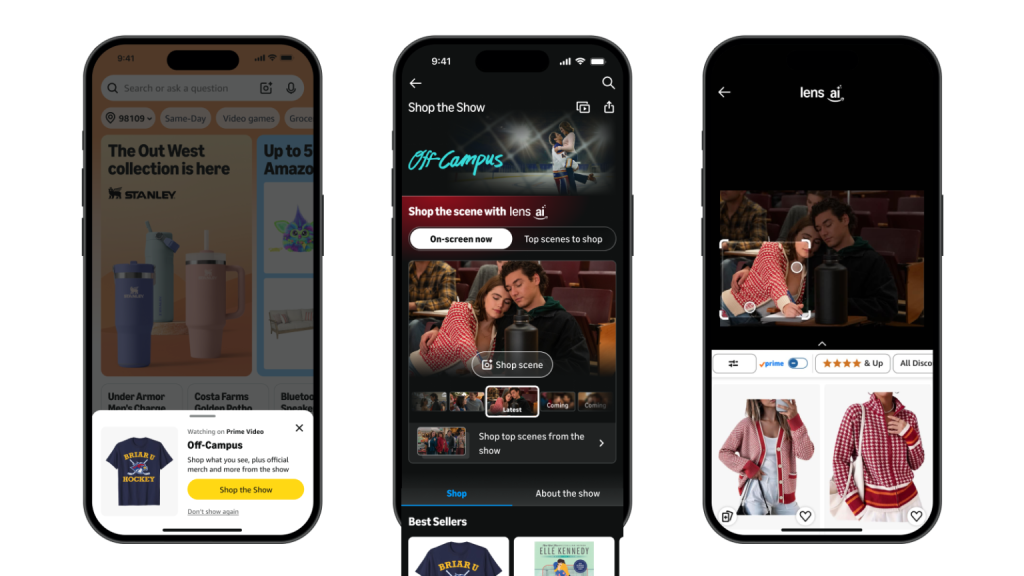
On September 10, Amazon expanded Prime Video’s Shop the Show experience from roughly 1,300 titles to more than 8,000 in the United States. It also added shopping directly into Prime Video’s X-Ray experience. But the more consequential addition is Shop the Scene, a new feature available across more than 600 titles that uses Amazon Lens to help viewers find products inspired by individual moments they are watching.
“We are making it easier than ever for Prime Video customers to shop what they see on screen,” Michelle Rothman, vice president of Prime Video shopping, said in announcing the expansion.
That explains the feature. It does not fully explain the play.
Shop the Scene changes what an image on television can become.
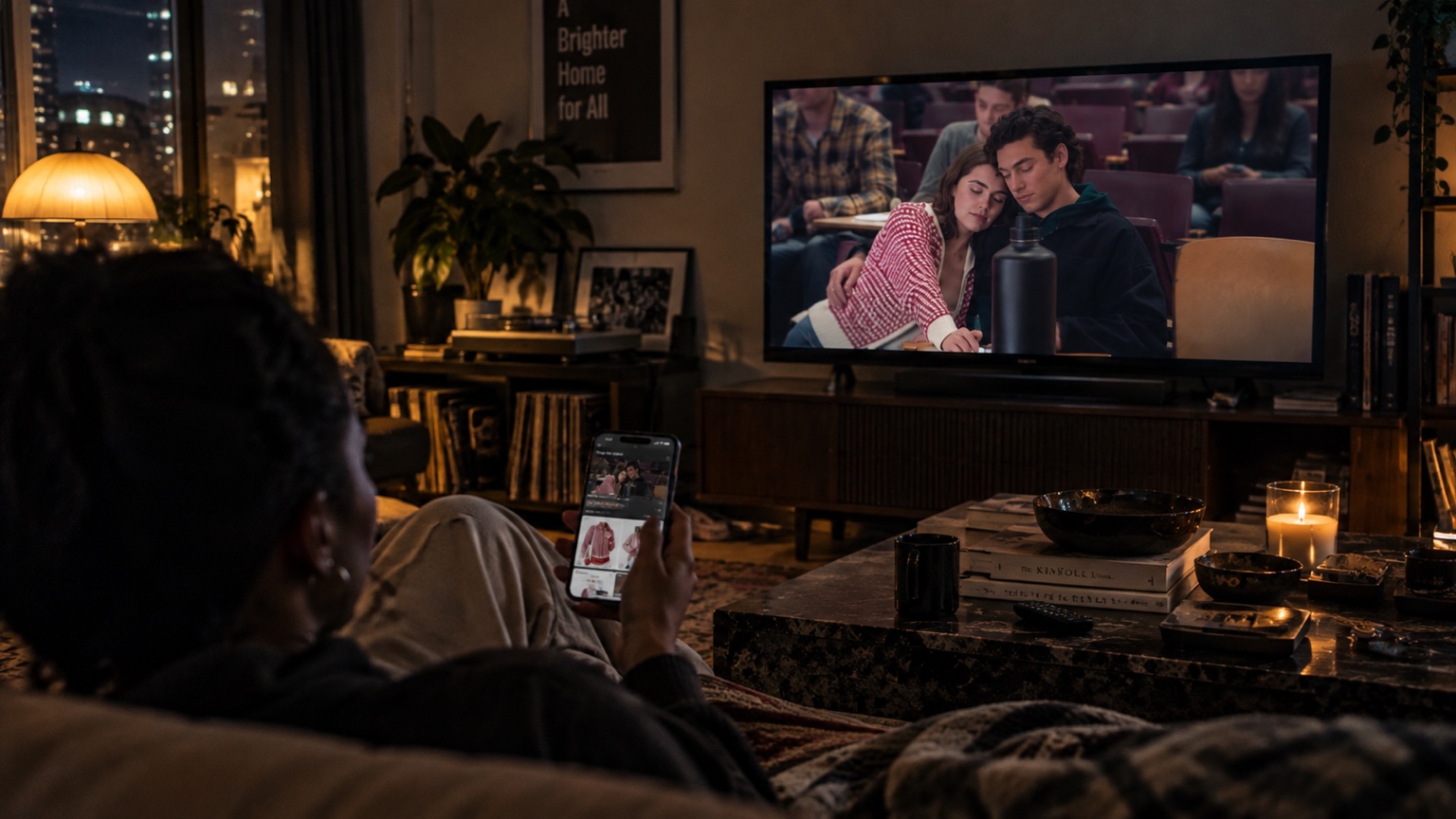
Amazon uses Off Campus as its example. A viewer notices a sweater Hannah is wearing. They open the Amazon Shopping app, which recognizes the Prime Video program playing and brings them into its storefront. The viewer selects the scene, Amazon Lens surfaces similar products, and something that began as a costume inside a television series becomes the beginning of a shopping journey.
The distinction between the same product and a similar product is important. Amazon is not promising that it can sell viewers the exact sweater, chair or lamp appearing in every scene. Its language is deliberately broader: Shop the Scene identifies products “inspired by” outfits, home décor and other objects on screen and can surface similar items through Amazon Lens.
That limitation may actually reveal why the technology matters.
Amazon does not necessarily need to sell the thing on the screen. It needs to understand what made you want it.
If a viewer likes a red patterned cardigan, Amazon can potentially find another red patterned cardigan. If someone notices a lamp behind a character, the commercial opportunity does not necessarily disappear because that exact lamp is vintage, custom-made or unavailable on Amazon.
The image has already communicated what the viewer wants.
Amazon can turn that interest into a search.
And underneath what appears to be a simple shopping feature is a much more sophisticated AI system.
AWS says scene detection for the experience is handled through Prime Video’s X-Ray system built with Amazon Bedrock. Shop the Scene receives frames from X-Ray and uses them as entry points into the Amazon Lens AI flow for product matching. AWS AppSync helps keep the television and second-screen experience synchronized.
That means the viewer does not necessarily have to know what something is called.
They only have to see it.
For years, the journey after that moment belonged to several different parts of the internet. Someone sees a jacket in a movie, searches Google for it, finds a fashion account or article identifying it, visits a retailer and eventually purchases something. Cultural influence may begin with the entertainment, but commercial intent can move through search engines, social platforms, publishers, creators and retailers before anybody gets paid.
Amazon is attempting to compress that journey.
See something. Find something like it. Buy it.
Few companies are positioned to make that compression as meaningful as Amazon because Prime Video is only the beginning of its relationship with the viewer. Amazon also operates the marketplace where products can be discovered, the shopping account where a transaction can happen and, for many purchases, the fulfillment system that eventually brings the product to the customer’s door.
The company is simultaneously building from the other direction.
In May, Amazon Ads introduced Dynamic TV Creative, technology that automatically personalizes interactive advertisements running on Prime Video according to signals including shopping and browsing behavior, Prime Video engagement, product availability and where Amazon believes someone sits in the purchase journey. Calls to action can change between options including “Add to Cart,” “Send to Phone,” “Save to Cart” and “Visit Brand Store.”
“Historically, video ads have been about casting a wide net,” Sarah Iooss, director of Global Agency & Global Twitch Ads, said when Amazon introduced the technology. “With new dynamic creative in our Interactive Video Ads, we can share the right message to the right viewer, based on actual shopping behavior.”
Shop the Scene and Dynamic TV Creative are different products. Amazon has not announced that advertisers can pay to determine which products Lens returns from a scene, and there is no basis for claiming that ordinary objects appearing inside Prime Video programming have suddenly become paid product placements.
That boundary matters.
But so does what is happening on either side of it.
Amazon is using commerce information to make advertising inside streaming television more actionable. At the same time, it is using visual AI to make objects inside the entertainment itself discoverable as commerce.
The screen is becoming the bridge between the two.
Amazon says its interactive video advertising has produced four times more add-to-cart actions and five times higher purchase rates than standard streaming television campaigns without interactive features. Those figures come from Amazon’s own study of 14,518 campaigns and should be understood as company-reported results, but they demonstrate why reducing the number of steps between seeing something and acting on it is commercially valuable.
Shop the Scene extends that idea beyond the advertisement.
Movies and television have always influenced consumption. A character’s clothes can change fashion. A beautifully designed television home can influence interiors. A sneaker, handbag, coffee maker or chair can become desirable simply because culture gave it context.
Traditionally, commerce waited downstream for the audience to do something about that desire.
Visual search changes the relationship.
Consider what happens to an older movie in this system. Someone discovers it years after release and notices a chair in an apartment. Amazon does not necessarily need the original manufacturer to still produce that chair. It does not need a new advertisement inserted into the movie. If Lens can understand what the viewer is looking at and find visually similar products available today, an old piece of entertainment can generate new product discovery without changing a frame of the original work.
That potentially gives a streaming catalog another kind of commercial value.
A movie or series does not have to create value only because someone subscribes to watch it, because advertising surrounds it or because the title itself generates merchandise. The objects and aesthetics already embedded within the entertainment can become pathways into a marketplace.
That is different from traditional product placement.
Product placement monetizes the decision to put a particular product into entertainment.
Visual commerce can monetize the curiosity created by what is already there.
Amazon did not invent shoppable television. Other streaming platforms, television manufacturers and advertising companies have spent years experimenting with ways to connect viewing and purchasing. Being first is not the important advantage here.
Owning so many of the steps that happen afterward is.
Prime Video supplies the entertainment. X-Ray understands the moment. Bedrock supports scene detection. Amazon Lens handles visual product matching. Amazon Shopping supplies the marketplace. An existing Amazon account can complete the transaction.
What once required several companies and several decisions can increasingly happen inside one company’s system.
That is why Shop the Scene should not be reduced to a feature that lets viewers dress like their favorite television characters. Fashion is simply an easy demonstration of something larger.
A jacket can become a search.
A lamp can become a search.
A chair can become a search.
An object sitting quietly in the background can become a search.
Anything on screen capable of creating curiosity can potentially become the beginning of commerce.
And that changes what Prime Video can represent inside Amazon. The service is not only a destination where Amazon competes for people’s attention. It can increasingly become a discovery layer sitting above the company’s much larger commerce business.
Amazon is therefore asking a more consequential question than whether someone wants to buy a sweater they saw on television.
What if everything you see could become something you shop?
For generations, culture created desire and commerce waited downstream for people to act on it.
Amazon is trying to meet them at the moment the desire begins.
Related Posts

Saudi Arabia’s Ambitious Leap into the Gaming Industry: A Vision for Powerhouse Status
In recent years, Saudi Arabia has set its sights on becoming a formida

United Partners with SpaceX to Revolutionize Inflight Wi-Fi with Starlink
Inflight Wi-Fi Revolution Now Arriving: United Signs Starlink Deal.

WEBTOON Is Using AI to Turn Comics Into Interactive Worlds
From Reading Characters to Interacting With Them

Celine and Master & Dynamic Unveil Opulent Headphones, Elevating the Auditory Experience
Celine and Master & Dynamic collaborate

Gentle Monster Unveils Avant-Garde Las Vegas Flagship at Caesars Palace
Gentle Monster unveils exciting Las Vegas store experience.