

Amazon’s Ring Is Moving Home Security Beyond Fixed Cameras With Autonomous Drones
By DaMarko GianCarlo
For years, the home security camera has operated on a simple principle: place it where something might happen and wait. A camera watches the front door. Another monitors the driveway. A third sits inside the house, pointed toward a hallway or living room. Each offers visibility, but only within the boundaries of its lens.
Amazon’s Ring is now attempting to change that relationship between the camera and the space it protects.
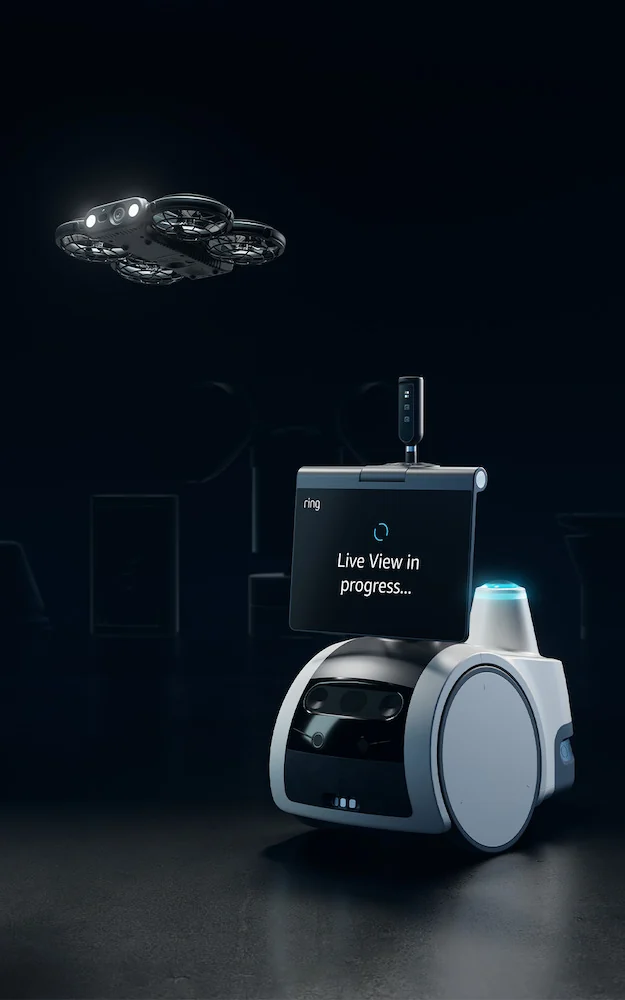
On November 10, 2026, Ring announced Ring Robotics, a new category of autonomous security devices designed to move through homes and businesses rather than remain mounted in one location. The introduction includes the Ring Drone Cam, a flying indoor security camera, and the Ring Rover Cam, a wheeled robot developed for commercial properties. Both use artificial intelligence to navigate their surroundings, follow programmed routes, and investigate activity detected by connected security devices.
The announcement represents a significant expansion of Ring’s business. The company that helped make video doorbells a familiar part of residential security is now developing systems capable of moving toward an event rather than waiting for that event to enter a fixed camera’s field of view.
That distinction is the center of the story.
“For years, customers told us they wanted eyes in the places a fixed camera couldn’t reach,” said Jamie Siminoff, Ring’s founder and chief inventor, in the company’s announcement.
The challenge, according to Siminoff, was not simply installing additional cameras. It was reconsidering what a security device could do. Ring’s answer is mobility.
The Ring Drone Cam is designed to operate inside a home, taking off from its charging station to follow routes established by its owner. A homeowner can schedule a patrol, initiate a flight through the Ring app, or configure the drone to respond when a compatible Ring camera, sensor, or alarm detects activity.
Consider a home with a security sensor installed near a rear entrance. Under a conventional setup, the sensor can notify the homeowner that something has happened, but determining what caused the alert may require a separate camera positioned nearby. Ring’s proposed system allows the drone to travel to a designated location and provide a view of the area.
The device captures 2K video, has a 148-degree field of view, and can rotate to provide a 360-degree perspective. Two built-in LED lights support recording in low-light conditions. Ring says the camera remains off while the drone is docked and activates when a flight begins.
The drone’s movement is managed by AI Pilot, a navigation system developed by Ring that combines camera information, specialized visual models, onboard sensors, and cloud processing.
During setup, the homeowner carries the device through the property so the system can create a floor plan and identify potential patrol locations. Once those points have been established, AI Pilot determines a route and adjusts the drone’s movements around obstacles such as furniture.
This is where the technology begins to separate itself from traditional connected cameras.
A conventional camera can recognize movement within its field of view and generate an alert. Ring’s autonomous system is designed to use information from its surroundings to move toward a location where additional visual information may be needed.
It is a shift from stationary observation toward automated investigation, although the drone’s movements remain limited to its programmed routes, navigation capabilities, and available battery power.
The idea itself is not entirely new.
Ring first introduced the concept of a flying indoor camera in 2020 with the Always Home Cam. The product attracted attention for its unusual approach to residential surveillance, but it never reached a broad commercial release. The new Drone Cam revisits that ambition with a redesigned device and a navigation system that relies more heavily on cloud-based processing.
That history is important because it separates technological ambition from commercial execution.
Ring has demonstrated a functioning version of the new drone, and journalists attending the November launch observed it flying through a controlled indoor environment. However, independent testing across ordinary households, different floor plans, and unpredictable conditions remains limited.
The Verge reported that the device can fly for approximately five to eight minutes per charge and depends on a working Wi-Fi connection for navigation. If that connection is lost, its ability to continue operating is restricted. The demonstration also did not establish how reliably the drone would navigate every obstacle or household situation.
Those limitations matter for a product being positioned as part of a security system.
A device that can investigate an alert provides a potentially useful additional perspective. But a short flight window, charging requirements, and dependence on connectivity mean it cannot simply be treated as a replacement for continuous surveillance.
Ring is nevertheless building a broader business around the underlying technology.
Alongside the residential drone, the company introduced the Ring Rover Cam, an autonomous wheeled security robot designed for commercial spaces. The Rover can travel between programmed locations, conduct patrols, and investigate disturbances detected by connected devices.
It includes a height-adjustable camera system for viewing over counters and shelving, a siren, a light tower, and two-way audio. Unlike the residential drone, which is designed for brief indoor flights, the Rover is intended to move across business environments such as retail floors, storage areas, and corridors.
The Rover also records and streams video at resolutions up to 4K while moving, allowing users to review activity encountered along its route.
Together, the two devices establish that Ring’s announcement is not limited to a single experimental consumer product. Amazon is introducing a shared autonomous navigation platform across residential and commercial security applications.
The business implications extend beyond the hardware.
Ring’s existing ecosystem includes cameras, doorbells, alarms, sensors, and a mobile application through which customers manage their devices. Autonomous cameras add another capability to that system, allowing connected products to initiate a physical response within a property.
A sensor detects activity. The system identifies a programmed destination. A mobile camera travels to that location and provides additional visual information.
For Amazon, that creates an opportunity to make its security ecosystem more interconnected while introducing new hardware and subscription-dependent capabilities.
Both devices operate through the Ring platform, and certain features require a compatible Ring Protect subscription. The Drone Cam is priced at $249.99, with U.S. shipments scheduled to begin January 27, 2027, while the $999.99 Rover Cam is scheduled to begin shipping in the United States on December 16, 2026.
The residential drone has not yet received the required authorization from the Federal Communications Commission. Ring’s published availability date therefore remains contingent on regulatory clearance.
That distinction is essential. Amazon has announced a commercial strategy and demonstrated working technology, but the residential product has not yet established a record of everyday consumer performance.
There is also a more personal question surrounding the technology.
A stationary camera allows homeowners to make relatively deliberate decisions about which areas of their property are monitored. A flying camera introduces the possibility of capturing images across multiple rooms, depending on the routes selected and the device’s operation.
Ring says its drone records only during flights and remains powered down in its dock. The company also says its new Throw Away the Key encryption system is designed to provide stronger protection for recorded video.
Those safeguards are part of Ring’s stated privacy approach. They do not eliminate the need to examine how household maps, cloud-based navigation, recordings, and access permissions are managed.
The technology may provide homeowners with more flexibility, but it also places new responsibilities on the company developing the system and the people choosing to operate it.
Questions about privacy, consent, and the handling of recorded information become particularly relevant when cameras can move through spaces occupied by family members, visitors, and household workers.
These are not reasons to dismiss autonomous security. They are considerations that accompany its expansion into private environments.
The larger development is that Amazon is making an identifiable business decision in real time.
Ring is investing in autonomous security as an extension of its established camera and alarm business. It has introduced two products, developed a shared navigation system, announced prices, and established intended commercial release dates.
What remains unknown is how consumers and businesses will respond once the devices become available, whether the technology will perform consistently outside controlled demonstrations, and how competing security companies will react.
Those outcomes have not yet occurred.
But the decision itself has.
For more than a decade, connected home security has largely been defined by the ability to see and receive alerts from a distance. Ring Robotics introduces another possibility: a security camera that can physically move to gather information after something happens.
Amazon has not established that autonomous drones will replace fixed cameras, nor has it demonstrated that every home needs one. What it has done is move beyond the traditional camera’s stationary design and commit to bringing mobile, AI-guided security devices into its product ecosystem.
The next chapter will be determined by regulatory approval, real-world performance, consumer trust, and adoption.
For now, the development is clear.
Amazon is no longer approaching home security exclusively as a question of where cameras should be placed. With Ring Robotics, it is asking where those cameras should be able to go.
Related Posts

Fueling Life Science Innovation: University Lab Partners Secures $2M for Accelerating Scalable Ventures
by Genesis Graves University Lab Partners (ULP), a leading nonprofit w

CINEMAGNUM Isn’t Just Building the World’s Largest Cinema LED Screen—It’s Building the Kind of Experience Streaming Can’t Recreate
Streaming Changed the Rules. Theaters Are Changing the Experience.
Goldtouch: Leading the Charge in Ergonomic Desktop Technology
Goldtouch Launches Elite Adjustable Ergonomic Keyboard

SOLiTHOR Breaks New Ground with Advancements in All-Solid-State Lithium Battery Technology
SOLiTHOR, a groundbreaking company in the field of solid-state lithium

Microsoft Appoints Sarah Bond as President of Xbox, Marking a Historic Moment for Diversity in Gaming Leadership
By DaMarko Webster In a groundbreaking move, Microsoft has taken a sig

Safe-Living Introduces the Pioneering Plug & Play Contactless Home Emergency Detection System at ces2024
Incorporating cutting-edge AI technology and a proprietary radar desig
POST COMMENT