

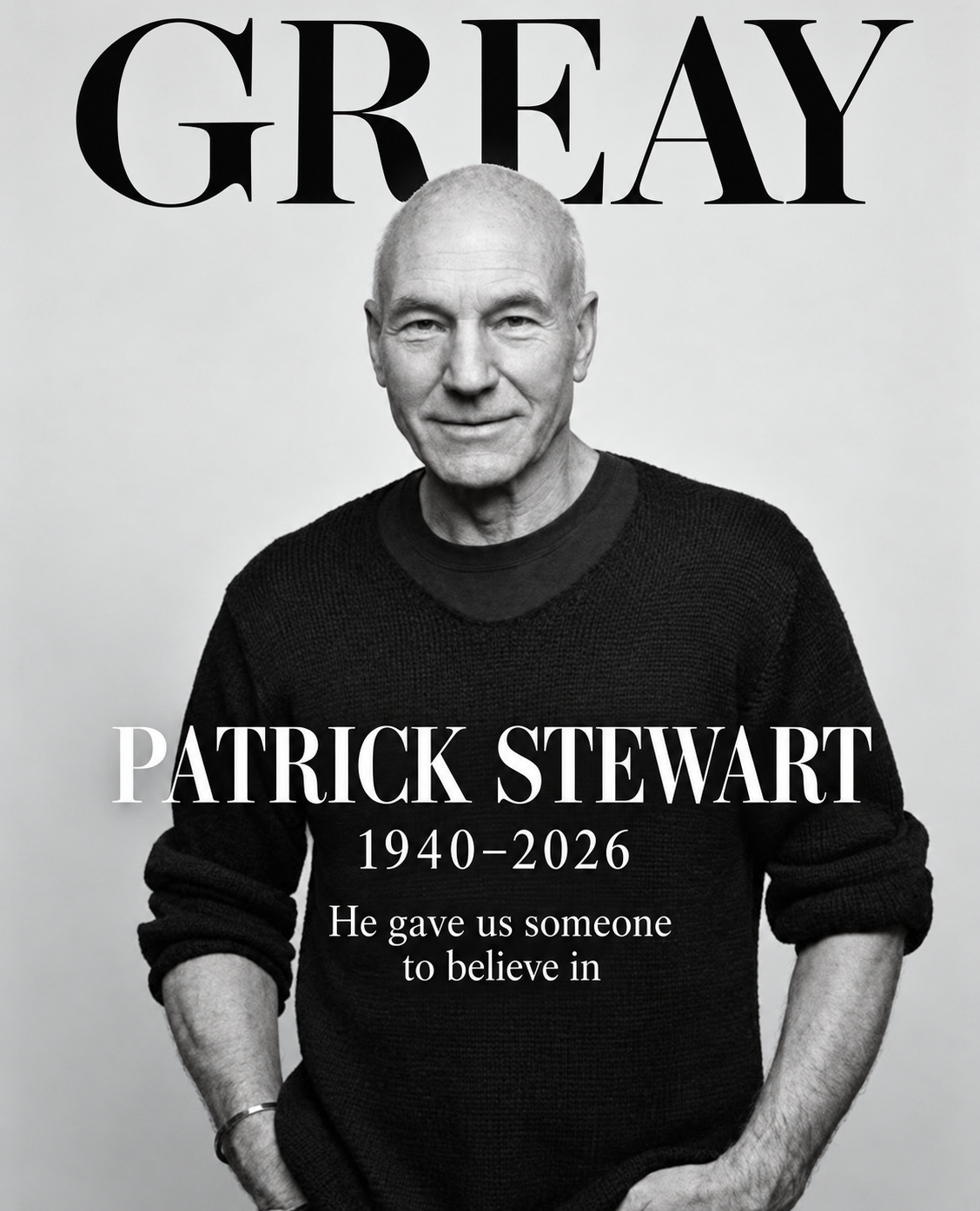
Patrick Stewart Gave Us Someone to Believe In
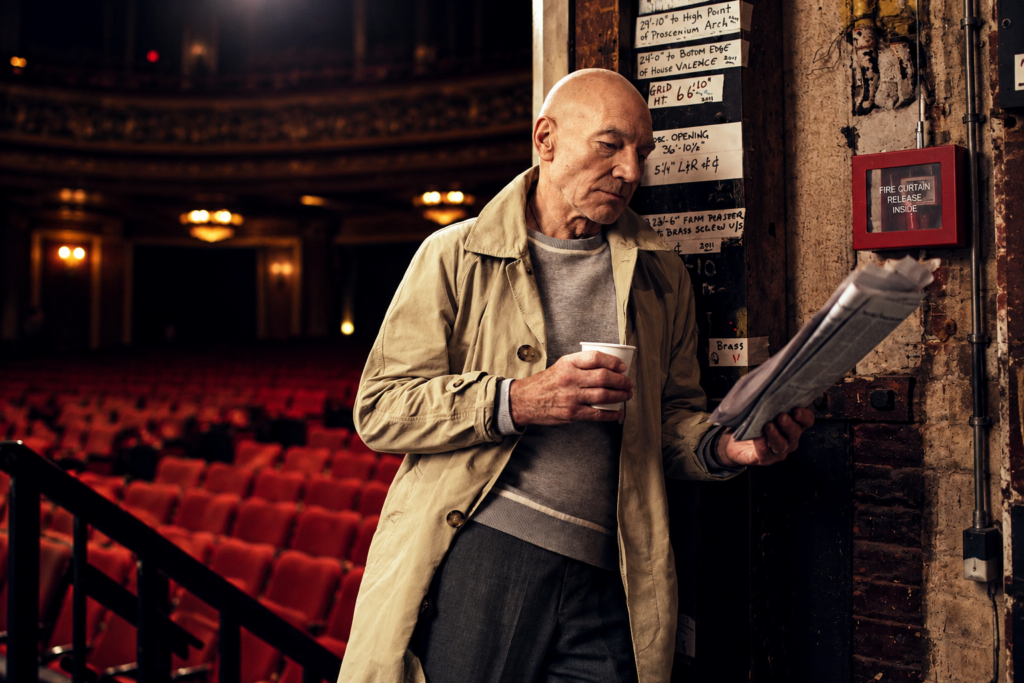
By DaMarko GianCarlo
Long before Patrick Stewart’s voice became familiar to millions, he listened to his father’s voice to discover what kind of evening lay ahead. He could hear him singing on the way home, Stewart recalled in a 2023 interview with the Folger Shakespeare Library. Depending on the song, the family could anticipate an enjoyable evening or prepare for something frightening. A boy learned to recognize the difference before the door opened.
It is a difficult memory to place beside the man audiences came to know: composed, articulate, capable of making a room seem steadier simply by speaking. Yet both belong to his life. Stewart spent decades developing the voice that made him famous and learning to speak about the childhood he once concealed. The assurance audiences recognized had a history they could not necessarily hear.
Sir Patrick Stewart died at his home in Los Angeles on October 28, aged 86. His death was announced the following day in a statement shared on his social media accounts, which disclosed Alzheimer’s disease and Lewy body dementia. His wife, the musician Sunny Ozell, was with him. The announcement described family, friends, music, and laughter surrounding his final days, returning an internationally recognizable figure to the intimate scale of a person being loved.
Among the recollections that followed, Seth MacFarlane’s offered a revealing glimpse behind the confidence. MacFarlane, who worked with Stewart on projects including American Dad!, remembered exchanging emails with him as Stewart began a film. The veteran actor confessed that arriving on a new set still made him feel like the least experienced person there. Even after everything he had accomplished, the beginning of a job could expose the uncertainty beneath his preparation. The people watching saw authority. The actor still had to find his way into the work.
Born in Mirfield, Yorkshire, in 1940, Stewart grew up in a home without hot running water or an indoor toilet. His childhood speech carried a highly local accent and dialect. He later recalled being told that pursuing acting seriously would require learning another way of speaking. Practicing it brought the risk of mockery from friends who heard him trying. The voice eventually associated with distinction required deliberate work, and changing it meant negotiating the expectations of the place he came from.
His English teacher, Cecil Dormand, helped him discover what that voice might do. Given Shakespeare to read aloud, Stewart responded to its sound and rhythm before he fully understood the language. He remembered the sensation of the words in his mouth. A teacher had placed something demanding within his reach and expected him to participate. That expectation helped open a life.
Acting also offered somewhere to direct feelings he could not easily explain. “I found more safety on the stage than I had experienced elsewhere,” he recalled in a 2023 Esquire interview. A role allowed him to enter another person’s circumstances and be seen on different terms. The stage became a place where attention and imagination could briefly change the conditions of his existence.
He trained at the Bristol Old Vic Theatre School and joined the Royal Shakespeare Company in 1966. Decades of professional work preceded the international recognition that television would bring. By the time American audiences encountered him as Captain Jean-Luc Picard in 1987, he was already a mature actor. What looked like an arrival was the result of years spent learning how to hold an audience’s attention.
The theater remained a continuing part of his life. In 1991, his solo adaptation of A Christmas Carol opened on Broadway, with Stewart carrying Dickens’s many characters himself. The production earned him a Drama Desk Award. It offered a concentrated demonstration of the craft beneath his screen presence: an actor could create a populated world through changes in voice, movement, and attention, provided the audience trusted him enough to follow.
His return to Shakespeare could also complicate the authority viewers associated with him. In Gregory Doran’s 2006 Royal Shakespeare Company production of Antony and Cleopatra, opposite Harriet Walter, Stewart played a soldier whose political standing and private desires could no longer be comfortably reconciled. The company’s account remembers an Antony at ease among his comrades and resentful of his rival. Here, command was vulnerable to appetite, pride, and attachment. His theatrical work kept room for people who used power badly or could not govern themselves.
That range matters because Picard’s cultural stature can make Stewart’s career seem narrower than it was. Star Trek: The Next Generation, which premiered in 1987, gave him an extraordinary audience. It also required adjustment. He later acknowledged bringing too much stage technique into his early performance. The character’s eventual ease developed through the practical work of television and an ensemble learning how to function together. The apparently inevitable captain was once a performance in progress.
Over seven seasons, Stewart made Picard’s intelligence dramatically compelling. He could listen as though an answer might alter his judgment. A pause suggested that a decision would have consequences after the scene ended. His rank gave him permission to command; his performance made us believe he felt responsible for explaining why.
In “The Measure of a Man,” written by Melinda M. Snodgrass, Picard defends Data against a proceeding that could classify the android officer as property. Stewart makes a question of personhood immediate. An institution’s desire to study something useful cannot settle whether it has the right to dismantle someone. His delivery gives reasoning emotional force, allowing the audience to experience an argument as an act of protection.
The series also exposed what command could not resolve. In “Family,” Picard returns home after his assimilation by the Borg, carrying trauma that cannot be dismissed through discipline. Stewart lets the distress break through his composure. The captain remains recognizable, but the audience sees what maintaining that recognizable self can cost. Vulnerability becomes part of his stature.
For viewers growing up with him, Picard could become part of an education in adulthood: someone who considered consequences, defended another person’s dignity, and remained capable of being hurt. Returning years later could change which qualities seemed most remarkable. The confidence that impressed a child might give way to an adult’s appreciation of restraint, or the difficulty of admitting that something had become unbearable.
Charles Xavier brought Stewart into another enduring story about power and belonging. In the X-Men films, his authority took a more explicitly educational form. Xavier offered younger people a place to understand abilities that could make them frightened of themselves and threatening to others. Stewart could suggest reassurance without removing the gravity of what they faced. He made guidance feel like an obligation assumed by someone who knew how much harm power could do.
In Logan, that relationship changed. Xavier himself required protection and care. Stewart’s performance allowed confusion, anger, dependence, and flashes of familiar clarity to coexist. Discussing the role with TIME in 2017, he explained that research for a stage production, including conversations with neurologist and writer Oliver Sacks, had helped inform his approach. The frailty was studied work. He sought to make the condition credible within a film whose premise could otherwise have kept suffering at a comfortable distance.
His own life was more complicated than the wisdom audiences found in those characters. In interviews surrounding his memoir, Making It So, Stewart discussed the breakdown of his first two marriages, his regrets, and difficulties within his family. He also described therapy as a sustained effort to understand his childhood and behavior. Success had not completed that work for him. An affectionate account of his life has to leave room for the distance between a persuasive performance and the imperfect person giving it.
His memories of his parents remained difficult to reconcile. He spoke lovingly of his mother and about the violence she endured from his father. Later, he tried to understand his father’s military experiences and psychological suffering. Yet he also acknowledged family recollections that complicated any explanation attributing the violence entirely to wartime trauma. Understanding more did not make every fact easier to accommodate.
Through his support for Refuge, the domestic violence charity, he gave those experiences a practical public consequence. Explaining why he became a patron, Stewart wrote, “I accepted for my mother.” The sentence carries the distance between what he could do as a frightened child and what he could contribute as an adult. He argued for places to escape, people able to intervene, and funding to sustain those services. His concern extended beyond telling his story to helping others survive theirs.
There was also pleasure in his life. His friendship with Ian McKellen deepened during X-Men through visits between neighboring trailers, tea, and wine during late work. Companionship accumulated through ordinary invitations. Away from the demands of the production, they enjoyed talking and being together.
Onstage, that trust could become play. Discussing their theatrical work in a 2023 Washington Post Live conversation, Stewart described the freedom of discovering something different each night. “No performance was ever quite the same,” he said. After decades in the profession, he still valued the possibility that someone standing opposite him could offer something unexpected.
His colleagues also remembered the humor behind the dignified image. In a statement following his death, Marvel Studios president Kevin Feige recalled discovering Stewart’s warmth and sharp wit after first knowing him as Picard. MacFarlane remembered a performer whose skill could improve the writing he was given. These recollections describe more than an admired face. They suggest what it meant to have Stewart at work: intelligence applied to other people’s material, experience shared, seriousness with room for laughter.
During the pandemic, he brought a quieter form of company into people’s homes by reading Shakespeare’s sonnets on Instagram. A practice that had begun with a teacher asking a schoolboy to speak aloud became a way of reaching people during isolation. The scale was modest—a poem, a familiar voice, a few minutes of attention—but it suited his gift. He could make language feel like an encounter.
At 83, he remained curious about the person behind the performances. Asked by WIRED about himself, Stewart answered, “That’s truly a work in progress.” The admission keeps his later life open. There were relationships to consider, experiences to understand, and possibilities that continued to interest him. He had lived a long time without concluding that he had finished becoming himself.
His death ends that continuing discovery. The performances remain, but there will be no new choice from the actor who made them: another unexpected inflection, another character, another account of something he had come to see differently. For those who knew him, the absence belongs to a private world beyond the public record. They have lost someone whose company cannot be recovered by pressing play.
For audiences, grief may arrive while watching something familiar. An episode will recall the person who first sat beside us. A face will return us to a home we no longer live in. We may recognize how much time has passed since Stewart entered our lives, and how steadily his presence accompanied it.
His work will continue to offer pleasure and discovery. A scene will make someone laugh. An argument will become newly relevant. A small change in expression will reveal something that escaped an earlier viewing. There is more to encounter in what he left.
We will hear the voice again. We will know what comes next. And still, for a moment, we may find ourselves listening as though he were here.
Related Posts

Lunella’s Back! Marvel’s Moon Girl and Devil Dinosaur Season 2 Set to Premiere
Brains, Beats, and a Big Red Dinosaur


Garmin’s fēnix 8 Series: A Game-Changer for Multi-Sport Athletes
Garmin adds AMOLED displays to fēnix 8 Series.

Byron Allen Isn’t Buying Media Companies — He’s Building a Distribution Stack
The New Media Bundle Is Being Built in Plain Sight

Tory Burch Unveils Sublime: A Fragrance That Embodies Sensuality and Strength Starring KENDALL JENNER
KENDALL JENNER IS FACE OF NEW FRAGRANCE

Christian McCaffrey Named Madden NFL 25 Cover Star
San Francisco 49ers running back Christian McCaffrey covers Madden NFL
POST COMMENT