

WEBTOON Is Using AI to Turn Comics Into Interactive Worlds

Kyra Greene
For most of the history of comics, the relationship between a reader and a character has been remarkably straightforward. A creator builds the world. The reader enters it. The issue ends, the book closes, and the audience waits for the creator to open the door again.
WEBTOON is beginning to test what happens when that door never completely closes.
Across 2026, the company has been introducing artificial intelligence into different parts of its platform. Viewed separately, they can look like unrelated product experiments. AI-powered translation can help independent comics cross language barriers. Character Chat lets readers communicate with fictional characters. byUs allows fans to step into existing stories and explore different scenarios. WEBTOON’s partnership with Genies is designed to turn creator-approved characters into interactive 3D personalities.
Put those pieces together, however, and a much larger strategy begins to emerge. WEBTOON isn’t simply adding AI to comics. It is using AI to change what can happen around a comic after someone has finished reading it.
WEBTOON has been increasingly explicit about that ambition. Spokesperson Kiel Hume described the company’s approach as using AI to “move beyond simple reading” toward a different kind of interactive fandom experience. Suddenly translation, Character Chat, byUs and interactive avatars stop looking like isolated features. They begin to look like parts of the same system.
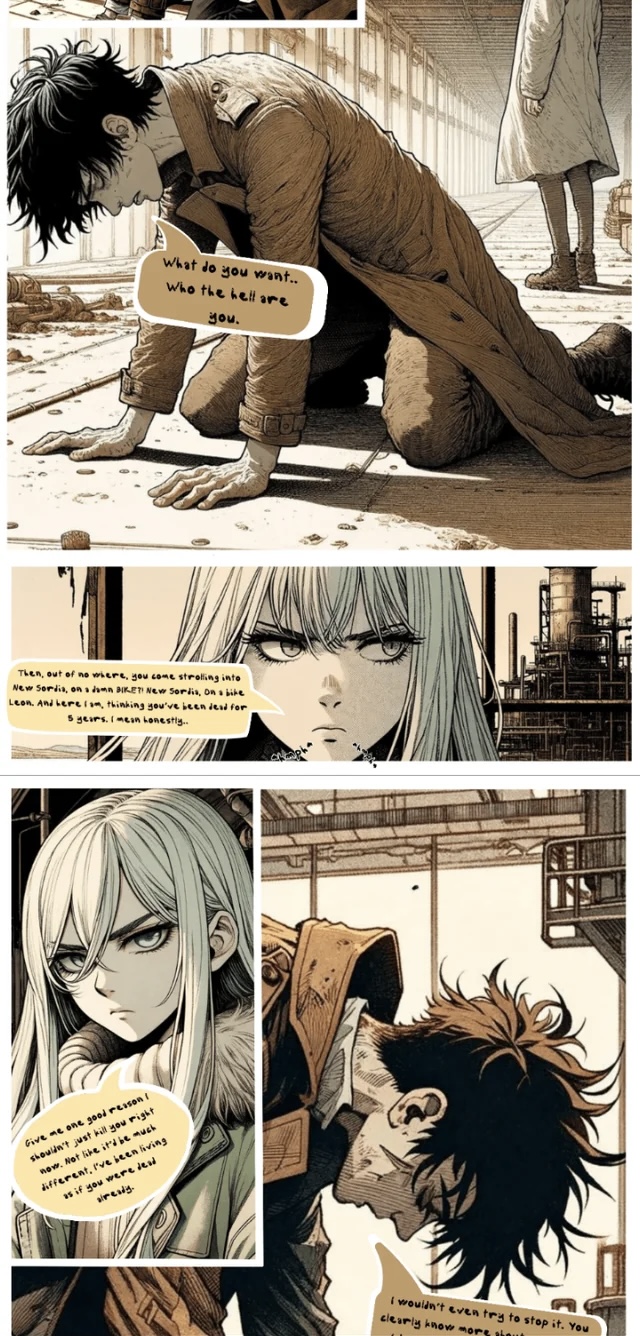
byUs provides one of the clearest examples. Introduced in Korea, the AI-powered interactive story-chat service works with official stories and creator approval. Readers can enter narratives and influence how an experience develops, or explore settings and situations that were never shown in the original work. Instead of only watching a fictional character make decisions, the reader can participate in an experience constructed around that character.
The first results are limited enough that they shouldn’t be mistaken for proof of how audiences will behave across the entire platform. But they are notable. WEBTOON reported that after byUs launched with Ctrl+Alt+Resign, readership of the original comic increased approximately 67 percent during its first week, while new readers more than doubled compared with the previous week. WEBTOON describes services such as byUs as moving the platform from a “one-way reading experience toward an interactive one.”
The most interesting part of that experiment isn’t simply the 67 percent.
It is where those people went.
They went back to the comic.
WEBTOON has reported a similar pattern around Character Chat, its AI-enabled service that lets readers communicate with participating characters. Since launching in Korea in 2024, the company says approximately 6 million users have exchanged more than 230 million messages through Character Chat. When the feature was introduced around a character from Star Three Shop, WEBTOON reported that original episode views increased 97 percent when comparing the week before and after launch. Readers increased 29 percent, paying users rose 22 percent and total payment volume increased 44 percent.
Those are company-reported results around specific properties, not evidence that every comic will behave the same way. But WEBTOON doesn’t necessarily need interactive characters to replace reading for the strategy to work.
It needs interaction to create another entrance into reading.
A reader discovers a comic. The reader becomes attached to a character. The episode ends, but the relationship no longer necessarily ends with it. The reader can talk to the character, enter another version of the story, discover additional material and eventually return to the canonical work.
That changes what a comic can become as a product.
WEBTOON’s partnership with Genies pushes the idea further. Participating creators can extend their characters into interactive 3D avatars. Fans can interact with them, uncover additional lore and creator-developed backstories, and collect digital items connected to those characters. WEBTOON summarized the ambition with a revealing idea: “the story doesn’t end when the episode does.”
Entertainment companies have extended fictional characters beyond their original mediums for decades. A superhero can begin in a comic, move into television, become a movie, appear in a game and eventually exist across merchandise and other products. Traditionally, however, those experiences have been separated by different productions, companies, release schedules and screens.
WEBTOON is attempting to collapse some of that distance.
Reading can lead directly to interaction. Interaction can lead to discovery. Discovery can send someone back to the original story. And a deeper relationship with a character can eventually follow that character into another medium.
AI-powered translation addresses another part of that architecture: getting the story in front of more people in the first place.
WEBTOON’s CANVAS Translation Program is testing AI-powered localization for eligible independent creators. Its unified international CANVAS system supports seven languages, potentially allowing a creator publishing in one market to reach readers elsewhere without building a separate localization operation for every territory. The program is opt-in, and WEBTOON has positioned it as a way for creators to reach wider audiences while maintaining control over their work.
For a platform connecting millions of creators and readers around the world, language isn’t a minor inconvenience. It can determine whether intellectual property ever reaches its next audience.
But removing that barrier introduces one of the most important tensions in WEBTOON’s strategy.
Translation isn’t simply exchanging one word for another. Humor, rhythm, cultural references, emotional intention and character voice can all change when a story crosses languages. Manga translator Zack Davisson captured that distinction precisely: “When I translate a work, I don’t translate the words—I translate the emotions of the piece.”
That is something an automated system has to account for. The question isn’t merely whether AI can determine what a sentence means. It is whether it can preserve what the creator intended the reader to understand and feel.
And interactive characters introduce an even more complicated question.
If a human creates and writes a character, but an AI system can eventually generate thousands or millions of individual conversations in that character’s voice, where does authorship end and simulation begin?
That question becomes increasingly consequential the further a character travels beyond the panels its creator drew and the dialogue its creator actually wrote.
WEBTOON appears aware that creator control will determine how far this model can go. Its Genies program is opt-in. Creators retain ownership of their intellectual property. Character assets go through an approval process, and WEBTOON says creator artwork isn’t used to train Genies’ general-purpose models. President Yongsoo Kim has framed that boundary plainly: “Creators are the foundation of everything we do at WEBTOON.”
Those protections matter because AI creates a possibility fictional characters have never had at this level.
A character was once limited by how much of that character a human being could physically create.
AI potentially removes part of that limitation.
The creator may go to sleep.
The character does not have to.
That is where WEBTOON’s experiments become larger than another collection of technology features.
A platform no longer has to ask only whether someone will return next week to read another episode. It can ask whether that person will interact with a character tonight. Whether they will enter another version of the story tomorrow. Whether they will discover something new about its world. Whether those interactions deepen their attachment to the canonical work. And eventually, whether that relationship follows the intellectual property into television, film, games, merchandise or whatever comes next.
CEO Junkoo Kim has connected these pieces himself, describing WEBTOON as “leveraging AI to create more interactive experiences” while the company simultaneously increases its investment in intellectual property. In its investor materials, WEBTOON describes a broader strategy of expanding into interactive fandom and participation while trying to capture more of the long-term franchise value its stories create.
The architecture is becoming clear.
Story → discovery → translation → interaction → deeper fandom → original story → adaptation → back to the platform.
That is the play WEBTOON appears to be making.
And it is why focusing exclusively on whether AI will eventually replace comic artists risks missing the more immediate transformation happening around comics. WEBTOON’s system still depends on humans creating characters worth caring about. A creator establishes the world, personality, relationships, visual language and canonical story. Without that creative foundation, there is nothing meaningful for the technology to extend.
AI enters around that work.
It can help move a story into another language. It can allow a character to respond after an episode ends. It can let a reader explore another scenario. It can transform a two-dimensional character into an interactive avatar. And if WEBTOON’s early experiments continue producing the behavior the company has reported, those experiences can ultimately send audiences back toward the human-created work at the center.
For years, entertainment companies have built franchises by taking successful stories and spreading them across more formats. WEBTOON is testing something slightly different: whether AI can make the relationship with those stories continuous, filling some of the space between the things their creators actually publish.
If that works, the comic stops behaving only like a publication.
It becomes the entrance to a world.
And the next major transformation of digital comics may not come from teaching machines how to draw them. It may come from using AI to make sure the worlds humans draw never completely close.
Related Posts

Samsung TV Plus Isn’t Just Streaming Anymore — Dhar Mann Is Up First
Hollywood Built Networks. Platforms Are Building Ecosystems.
Hi Power Cycles and Warner Bros. Discovery Global Consumer Products Announce Limited-Edition Wayne Enterprises Electric Bikes
Hi Power Cycles Collaborate with Warner Bros. Discovery Global Consume

Formovie Unveils the Theater Premium: A Cutting-Edge 4K UST Projector with Enhanced Visuals and Audio
Formovie Unveils the Theater Premium: Step Into Epic Entertainment.

Reolink Launches Industry-First 2K 4MP Battery-Powered Doorbell with 1:1 Aspect Ratio, Redefining Smart Home Security
Reolink industry-first 2K 4MP Battery Doorbell with 1:1 Head-to-Toe Vi

Virtual Internet Unveils “Continuous Connectivity” with Virtual 5g
Virtual Internet, a pioneer in Software 5G (Fifth Generation) Mobile B

HyAxiom Unveils Groundbreaking Green Hydrogen Solutions for the First Time, Featuring High-Efficiency PEM Electrolyzer and Premier PureCell® Model 400 Fuel Cell
HyAxiom Unveils Groundbreaking Green Hydrogen Solution
POST COMMENT