

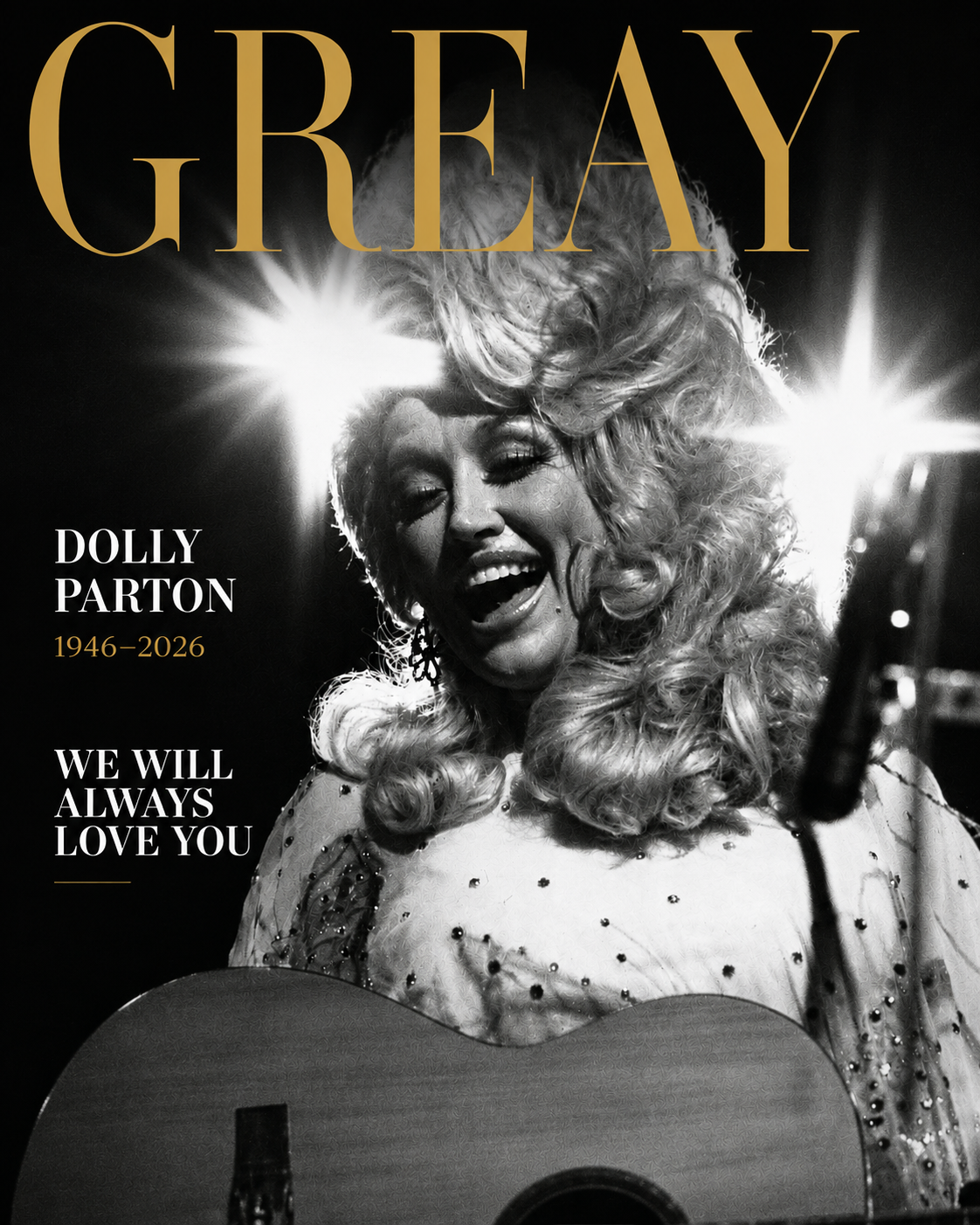
Dolly, We Will Always Love You
By DaMarko GianCarlo
There are famous people, and then there are people who become part of the emotional architecture of a country. Dolly Parton became something even rarer. She became Americana.
Not Americana as costume. Not the flag printed across a T-shirt, the old pickup truck beside a barn, the diner counter, the front porch or some polished version of small-town America designed to make the past seem simpler than it was. Dolly represented something deeper. She carried the contradictions, ambitions, wounds, humor, faith, commerce, invention and possibility of America inside a single life.
She was born poor and became extraordinarily wealthy. She grew up in the mountains of East Tennessee and became recognizable around the world. She sang in church and eventually became beloved by people who might never enter one. She constructed a public image so exaggerated that it bordered on caricature, yet somehow became one of the most authentic figures in American culture. She understood capitalism well enough to protect her intellectual property and generosity well enough to use what that ownership produced to improve lives she would never personally know.
When Dolly Parton died on August 25, 2026, at 80 years old, something happened that has become increasingly difficult in America: people agreed about something. They loved Dolly. The affection crossed generations, geography, class and politics. Country music claimed her, but country music had stopped being large enough to contain her decades ago.
The easy explanation is that Dolly was nice. The more interesting explanation is that she spent a lifetime demonstrating that being deeply rooted somewhere did not require rejecting everyone who came from somewhere else.
That began long before the rhinestones.
Dolly Rebecca Parton was born in 1946, one of 12 children. Her family had little money. Her father, Robert Lee Parton, worked relentlessly but could not read or write. Her mother, Avie Lee, filled their home with music and stories. Around the age of six, Dolly wrote a song about a corncob doll. Her mother wrote the words down and kept them.
It is a tiny moment inside an enormous life, but perhaps it explains more than it initially appears to. Before Nashville, before Hollywood, before the Grammys, before Dollywood, before anyone believed Dolly Parton’s words had monetary value, her mother heard something her daughter had created and decided it was worth keeping.
Dolly would spend the rest of her life understanding the importance of that distinction: knowing what to keep and knowing what to give away.
Her childhood gave her much of the material. Her mother made her a coat from scraps of fabric, something Dolly experienced as an act of love before other children taught her to see it as evidence of poverty. They laughed at her. Years later, she transformed that memory into “Coat of Many Colors.” The instinct would repeat throughout her life. Dolly rarely erased the things that could have embarrassed her. She repurposed them. Poverty became songwriting. Her accent became identity. Being underestimated became leverage. Heartbreak became intellectual property. Her father’s illiteracy became books.
Even the visual construction of Dolly Parton came from a place respectable society might have told her to reject. She remembered seeing a woman in her Tennessee hometown with tight skirts, high heels, red nails, red lipstick and peroxide hair. Adults called the woman trash. Dolly thought she was beautiful.
Success did not cause Dolly to replace that little girl’s definition of beauty with somebody else’s definition of taste. She gave the girl’s imagination a budget.
The hair got higher. The clothes got tighter. The rhinestones multiplied. Yet somehow, the more deliberately artificial the exterior became, the more authentic the person underneath it seemed. Dolly understood the difference. The image was something she constructed, played with and controlled. What looked excessive from the outside was also an extraordinary act of self-definition.
People could notice the body first. They could make the blonde jokes. They could hear the laugh and mistake warmth for naïveté. Dolly didn’t have to spend her life correcting every person who underestimated her. She could let them look at the construction while she continued writing, negotiating, owning and building underneath it.
One of the clearest demonstrations of that instinct came through the song that now feels impossible to separate from her death.
“I Will Always Love You” was originally a goodbye to Porter Wagoner. His television show had given Dolly an enormous platform, but after years working alongside him, she understood that gratitude could not become permanent dependency. She needed to discover what Dolly Parton could become without standing beside someone who had helped introduce her to the world. When words weren’t enough to make Wagoner understand why she needed to go, she did what she had been doing since she was a little girl.
She wrote a song.
The relationship ended. The song remained.
Then Elvis Presley wanted to record it.
For a songwriter from Tennessee, Elvis singing one of her compositions could have represented the kind of validation that made every earlier struggle feel worth it. Dolly wanted it to happen. But Colonel Tom Parker wanted a substantial share of the publishing rights. Dolly refused. She was heartbroken, but she understood that the copyright was among the most valuable things she possessed and something she intended to leave to her family.
That wasn’t merely a smart business decision. Dolly understood that being chosen by someone powerful was not necessarily more valuable than owning what you created.
Then came Whitney Houston.
In 1992, Houston recorded “I Will Always Love You” for The Bodyguard, and the song became something neither its writer nor its original recording could have predicted. A composition written by a white woman from the Tennessee mountains traveled through the voice of a Black woman raised in Newark and gospel music and became one of the defining recordings in popular culture.
Dolly wrote the words. Whitney found something else inside them. The silence at the beginning. The restraint. Then that voice.
And because Dolly had protected the publishing, Whitney’s extraordinary interpretation created extraordinary wealth for the woman who had written it.
Years later, Dolly connected money generated by Whitney’s recording with her Nashville office complex in what was then a predominantly Black area. She spoke warmly about the connection and called it “the house that Whitney built.”
The Elvis story and the Whitney story belong beside one another because together they reveal something more sophisticated than Dolly simply being a good businesswoman or a generous person.
She knew what belonged to her without believing everything belonged to her.
She protected the song when surrendering part of it was the price of having Elvis sing it. But when another artist’s brilliance transformed that song into something larger than Dolly herself had made it, she understood that transformation deserved acknowledgment too.
One woman wrote it. Another woman transformed it. Tennessee met Newark. Country met gospel. White American songwriting and Black American vocal tradition occupied the same piece of music.
That is Americana too.
America has always been created through collision and exchange: rural and urban, Black and white, sacred and secular, inherited traditions and invented ones. Those exchanges have sometimes been beautiful and sometimes exploitative. Often, American culture has emerged from the uncomfortable space between the two.
Dolly and Whitney gave us one of the beautiful ones.
The same instinct to remember where something came from appeared elsewhere in Dolly’s life. Her father couldn’t read or write. Dolly never interpreted that as a lack of intelligence. She called him one of the smartest people she had ever known. What troubled her was understanding that a man she considered brilliant had been denied possibilities because circumstances had denied him an education.
She couldn’t go backward and give her father a different childhood.
So she went forward.
In 1995, Dolly created the Imagination Library in Sevier County, Tennessee. The idea was almost radical in its simplicity: send children books. Not as prizes. Not because their parents could afford them. Not after asking a family to prove that they deserved assistance. A child could receive a free book every month from birth until age five.
What began in her home county eventually expanded internationally, putting hundreds of millions of books into children’s hands.
Those numbers establish magnitude. They do not explain meaning.
For that, you have to return to her father.
Robert Lee Parton lived long enough to see the program grow. Dolly remembered how proud he was when children began calling his famous daughter “The Book Lady.” She said that meant more to him than the fact that she had become a star.
Think about that.
His daughter had become Dolly Parton. She had written songs the world knew. She had money, awards, movies, businesses and fame. Her face was recognizable far beyond the mountains where he had raised her.
And the father who couldn’t read was especially proud that children knew his daughter because she gave them books.
Suddenly the Imagination Library stops looking like celebrity philanthropy.
It becomes something much more intimate.
It becomes a daughter trying to repair in other children something she had been powerless to repair in someone she loved.
She couldn’t give young Robert Lee Parton the education he had missed. She couldn’t return whatever possibilities disappeared because he couldn’t read. But she could make it less likely that another child would inherit the same limitation.
That is love looking for somewhere useful to go.
Once you recognize that instinct in Dolly, you begin seeing it everywhere. When wildfires devastated East Tennessee, she created the My People Fund to help families whose homes had been destroyed. When COVID-19 arrived, she gave $1 million to Vanderbilt University Medical Center research that supported work associated with the Moderna vaccine. She put scholarships into the county where she was born. She helped build Dollywood into a major economic presence in the region that had formed her.
Dolly left home.
But she kept sending things back.
Money, jobs, books, attention, opportunity.
That may be one of the most American things about Dolly Parton’s life because America is obsessed with reinvention. Leave the small town. Move somewhere bigger. Become somebody. Make the money. Build the life. Become unrecognizable from the person you once were.
Dolly accepted the ambition and rejected the erasure.
She didn’t treat success as permission to become embarrassed by the person she had been before success arrived.
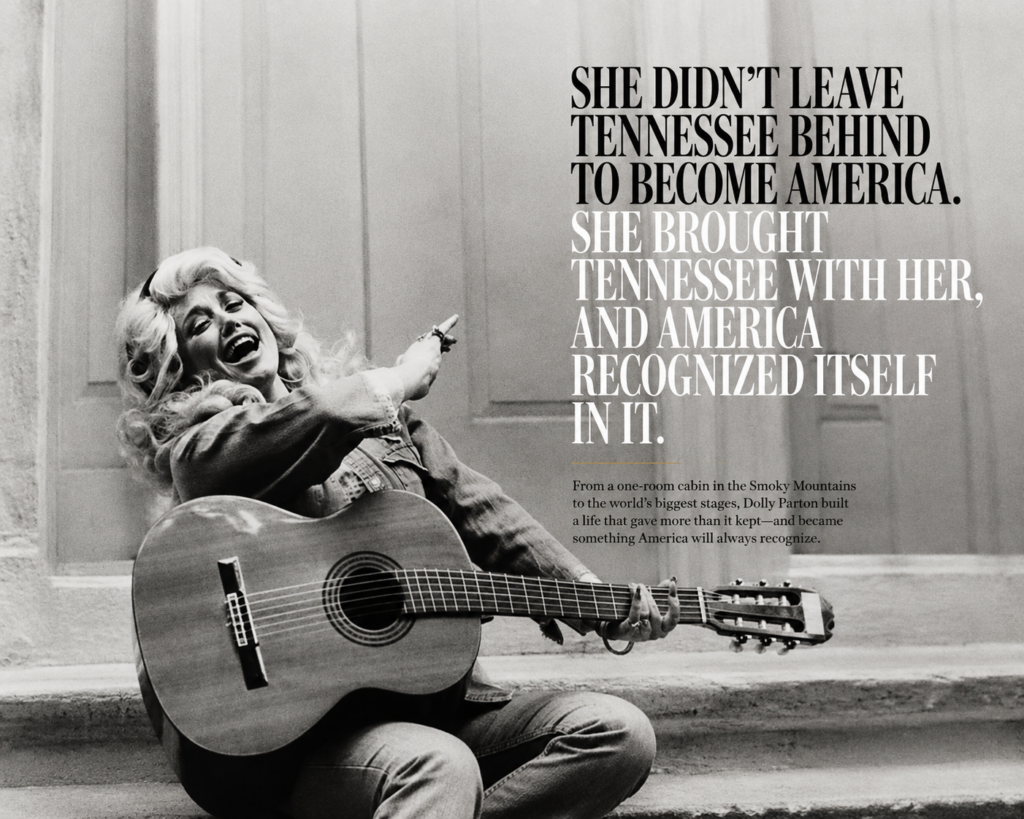
Dolly didn’t leave Tennessee behind to become America. She brought Tennessee with her, and America recognized itself in it.
The accent stayed. The faith stayed. The mountains stayed. The family stories stayed. The humor stayed. The rhinestones stayed. The memories of having very little stayed.
Dolly reinvented herself without rejecting herself.
That distinction may explain why so many different Americas could find something recognizable in her. Working-class America could recognize the family stretching what little it had. Churchgoing America knew the language Dolly spoke. Women trying to establish independence inside industries dominated by men could recognize the decision to leave Porter Wagoner. Songwriters understood why she told Elvis no. Entrepreneurs understood Dollywood. Queer audiences could recognize something in a woman who constructed herself exactly as she wanted to be seen and refused to apologize for the excess of it.
And children knew the Book Lady.
People who disagreed about almost everything else could somehow agree about Dolly.
That feels particularly significant now because America has become remarkably efficient at sorting itself. Red or blue. Urban or rural. Religious or secular. Working class or elite. Traditional or progressive. Us or them.
Dolly resisted the sorting, but not by becoming neutral.
She became more specific.
She didn’t hide that she was Southern. She didn’t hide her Christianity. She didn’t hide her wealth, femininity, cosmetic procedures, ambition or where she came from. And she didn’t appear to require somebody else to become more like her before she could make room for them.
Her universality didn’t come from sanding herself down until there was nothing left to disagree with. It came from something almost opposite.
Dolly showed that you can belong somewhere without believing everyone else has to belong there too.
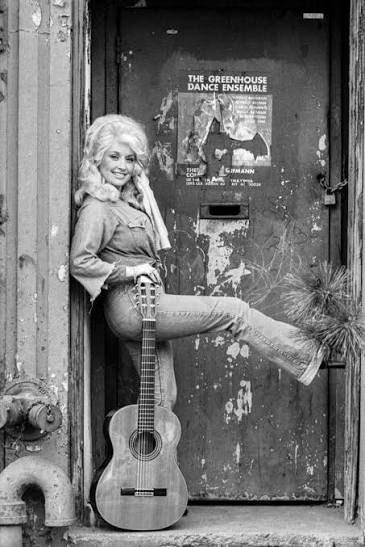
That may be the version of Americana worth preserving.
Not nostalgia for an America that never completely existed. Not a fantasy in which everyone agreed, everyone had the same opportunity and hard work inevitably produced prosperity. Dolly’s own life complicates that mythology. Her father worked extraordinarily hard and remained poor. He was intelligent and couldn’t read. Dolly entered an industry where men controlled much of the power. A Black woman eventually made Dolly’s composition globally enormous in a country with a long history of Black artists watching other people profit from Black musical innovation.
Those contradictions are America too.
Americana cannot only be the beautiful parts. It has to contain the complications.
Dolly did.
She could represent aspiration without pretending beginnings didn’t matter. Capitalism without believing money was the only measure of value. Faith without requiring conformity. Femininity without submission. Tradition without complete resistance to change. Individualism alongside an extraordinary belief in community.
She was artificial and authentic. Local and global. Country and pop. Poor and rich. Sacred and secular.
Dolly contained contradictions because America contains contradictions.
Somehow, she made hers coexist.
There is a temptation when someone this famous dies to inventory the evidence. More than 100 million records sold. Thousands of songs written. Grammys. Movies. Television. Dollywood. The Imagination Library. Awards. Businesses.
Those numbers tell us how large Dolly Parton became.
They cannot explain why people are grieving her.
For that, the measurements have to become smaller.
A mother putting her little girl’s first song into a shoebox because she believed it was worth keeping. A coat made from scraps. A young woman understanding that gratitude did not require permanent dependence on the man who helped her. A songwriter crying because she had to tell Elvis Presley no. A Black woman taking that songwriter’s country ballad and finding something inside it neither woman could have created alone. A Nashville property Dolly thought of as the house Whitney built. A father who couldn’t read watching his daughter become the Book Lady. A child opening the mailbox and finding their own name printed on a package containing a book.
A woman leaving the Tennessee mountains, traveling almost everywhere a person can travel, and still carrying those mountains with her.
Those aren’t side stories in Dolly Parton’s biography.
They are the story.
Together they explain why calling Dolly an American icon somehow feels insufficient. Icons sit above culture. Dolly lived inside it.
The hair. The voice. The clothes. The one-liners. “Jolene.” “9 to 5.” “Coat of Many Colors.” “I Will Always Love You.” They became pieces of American language that eventually stopped requiring explanation.
That is Americana.
Not because Dolly represented a perfect America. There isn’t one. She represented something more useful: the possibility that America could remain complicated without surrendering its capacity for generosity. That you could protect what was yours and still give. Become wealthy and remember poverty. Leave home without abandoning it. Believe deeply without demanding sameness. Recognize somebody else’s brilliance without believing it diminished your own.
Dolly understood ownership, but perhaps more importantly, she understood reciprocity.
Her mother preserved the first songs. Dolly protected the publishing. Porter Wagoner gave her a platform. Dolly eventually had to leave it. Whitney expanded the song. Dolly remembered Whitney when she thought about what its money had built. Her father couldn’t read. Dolly put books into the hands of millions of children. Tennessee gave Dolly a story. Dolly spent the rest of her life giving something back to Tennessee.
Things kept coming into Dolly Parton’s life, and she kept finding ways to send something back out.
That is why the final chapter of her story cannot simply be about death.
Legacy is usually discussed as remembrance. We talk about whether someone’s name will survive them, whether the songs will still be played, whether the movies will still be watched, whether future generations will understand how important someone once was.
Dolly’s life suggests a more useful definition.
Perhaps legacy isn’t only about being remembered.
Perhaps it is about continuation.
There will be children born after Dolly Parton died who receive books because she once loved a father who couldn’t read. They won’t remember her. They never met her. Some may not recognize her voice. They may know nothing about Porter Wagoner, Elvis Presley, Whitney Houston or the woman in Tennessee whose appearance helped inspire Dolly’s rhinestones.
But somewhere a package will arrive. Their name will be printed on it. Someone will open the book.
And something Dolly started will continue.
Maybe that is immortality in its most practical form: not remaining here, but remaining useful.
Which brings us back to the song.
Dolly wrote “I Will Always Love You” because she needed to leave someone she cared about. It was a goodbye, but a particular kind of goodbye—one built around the understanding that departure does not require love to disappear.
She left Porter Wagoner and kept the song. Elvis wanted it, but she wouldn’t surrender what belonged to her. Whitney Houston eventually carried it somewhere neither Elvis nor Dolly could have predicted. The song crossed race, genre, geography and generations. It moved from a country farewell into one of the defining vocal performances in popular music. It created enormous wealth, and some of that wealth became connected, in Dolly’s telling, to a place she could look at and think of Whitney.
More than half a century after Dolly wrote those words, the song has arrived at one final transformation.
For all those years, Dolly Parton was the person saying them.
Today, she is the person leaving.
America has spent decades receiving something from Dolly Parton: songs, stories, laughter, jobs, books, generosity, and an example of what it might look like to know exactly who you are without requiring somebody else to become the same.
Dolly spent a lifetime sending something back.
Now the exchange reverses.
The little girl from Tennessee who carried her mountains all the way into the American imagination has finally left us. And for once, in a country that has forgotten how often it once sang the same songs together, America seems to know what to say.
Dolly, we will always love you.
Related Posts
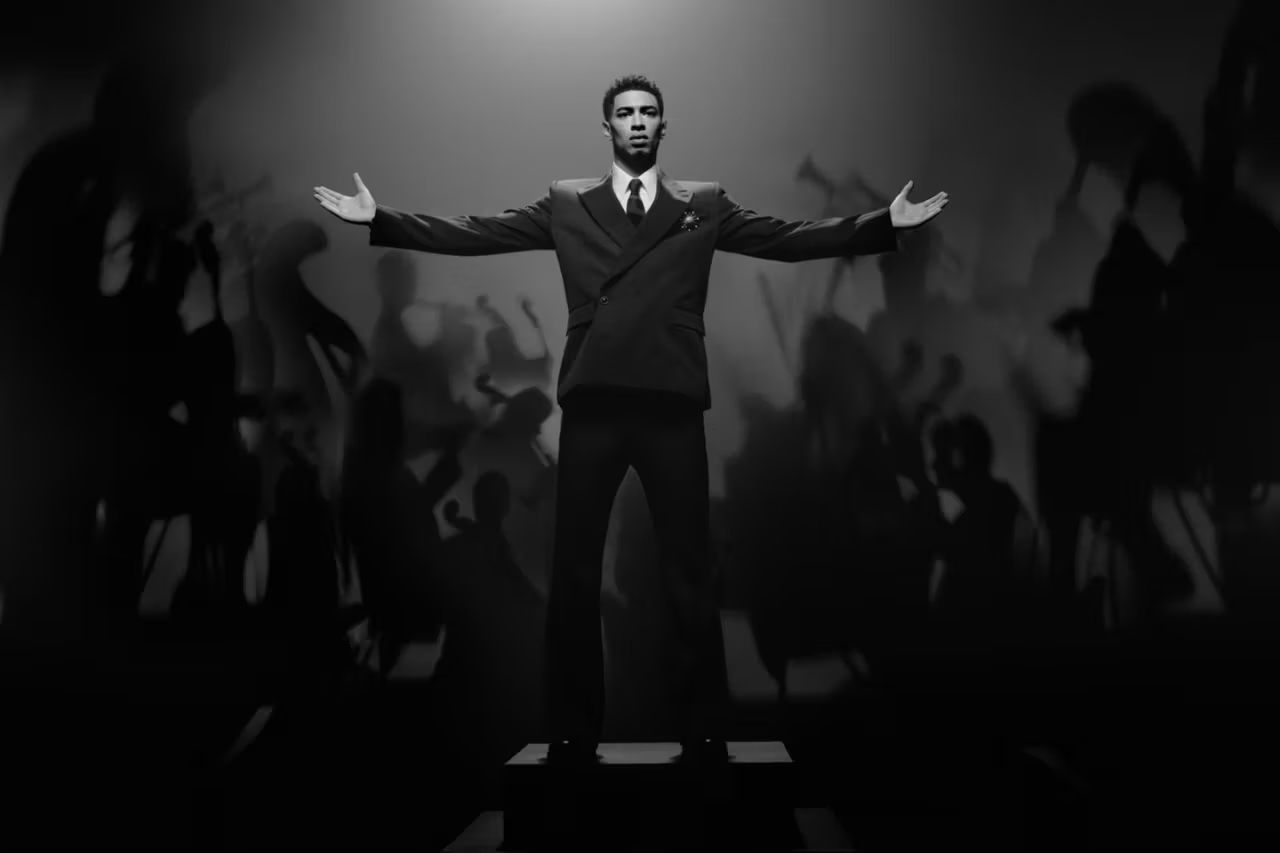
Jude Bellingham Joins Louis Vuitton as Newest “Friend of the House”
Jude Bellingham Is Louis Vuitton's Newest "Friend of the House".
What Happens When a Shoe Stops Explaining Itself
The Social Work of a Shoe
Netflix Releases Trailer for The Witcher: Sirens of the Deep
Watch the Official Trailer for ‘The Witcher: Sirens of the Deep’

Universal Announces Opening Date for Epic Universe, Its Most Ambitious Theme Park Yet
Universal Orlando To Open ‘Epic Universe’ Theme Park in May 2025.

Jeffrey Wright will officially reprise his role as Isaac for The Last of Us season 2
Jeffrey Wright will play Isaac Dixon in The Last of US 2
Ayra Starr Is Showing How Instagram’s Profile Grid Is Changing
Beyond What You Post