

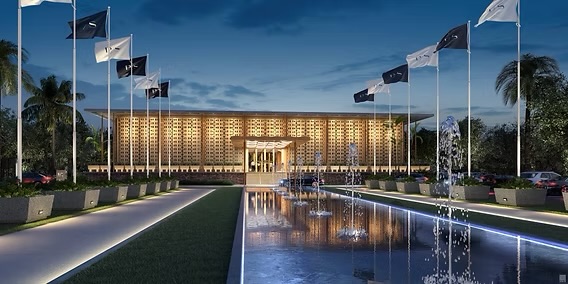
The Airport Experience Is Evolving, PS Miami Is Proof

By Carlos Mendez
The most important changes in business rarely announce themselves.
They arrive looking smaller than they are.
A new feature in a familiar app.
A different way to buy a product.
A company entering a market no one expected.
Only in hindsight do those moments reveal that they were never isolated events. They were evidence that an entire system had begun operating under a new set of rules.
PS Miami feels like one of those moments.
At first glance, it is easy to see a luxury terminal. Private security, curated lounges, chef-prepared meals, wellness treatments, and a chauffeured ride directly to the aircraft all invite the same conclusion: premium travel has become even more premium.
But luxury is the surface.
The real story lives underneath.
PS asks a question that extends far beyond aviation.
What happens when an institution no longer has to create every part of its own value?
For most of the twentieth century, the answer would have seemed obvious.
It did.
Airports owned the airport experience.
Retailers owned retail.
Television networks owned programming.
Universities owned education.
Institutions were expected to build complete systems because scale depended on control. The more an organization owned, the stronger it became.
That logic built the modern world.
It also has limits.
As institutions mature, complexity grows faster than control.
Every new responsibility demands expertise. Every new layer requires investment. Every new expectation stretches the organization further away from the thing it was originally designed to do.
Eventually, success creates its own constraint.
The institution becomes so essential that it can no longer be exceptional at everything happening inside it.
That is the moment mature industries begin to evolve.
Not by becoming larger.
But by becoming platforms.
A platform is often misunderstood as a piece of technology.
It is something much older than that.
A platform is an institution that recognizes it can create more value by enabling others than by trying to do everything itself.
Apple became more valuable when developers could build on the iPhone.
Amazon became more valuable when merchants could build businesses inside its marketplace.
YouTube became more valuable when creators became its programming.
None of those companies surrendered control.
They redefined what control meant.
They stopped measuring success by how much they produced themselves and started measuring success by how much value others could create because they existed.
PS suggests aviation has reached that same threshold.
It does not replace the airport.
It expands what the airport can become.
That distinction matters.
For generations, airports functioned as vertically integrated institutions. They organized every meaningful interaction between arriving at the curb and boarding an aircraft. The experience belonged almost entirely to the airport and the airline.
PS introduces another participant into that journey.
Not because the airport failed.
Because the airport has become sophisticated enough that new forms of value can now exist alongside it.
That is what mature infrastructure eventually allows.
Participation.
This is why PS is not fundamentally a hospitality story.
Nor is it primarily a luxury story.
It is a story about the evolution of institutions.
When an institution reaches maturity, its greatest contribution is often no longer the experiences it creates alone.
It is the experiences it makes possible for others to create.
That principle now appears across nearly every sector of the economy.
Hospitals increasingly rely on specialized technology partners.
Sports venues are becoming districts filled with independently operated experiences.
Universities collaborate with digital learning platforms.
Cities work with private mobility networks instead of attempting to own every mode of transportation themselves.
The pattern repeats because the economics repeat.
As systems become more complex, specialization stops being a competitive advantage.
It becomes inevitable.
The institution that insists on owning every layer eventually slows its own evolution.
The institution that creates space for others often discovers that its ecosystem becomes more valuable than anything it could have built alone.
That may be the most important lesson hidden inside a private terminal in Miami.
Not that travelers are seeking more luxury.
Not that airports are becoming more exclusive.
But that one of the world’s oldest forms of public infrastructure has begun behaving according to one of the defining economic principles of the twenty-first century.
For more than a century, institutions created value by building complete systems.
The next century may belong to institutions that understand a different responsibility.
Not to build every experience.
But to build systems so strong that other people can create experiences the institution could never have imagined on its own.
PS Miami is not remarkable because it changes the beginning of a flight.
It is remarkable because it suggests that the future of infrastructure will be measured less by what it owns than by what it enables.
Related Posts

From Incredible to Infernal: The Hulk’s Most Terrifying Evolution Yet
Bruce Banner vs. His Worst Nightmare—Himself

Jessie Prez Builds Through Process Not Performance
The Work That Doesn’t Announce Itself

Après-Ski, Reimagined: Nike and Jacquemus Blur the Line Between Sport and Style
Skiwear, Elevated

Tamla Was the Blueprint. Now It’s the Test Again
Motown Isn’t Going Back. It’s Reinstalling the System
Ray-Ban Is Building Atmosphere
The Best Brands No Longer Feel Like Stores
How The Wire Trusted Viewers With Complexity—Before Culture Learned to Ask for It
Cultural Intelligence, Played in the Long Game