

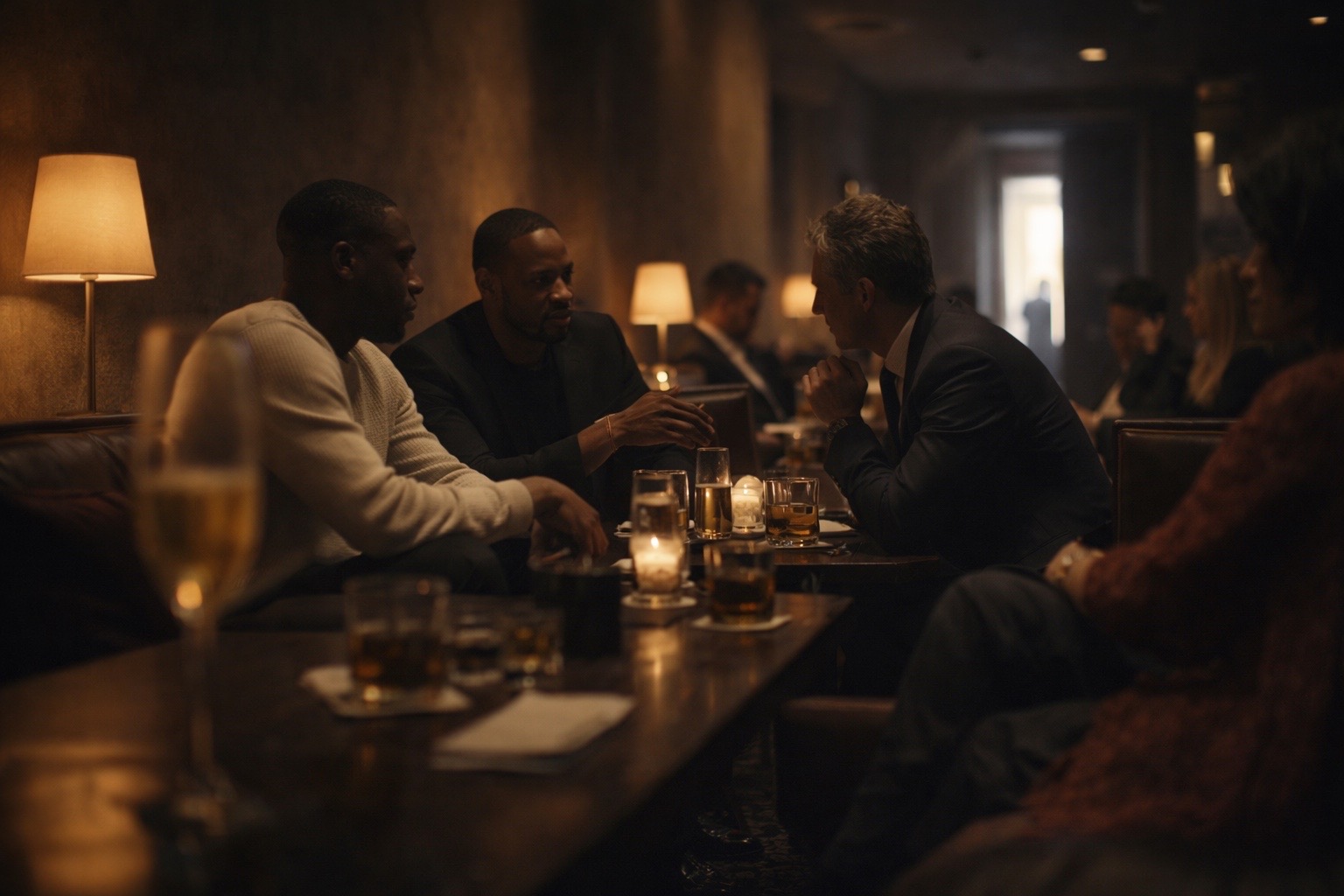
The Venue Is the New Platform
By Johnathan Cleverson
There was a time when fame was measured by how many people were looking at you. Now it’s measured by where those people go.
For decades, visibility was the prize. The camera found you, the audience followed, and the system rewarded whoever could hold attention the longest. But attention, once scarce, is now everywhere—endless, scrollable, and increasingly disposable.
What’s scarce now is not attention.
It’s context.
Long before that shift had a name, Jay-Z began building toward it—not through announcement, but through architecture.
The 40/40 Club did not present itself as a thesis. It was a room—elegant, controlled, selective. But inside that room was a different kind of power. Athletes, executives, artists—different systems of influence intersecting in a single environment, governed by a single host.
The insight was quiet, but precise:
If you control the room, you control the moment.
And if you control the moment, you begin to shape culture itself.
In another era, Hollywood didn’t just produce films—it owned theaters. Control the screen, control the audience. What’s emerging now feels familiar, just updated for a different medium. The theater has been replaced by the venue. Distribution has been replaced by presence.
The room was only the beginning.
With Roc Nation, the environment gained infrastructure. Talent, production, touring—the systems that don’t just fill a space, but sustain it. The energy inside the room no longer had to be imported. It could be generated, directed, and repeated.
Then came the pipeline. Tidal wasn’t simply about streaming. It was about ownership of flow—how culture moves, how audiences arrive, how moments extend beyond their origin. The room was no longer isolated. It became connected.
Scale followed.
The Made in America Festival expanded the idea outward—transforming city blocks into temporary ecosystems. Streets became corridors of culture. Stages became focal points of attention. What had once been contained within four walls now operated across an entire urban grid.
The principle remained unchanged:
Gather the audience. Shape the environment. Control the experience.
When an artist can fill a stadium on their own terms, the venue stops being a stop on a tour. It becomes the platform itself.
Even the details were deliberate. Armand de Brignac and D’Ussé were not adjacent ventures—they were embedded elements. To enter the space was to encounter them. To participate in the moment was to consume them. Product was no longer separate from culture. It was part of the architecture.
Taken together, it forms a closed loop:
Attention brings people in.
The environment holds them.
Infrastructure sustains the flow.
Products monetize the presence.
And the system repeats—self-contained, self-reinforcing.
What once looked like diversification now reads as design.
You can see the pattern extending. 50 Cent moving toward large-scale entertainment venues. Pharrell Williams shaping city-level cultural ecosystems. Drake building recurring gatherings that anchor identity to place.
Different scales. Same instinct.
Because the limitation of the digital era is becoming clear: everyone can reach an audience. Fewer can hold one. Almost no one controls the conditions under which that audience experiences something together.
That is the new leverage.
Digital didn’t disappear. It scaled attention. The venue is where that attention becomes real.
A venue is no longer just physical. It is programmable. A room can be activated, documented, amplified, and redistributed. What happens inside it does not stay there—it becomes signal, content, mythology.
Which is why the shift isn’t from offline to online.
It’s from visibility to orchestration.
Celebrities are no longer just participants in culture. They are becoming its hosts.
And hosting is power.
To host is to decide the guest list. The tone. The access. The moment. It is quieter than fame, but far more durable. Because while attention fluctuates, environments endure.
Social media turned everyone into broadcasters. It democratized reach and flattened distribution. But in doing so, it created a new scarcity: not attention, but places where attention gathers with intention.
The next phase of culture will not be defined by who has the most followers.
It will be defined by who controls the rooms those followers enter.
Because the next platform isn’t something you follow.
It’s somewhere you show up.
Related Posts
Hulu Not moving forward on Sammy Davis Jr. Limited Series; Project Seeks New Platform
Hulu has decided not to proceed with its previously announced limited

Footshop x BAPE Shift Into High Gear With a High-Octane Streetwear Drop
Racing the Streets

Game Informer Shuts Down After 33 Epic Years in the Industry
‘Game Informer’ Shut Down by GameStop
Luxury, Authored: Willy Chavarria and Cultural Gravity
Defining Luxury Without Permission
Netflix Unveils Tense New Trailer for The Waterfront, a Southern Gothic Family Drama
The Buckleys Are Sinking
Maroon Rising: Kwame Onwuachi’s Afro-Caribbean Revolution in Vegas
Diaspora on a Plate