


The Algorithm Is the New Greenlight
By Dennis Quails
For most of modern entertainment, power lived in a single, quiet moment.
A script crossed a desk. A room went still. A decision was made. The greenlight.
It was private. It was controlled. It was human.
And for decades, it defined what the world would eventually watch.
That moment hasn’t disappeared. But it has moved.
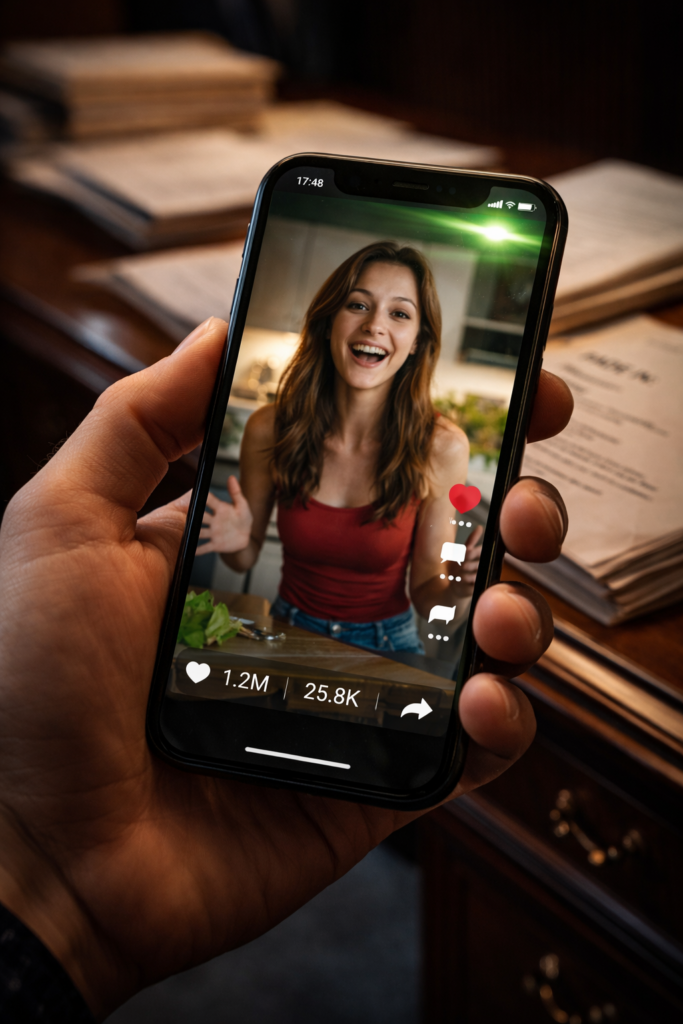
In a quiet but revealing alignment, Tubi and TikTok are not simply building a bridge for creators to move from short-form into long-form storytelling. They are reorganizing where validation happens—shifting it upstream, away from rooms and into systems that operate in public, at scale, and in real time.
Because validation no longer begins with a decision.
It begins with behavior.
Every scroll is now a filter. Every loop is a test. Every share is a form of approval rendered instantly and collectively. What was once argued in meetings is now measured in motion. What was once speculative is now observable. The audience is no longer waiting for content to be delivered; it is actively determining what deserves to exist before it ever reaches a structured format.
The algorithm has become the first greenlight.
Not because it creates, but because it validates.
This is the inversion at the center of the moment. TikTok does not just distribute ideas—it surfaces proof. It identifies what holds attention, what sustains repetition, what travels across audiences without friction. It performs, in public and continuously, what development executives once attempted to approximate in private.
Tubi enters after that point.
Not as a discoverer, but as a translator.
A system designed to take what has already been validated—fragments of performance, tone, character—and expand it into structure. Into episodes. Into narrative. Into something that can live beyond the loop.
This is not a partnership in the traditional sense. It is a pipeline.
One platform captures attention. The other attempts to stabilize it into story.
The studio system, as it once existed, controlled the process from the top down: development, production, distribution. Authority flowed outward. This model begins at the opposite end. It starts with the audience—its behavior, its signals—and builds upward.
Not from authority to audience.
From audience to authority.
But validation and storytelling are not the same discipline.
What works in seconds does not automatically sustain minutes. The loop is not the arc. The algorithm rewards immediacy, while narrative demands patience, structure, and progression. The risk embedded in this shift is not whether creators can be found. That problem has already been solved. The risk is whether what has been validated in fragments can survive expansion without losing the very quality that made it resonate.
That tension is the experiment.
And it is why this moment matters—not as a conclusion, but as a document.
Because if this model works, the implications are structural. The pilot becomes unnecessary. The greenlight becomes reactive. Development collapses into a continuous process where ideas are born, tested, and scaled within the same ecosystem. The distance between creator and studio disappears, replaced by a loop that never fully resets.
And if it doesn’t work, the signal remains just as clear.
Because the attempt itself reveals a shift in belief: that the authority to decide what should exist no longer belongs exclusively to Hollywood.
It belongs to the system that can measure what already does.
This is not the end of the studio.
But it may be the end of the studio as the place where validation begins.
Now, validation happens earlier. Faster. In public. Without permission.
In the feed.
Before the script. Before the meeting. Before the decision.
And once that shift occurs, the role of the industry is no longer to decide what works.
It is to recognize it.
Related Posts

ASUS Republic of Gamers (ROG) Unveils the ROG Ally X: Enhanced Handheld Gaming Console
ASUS (ROG) Unveils the ROG Ally X

LG Display Set to Mass Produce World’s First Gaming OLED Panel Offering Switchable Refresh Rate and Resolution
LG Display Set to Mass Produce World's First Gaming OLED Panel
Unveiling BetterLix: An Innovative AI-Powered App Fostering Liver Health and Well-being
Amsety, a leading company in liver health solutions.

Hisense Redefines Home Entertainment with HT Saturn Wireless Home Theater System Debut at CES 2025
Hisense reimagines cinematic sound with HT Saturn.

Netflix Didn’t Enter Vertical Video—It Moved the Beginning of the Story
You Don’t Start the Story Anymore