

The Platform Is the Studio Now
By Tre Lamont
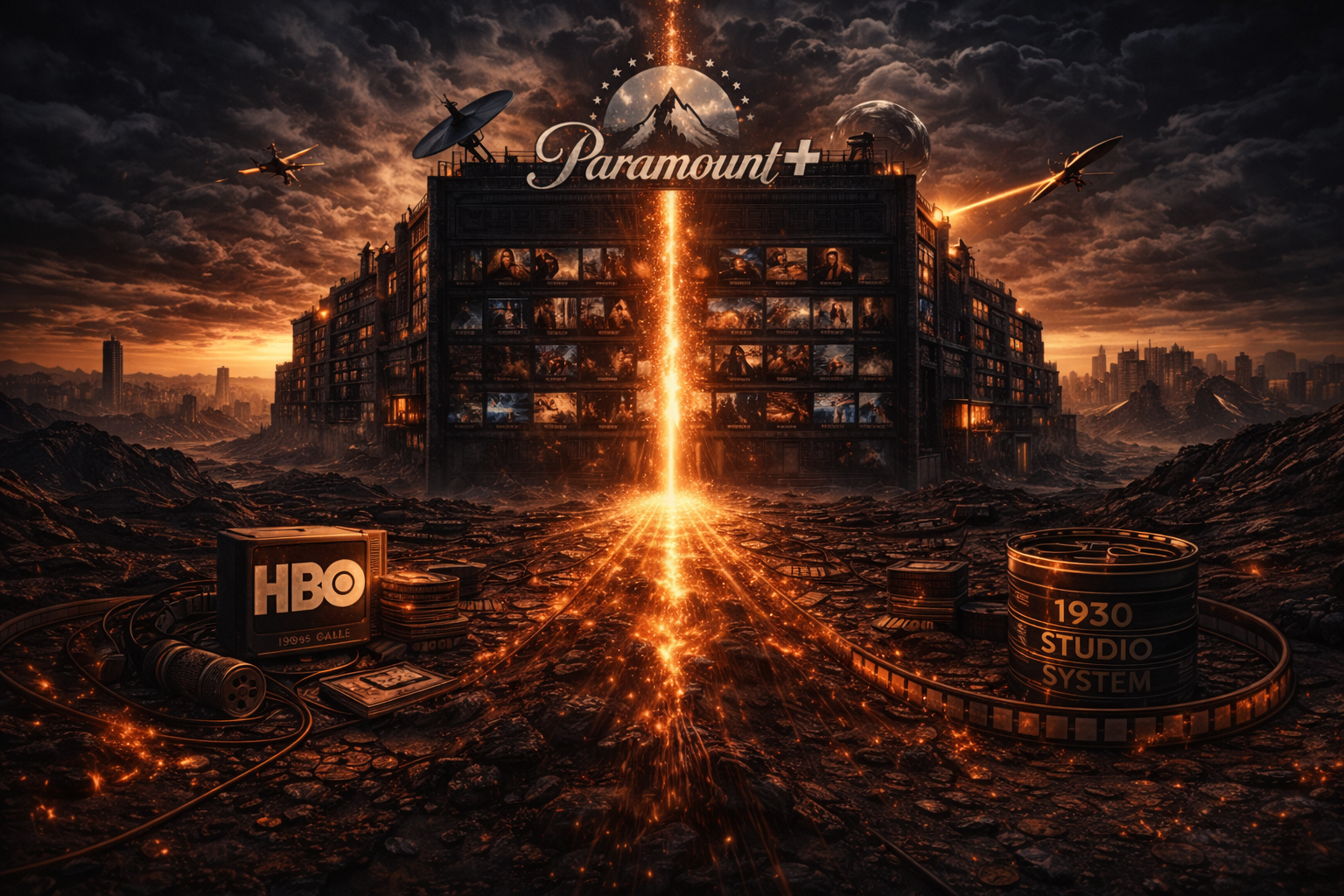
For a decade, the streaming era has been defined by expansion — more platforms, more originals, more noise. But the quiet consolidation of HBO and Paramount+ signals something more structural: the industry is no longer racing to create the next hit. It is consolidating the past. What appears to be a product decision is, in reality, a reorganization of cultural memory — a shift from fragmented platforms to concentrated ecosystems where decades of storytelling are compressed into a single point of access.
The first phase of streaming rewarded velocity. Platforms competed on output — more originals, more franchises, more “next big things.” But volume created fatigue, and fatigue exposed a deeper truth: hits are temporary, but libraries endure. This merger reframes the competitive advantage. It is no longer about what you release next, but what you already control. By combining the prestige authority of HBO with the generational film and franchise infrastructure of Paramount, the platform shifts from chasing attention to anchoring it, moving the industry from hits to holdings.
Streaming platforms are no longer storefronts. They are infrastructure. A modern content library functions simultaneously as a retention engine, a licensing weapon, a recommendation system, and a cultural archive. Each additional title strengthens the system not just as content, but as data, leverage, and memory. In this model, time collapses. A film from 1972 and a series from 2024 no longer exist in separate eras — they exist as simultaneous assets within the same ecosystem. This is not distribution. This is cultural compression.
We have seen this structure before, just in more visible forms. In the 1930s, studios like Paramount Pictures controlled the entire film pipeline — production, distribution, and exhibition. They did not just create films; they controlled how films reached audiences. That level of vertical integration became so powerful it led to the antitrust case United States v. Paramount Pictures, Inc., forcing studios to separate production from exhibition. Decades later, cable television reintroduced a softer version of this control through bundling, where consumers did not subscribe to individual channels but to systems. Now streaming completes the cycle. With the consolidation of HBO and Paramount+, vertical integration returns in a more refined form: content is owned, distribution is unified, and discovery is algorithmic. There are no theaters to regulate, no cable boxes to negotiate — only an interface. And that interface obscures the concentration behind it.
Fragmentation was never the destination. It was a phase. Consumers were temporarily distributed across platforms, but the model was unsustainable — too many subscriptions, too much duplication, too much friction. Consolidation is the correction. A unified platform reduces decision fatigue while increasing dependency, and in the attention economy, dependency is value.
Control has not disappeared. It has evolved. In a consolidated system, fewer platforms decide what gets funded, fewer systems determine what gets seen, and algorithms mediate visibility at scale. The gate is still there, but it is no longer visible. The question is no longer what gets made, but what gets surfaced. This marks the transition from editorial authority to systemic authority.
The streaming wars were defined by expansion and competition. What follows is consolidation and control. Fewer platforms, larger ecosystems, deeper libraries, stronger retention loops. This is not contraction. It is stabilization through scale. What emerges is not simply a marketplace, but an infrastructure.
The consolidation of HBO and Paramount+ will be positioned as convenience — fewer apps, broader catalogs, simpler access. But history makes the pattern clear. From the studio system to cable bundling, every dominant media era eventually centralizes control over both content and distribution. What makes this moment different is its invisibility. The system is no longer physical. It is architectural. And in that architecture, ownership defines access, and access defines culture. The streaming era is not ending. It is consolidating into its most powerful form.
Related Posts

ANTA and Kyrie Irving Celebrate the Launch of ANTA KAI 1
ANTA and Kyrie Irving Launch ANTA KAI 1
Aziz Ansari and Keanu Reeves Flip the Script in Supernatural Comedy “Good Fortune”
Keanu Reeves Loses His Wings

Connection Above All: Nuria Vega on the Art That Moves Us
From Mexico to the Mythic West

From Manhattan to Mayfair: “Only Murders in the Building” Heads to London in Season 6 Renewal
Murder, Mystery & Luxury

Pacsun Launches ‘A.R.C.’: The Ultimate Men’s Activewear Line for Gen Z
Pacsun unveils first dedicated men’s activewear line.

Maison Kitsuné Unveils Its Latest Footwear Innovations: The Sora Runners and Chiru Trainers
Maison Kitsuné Unveils Its Latest Footwear