
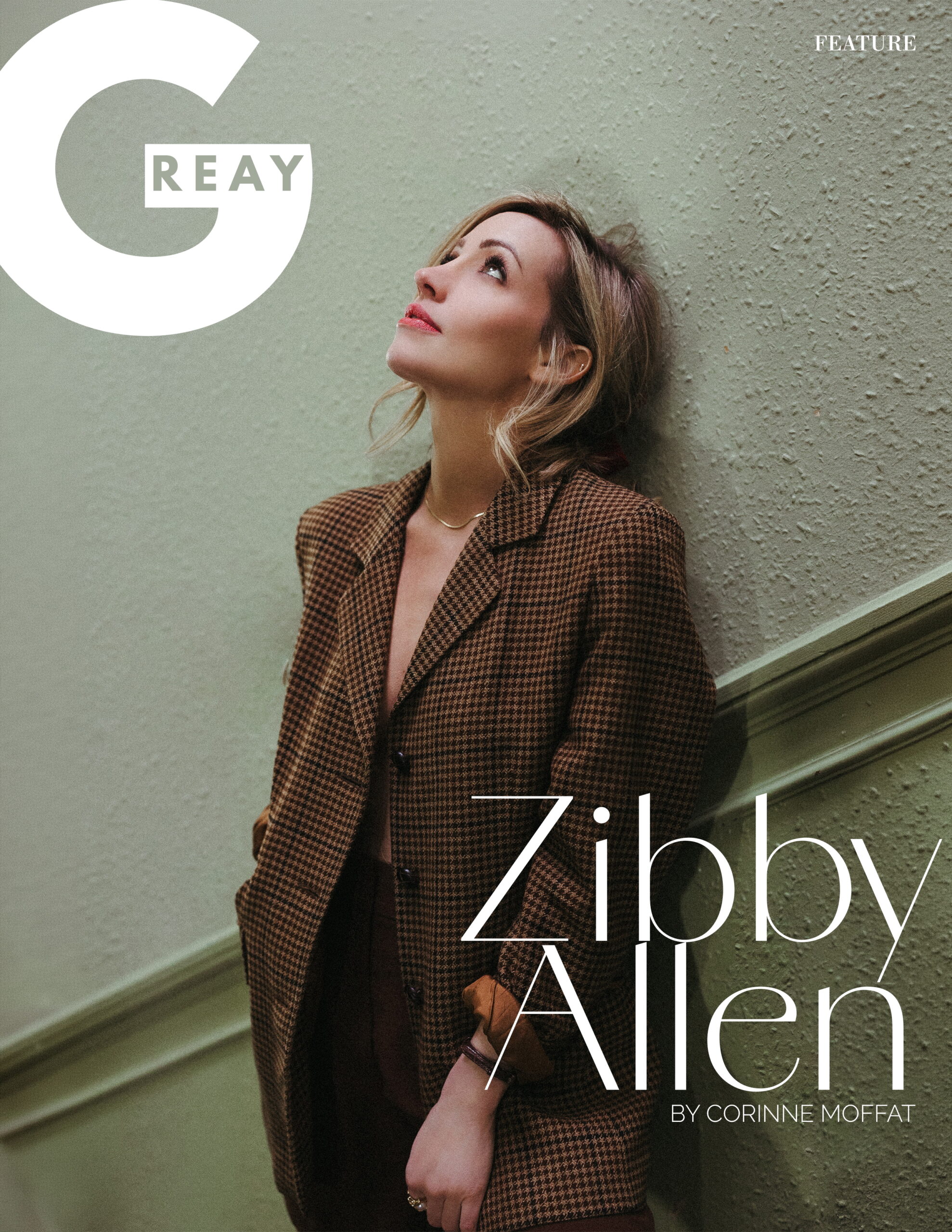
Zibby Allen: Acting in the Space Between Feeling and Form
There is a particular kind of actor whose work does not rely on spectacle, but on quiet negotiations the audience can feel before they fully understand them. Zibby Allen has built a career in that space — portraying women whose composure often conceals deeper internal movement. Whether audiences know her through the evolving emotional terrain of Brie in Virgin River or through earlier work across television and film, Allen’s performances rarely announce themselves loudly. Instead, they unfold through restraint, contradiction, and the subtle electricity between what a character feels and what she allows the world to see. In conversation with GREAY Magazine, Allen reflects on the inner architecture that shapes her work — a mind that is rarely quiet, a creative instinct that is constantly framing life as story, and a philosophy that resists fixed perspectives in favor of curiosity and change.
When no one is watching — no set, no scripts, no interviews — who are you in the quiet architecture of your own mind?
Honestly? Rarely quiet, though it might look that way from the outside. I slow my pace down, I unsubscribe from time, I absorb. But inside it’s very full. I am hyper-creative in a way I can’t really switch off – perpetually taking experiences, feelings, things I notice, things I notice I fear or love or want, and turning them into tiny stories. Framing life in story form is how I make sense of it. I wish I could just zorg out to trash TV, but my mind is endlessly creating, endlessly crunching on ideas and my own sense of things at any given moment. I’m also deeply philosophically curious – I read a lot, I feed my perspective constantly, because I’m genuinely terrified of a fixed point of view. A fixed perspective might keep me from seeing something important, something I’d otherwise miss. Like, I don’t even like sleeping on the same side of the bed for more than a week – I make my husband switch with me constantly. Ha! I pursue change because getting too comfortable feels like it dulls the senses and I’d rather be more engaged with it all, even the mundane.
You’ve built a career portraying women who feel composed on the surface but carry internal negotiations underneath. Is that instinctive alignment with who you are, or a craft you’ve consciously shaped?
Ha! Probably both. I think we are all profoundly dualistic humans, and that duality is what I’m always looking for in any character I play: what someone feels internally versus what they actually show the world. What I love most is that the audience can sense the dissonance between what’s felt and what’s shown when they’re watching something real. There’s a kind of electricity in that gap. I really try to trust my audience to feel it, to know it, without me showing them every single thing the character is carrying. The tension of restraint is very much a part of my craft – or attempt at it. But I’d be lying if I took all the credit for consciously designing it that way. I’m of the belief that actors attract roles that share secrets with them. Over the last decade I’ve become more composed on the outside, but I am most definitely in a constant negotiation on the inside – and I’ve been playing Brie for half a decade now, so sometimes it’s hard to know what’s hers and what’s mine.
What does discipline look like for you between seasons — when the phone isn’t ringing and the character isn’t demanding your attention?
I am the most consistently inconsistent person. Don’t get me wrong – give me a deadline and I will get it done, thoroughly and likely early. But when there’s no outside force demanding something of me, self-discipline looks more like staying committed to marching to the beat of my own inner nudging. I’ve made peace with my inconsistency – maybe rigid discipline dulls the very thing that makes me creative. So I follow my intuition, follow creative whims, pay attention to what my body needs and actually give it to myself, even when I feel too lazy about it. I connect with my personal resources: dear friends, important books, teachers.
Lately, following a creative whim has looked like making tiny one-minute videos — little tone poems, really. Mini dispatches from a fictional woman’s internal negotiations with desire. I take pieces of writing, thoughts that are mine or borrowed from somewhere else, and stitch them together with a small narrative, images, music, voices. I’m making them purely for myself, as a way to process and play, but through that I’m also learning to edit, learning my taste, growing my skills quietly in the background.
And then there’s meditation. Daily. It helps me connect to myself just past the mind, where it gets quiet and wordless. I like dipping into that space for a few minutes every day. I find it calming and sacred.
Has there been a role that altered you privately — not in visibility, but in how you understand autonomy, relationships, or emotional boundaries?
Every single role has played a part in altering me, honestly. In order to let a character in, I have to let them work their way through me. But Brie has obviously played a very primary role in shaping my outlook on relationships and emotional boundaries. She’s had to live with and reconcile a truly violent and violating betrayal from a man she chose to trust and give full access of herself to. She’s had to figure out how to reclaim her sexuality while navigating a total fissure in trust – in herself and in men. She’s had to negotiate a massive war between her head and her heart when it comes to Brady. On one hand she has to have him — her heart is completely consumed by him. On the other hand he hasn’t been truthful, he’s made very costly, life and death mistakes, and he’s a total liability to her deep need for security and safety. And then there’s the question of Mike – if she gives herself the safe guy, will that anchor her in a life that won’t destroy her? Which is valid. That could be considered an ultimate act of self love.
As Zibby playing Brie, I have to work through all of these inner negotiations myself – ask why this boundary and not that one? When she crossed the line and cheated on Mike with Brady, what fuels that? How do I create an understanding around it that avoids condemning her, while also weaving in a personal accountability that keeps her from being that person moving forward?
And through all of that, Brie has taught me that boundaries are mutable – they can shift, they can grow, they are necessary, but they’re ours and we need to own them. I’ve also learned that most chaos comes when the head and the heart are in discord. So if I’m hemming and hawing over something, I’ve learned to just ask my heart what it wants – and then pay attention to how my body feels when my heart answers. That’s when I know. That’s my direction.
In an era where careers can be driven by momentum and metrics, how do you stay rooted in artistry instead of velocity?
Velocity has never really been my compass – so staying rooted in artistry isn’t something I’ve had to fight for so much as protect. My access point has always been internal. I’ve never been great at performing a career. I’m much better at following what genuinely calls to me and trusting that. The danger I’ve always been more afraid of than irrelevance is becoming dull – too comfortable, too fixed, too certain. That to me is the real threat to my work. So I keep moving, keep feeding my perspective, keep making things for audiences and no audiences. I stay close to the work that asks something real of me. And I try to stay closer to my own signal than to the noise of what a career is supposed to look like. Easier said than done some days! I’m not always good at it. The metrics, the social media of it all, can really stoke a fear in me if I let it. I’m human. But I do my best. And I think doing your best, honestly and without pretense, is probably the most artful thing any of us can do.
Is success measured in visibility, range, longevity — or something more personal at this point in your journey?
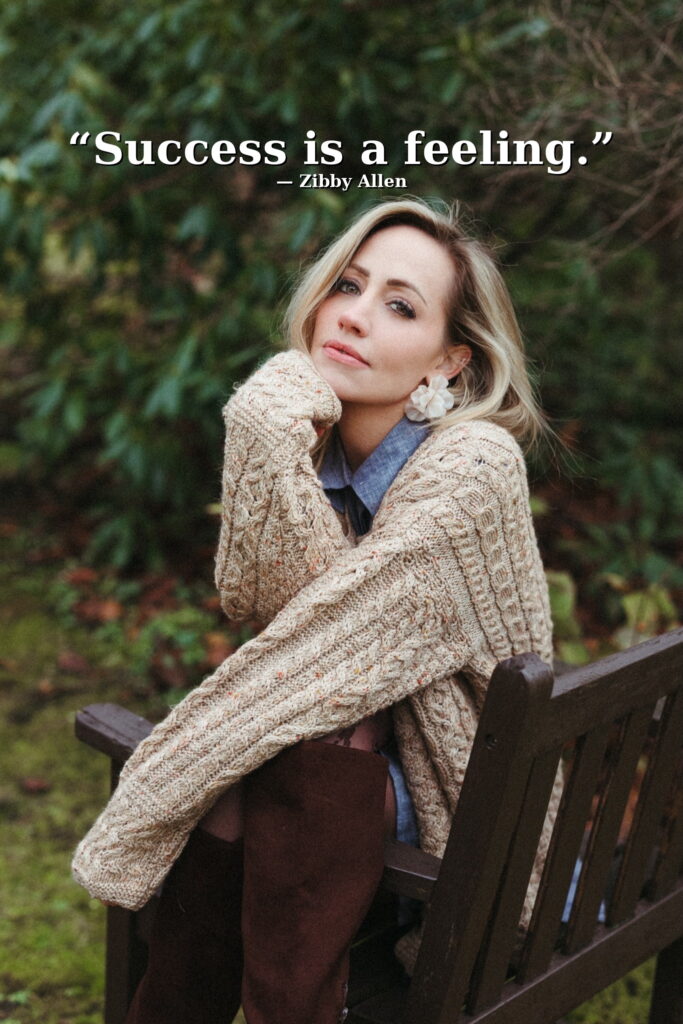
Obviously it depends on who you ask. But since you’re asking me, I’m not entirely sure. I think maybe success is a feeling. I made a little tone-poem video yesterday that I absolutely loved. I probably won’t share it with anyone, or maybe I will one day, who knows. But that felt like a total success. It was mine. I didn’t have to rely on anyone else to give me the part, give me the chance, do it for me. It wasn’t for pay, it was for the pure need to feel my creativity rise up and put out something small and lovely. I could have very easily sat on the couch and scrolled Instagram while drinking my coffee. That morning, I didn’t. And somehow that felt successful.
But then there are also these moments lately that feel like a strange little dream. Dispatches from what I always imagined success might look like. I’m walking down the street and someone stops me to say how much they love Brie in Virgin River. Or I’m at a photoshoot wearing clothes that look all fashion-y and I think, “Zibby, you did it. Look where we are.” And those moments are more right-sized now that I’m actually living them. They aren’t really about visibility or any of that, they’re about me believing myself here. Like, I believed in myself enough to have those moments too. And that, to me, is a real success. The success of self-belief.
What emotional terrain are you still hungry to explore that audiences haven’t yet witnessed from you?
I am dying to do a period drama. Blame living in Edinburgh for that, maybe – I walk around this city with ancient buildings and a constant reminder of history under my feet and it is seducing me, honestly. Just give me the costume and drop me into another time and place. I am so into it. I also love watching historical dramas, so the hunger is very real.
And I miss comedy. I used to work exclusively on the comedy side of the industry and that instinct is still completely intact in me. I miss improv, and comedic sets. I love being in Virgin River. I am genuinely obsessed with that world and with being Brie. And I’m also excited for the world to know me and my range outside of that bubble. I think audiences who only know me from Virgin River might be surprised by what else is in there. Excited for more of that reveal too.
Was there an early career moment where you realized you were no longer “auditioning to be chosen” but stepping into authorship of your own narrative?
I don’t know if there was a clear moment when that shifted, and honestly, I’m not sure it’s shifted completely. There are still times I catch myself getting caught up in the idea of being chosen before I’ve even stopped to ask whether it’s something I actually want. What I can say is that I’ve trained myself to be more discerning, to pause and check in with what I truly want versus what I think I should be doing. And the repetition of that practice has made something shift over time – the no’s are more immediate now, more obvious, and the yes’s come from somewhere inside me rather than from outside noise.
And I don’t want this to get twisted, but – the more people I meet, the more I realize I don’t really want to be like anyone more than my own self. So being chosen just holds less weight for me now than it did when I was younger and didn’t quite have myself figured out, or like myself, as much as I do now
Brie arrived in Virgin River carrying professional composure, but beneath that was unresolved trauma and a complicated relationship with power and trust. How did you decide where her guardedness should crack — and where it shouldremain intact?
Not to sound wanky, but I didn’t make an intellectual decision about that, I just feel it. With Brie, with the writing. When I’m reading a new script I’ll notice when I, Zibby, choke up at a line or a word or even a stage direction. And when that happens, I can almost guarantee that Brie will crack a little on the day too. It’s instinct more than calculation.
The gift of playing someone long-form, over many years, is that she’s just in me now. I don’t have to think about where the walls are. I know them the way you know your own. And I’ve learned to really trust that the writers and that world will serve up exactly what Brie needs to move her forward. So in a way, I’m not deciding where she breaks open and where she holds it together – I’m just listening. To her, to the material, to whatever catches in my throat
Brie’s relationship arcs often unfold slowly — particularly in how she negotiates intimacy after violation. How intentional are you about calibrating physical and emotional proximity in those scenes?
The writers and I have worked closely with consultants from RAINN – the nation’s largest anti-sexual violence organization – to make sure we’re treating Brie’s experience of sexual violation, the aftermath of that, and her own sexuality with authenticity and care. That’s been invaluable, and I’ve been able to check in with them whenever I’m in doubt about how to approach certain scenes.
What I really love about Brie’s physical chemistry with Brady is how instinctive it is. I think that’s where she gets to feel a real sense of abandon — a reclamation of her own sexual autonomy, and ultimately, trust. It might actually be the strongest point of trust between them, when they’re being intimate. There’s something quite healing in that for her. Because even though she has to do a lot of negotiating between her head and her heart when it comes to the emotional and practical realities of being with Brady in a real, consistent partnership – their physical connection gives her somewhere to just let go. And we know that’s not something Brie does easily…
Over multiple seasons, Brie has shifted from outsider to embedded member of the Sheridan family fabric. What did it take to evolve her from reactive presence to emotional pillar within the town?
We can thank the writers for that, for sure. But I also think there’s a natural chemistry between myself, Martin Henderson, and Alexandra Breckenridge that lends itself to the sense of family and connectivity that Virgin River captures so well. It just exists between us, and I think audiences feel that.
The Sheridans are good, loving, loyal, slightly intense, deeply feeling people, with a bit of a hero complex. Jack likes to save, fix, solve, and protect. So does Brie. And while those qualities can sometimes be as much a burden as a gift, they’re also wonderful things to bring to a community. There’s never a dull moment in Virgin River, so it’s a good place for someone like her – somewhere she can be of service, feel purposeful, and still have a soft place to land while she’s navigating her own troubles.
And there’s something else I always love about the Jack and Brie dynamic specifically – there’s real value in watching siblings find each other in adulthood, lean on each other, and become both loyal support and a kind of mirror for one another. They were each other’s closest witnesses growing up, and that shared history means something. I think audiences respond to that because it’s so recognizable and true.
Virgin River thrives on emotional steadiness rather than spectacle. How do you sustain stakes in a world that moves at a gentler pace without allowing the performance to plateau?
I think life is actually more like that though. Life happens, and it’s naturally intense – it has its own highs and lows without needing to be manufactured. There is magic in the mundane. There’s always an internal negotiation happening, always a need or a desire for more or less. There’s always an opportunity to show up for someone else, or to look in the mirror. To take accountability. To mess up and be forgiven. To forgive. To change your mind, to discover something new about yourself – someone else. There’s nothing uninteresting about any of that to me.
I think our show works because we’re not constantly shocking our audience’s nervous systems. We’re just living in a small town and encountering life’s realities in as relatable a way as possible. And I mean – we’re still pretty soapy, steamy, and a little famous for our strong cliffhangers. But we’re not out here trying to traumatize our viewers, and I like that about us. So the pace doesn’t feel like a constraint to me. It feels natural.
Throughout our conversation, Allen returns again and again to a simple idea: artistry is not sustained by momentum, but by attention. The attention to instinct, to curiosity, to the quiet signals that guide a creative life away from performance and toward authorship. For Allen, success is no longer measured solely by visibility or trajectory, but by the private moments when creativity rises unprompted — a small video made in the morning, a story forming quietly in the mind, a decision to follow the internal signal instead of the external noise. In an industry often driven by acceleration, her perspective is a reminder that the most durable careers are often built in the quieter spaces — where imagination remains active, perspective stays fluid, and the work continues long after the cameras stop rolling.
Related Posts

Timex Celebrates 170 Years of Watchmaking Excellence
It's not a Watch; It's an American Icon

The RLJ Companies Appoints Scott Royster as CFO of Caribbean CAGE
CAGE is licensed to operate video lottery and video gaming terminals,

Lewis Hamilton Triumps at 2024 british Grand prix
Lewis Hamilton Wins 2024 British Grand Prix
The Brand That Needed a Door—and What Happened When It Disappeared
From Storefront to Feed to Nowhere

Footshop x BAPE Shift Into High Gear With a High-Octane Streetwear Drop
Racing the Streets

amazon Prime Video Unveils Exclusive trailer of “Like a Dragon: Yakuza” Series
Amazon Video Previews Trailer Based on SEGA’s ‘Yakuza’ Video Gam