
YouTube Is Giving Creators the Architecture of a Media Company
By Brian K. Neal
YouTube spent its first era teaching people that anyone could upload a video. Its second proved that some of those people could build audiences large enough to turn those videos into careers. Now the platform appears to be entering something more consequential. YouTube is giving individual creators more of the tools that once required an entire media organization.
That is the larger play behind the more than 30 updates introduced around Made On YouTube 2026. Taken separately, Shorts Series, Custom Feeds, conversational editing, expanded television features, livestreaming tools, creator-brand systems and AI-assisted production can look like another collection of product updates. Taken together, they reveal something more structural. YouTube is increasingly building an environment where a creator can develop programming, produce it, distribute it, market it, monetize it, protect it and build a community around it without leaving the platform.
The clearest example may also be one of the simplest. Shorts can now become series.
With Shorts Series, creators can organize short-form videos into shows with episodes, custom thumbnails and sequential playback. A viewer who encounters one episode can move into the larger series instead of immediately disappearing into an unrelated stream of videos. That changes something fundamental about the language of short-form content. For years, the defining behavior has been the swipe: watch, move on, repeat. A series asks for something different. Watch this episode, then watch what happens next. Return for another one. Follow a story rather than simply following a feed.
That is programming.
And YouTube has reason to believe audiences are ready for it. Microdramas generated more than 6.5 billion views on YouTube during the first half of 2026, while watch time increased more than 50 percent year over year. More revealing is where some of that growth is occurring: YouTube says microdrama viewing on televisions increased more than 90 percent.
That television screen matters.
More than half of YouTube’s top 100 creators now have television as their most-watched interface. The creator whose work once lived primarily inside a browser window or phone is increasingly appearing on the same screen where audiences choose movies, streaming series and traditional television. Creator content has not become traditional television, but the physical distinction between where those worlds are consumed is disappearing.
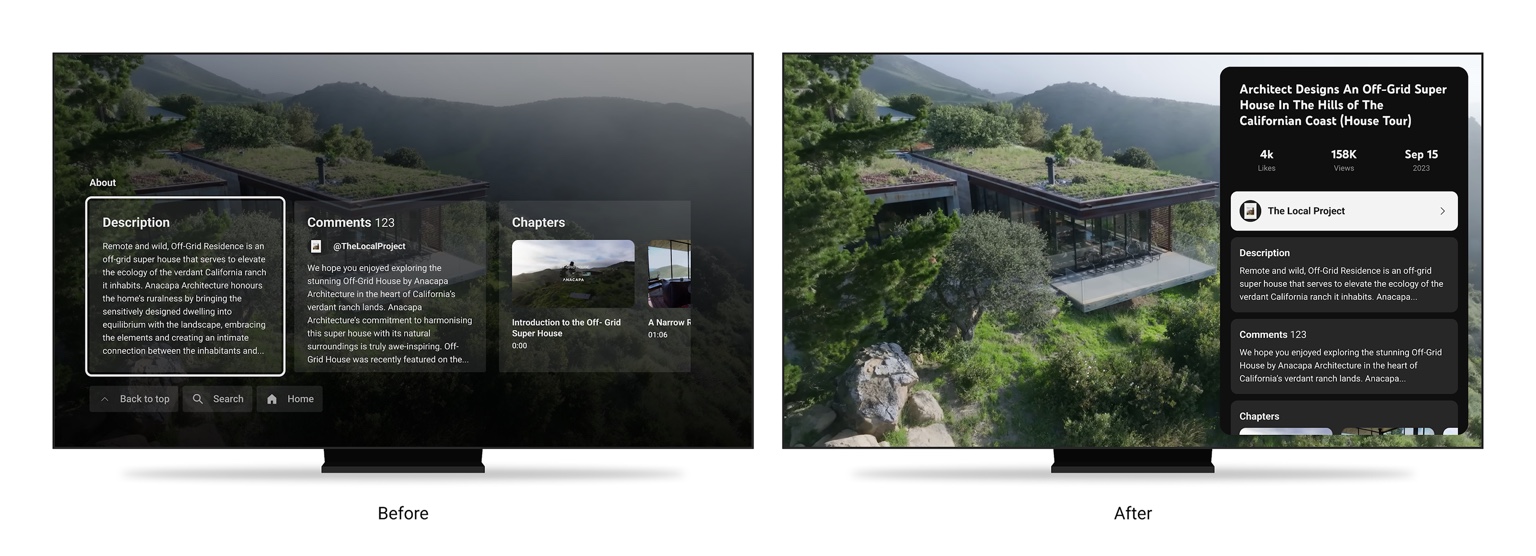
YouTube is responding accordingly. Posts are coming to television. Viewers will be able to use voice input to leave comments from their TVs. Shorts Series carries episodic creator programming onto the television screen. These are behaviors developed around creator culture being redesigned for the living room.
But programming is only one part of operating a media company. Someone still has to make the programming.
Here, YouTube is increasingly building the production department into YouTube itself. Studio tools can help creators research ideas, evaluate titles and thumbnails and examine how videos may perform before and after publication. YouTube is expanding experimentation beyond packaging, with plans that allow creators to test different versions of their work. Conversational editing pushes the idea further by allowing creators to describe changes they want made to footage while retaining the ability to refine the result themselves.
The important story is not simply that YouTube has added AI.
AI is the mechanism. The larger change is what that mechanism makes accessible.
Work that can involve researchers, editors, producers, audience analysts and marketing teams is increasingly being compressed into tools available from the same ecosystem where a creator publishes the finished video. That does not make those professions unnecessary, nor does it mean software can replicate everything those people contribute. It means the threshold for accessing some of their functions is becoming dramatically lower.
Then YouTube is building more of the business department around the creator.
Creator Partnerships gives brands ways to discover channels and work with creators. Ask Studio is being positioned to help creators respond to briefs and develop pitches. YouTube Shopping continues expanding internationally, while affiliate campaigns give brands additional ways to build commercial relationships around creator audiences. A creator can increasingly move from making the program to selling against the program without assembling all of that machinery independently.
Livestreaming is being reorganized around the same idea. YouTube is developing additional ways for creators to collaborate during live broadcasts, including systems intended to help creators find or be matched with other people who are streaming. Live Showdowns add an interactive layer supported by viewers, while expanded Watch With experiences create another path for creators to build programming around existing content.
Then there is language.
YouTube says more than 40 percent of live watch time comes from outside a creator’s home country. Planned real-time auto-dubbing for live video, beginning with English and Spanish, could make that international audience easier to reach. Localization has traditionally required additional resources. YouTube is trying to turn at least part of that process into a feature.
Even the less glamorous parts of running a media operation are appearing. Likeness-detection technology is expanding beyond faces toward speaking voices. Personalized comment moderation is designed to learn from the kinds of comments an individual creator has previously removed and hold similar messages for review. Those may sound like small creator tools, but they address problems that emerge when a person is no longer managing only videos. They are managing an audience, a business and an identity.
None of this means YouTube has eliminated the media company. And it does not mean creators suddenly control the system around them.
In fact, the opposite tension remains important. YouTube owns the platform. It controls the underlying distribution environment, recommendation systems, monetization policies and much of the technology connecting creators with their audiences. A creator may increasingly operate like a small media company inside YouTube while still building that company on architecture they do not own.
That tension is precisely what makes this moment more interesting than another collection of feature announcements.
A traditional media organization brings together a series of functions: development, production, programming, distribution, audience acquisition, advertising, commerce and rights management. YouTube is steadily placing versions of those functions within reach of individual creators. Not every creator will use all of them. Not every creator wants to become a media company. But the architecture is increasingly there for those who do.
For years, the creator economy was largely discussed through the language of influence: followers, subscribers, engagement and sponsorships. YouTube’s latest moves suggest a different vocabulary may be necessary for what comes next.
Shows. Episodes. Programming. Production. Distribution. Commerce. International audiences.
The creator is no longer being treated simply as the person who supplies the video.
YouTube is beginning to build the rest of the company around them.
Related Posts

LG Brings 6K Clarity and Thunderbolt 5 Speed to the Creative Workspace
Pixel Precision

BetMGM and Inspired Entertainment Launch MGM Bonus City, Revolutionary Hybrid Dealer® Game
By Brad Jerkins BetMGM, a leading iGaming and sports betting 

ROG Xbox Ally and Ally X: Where Console Soul Meets PC Power
Handheld Evolution
Sora 2 Launches: How OpenAI Is Reinventing AI-Driven Short Video
When AI Meets Social
Hi-Res Meets High Style: SteelSeries Introduces the Arctis Nova Elite
Gaming, Elevated
You Don’t Buy Samsung — You Live Inside It
A System, Quietly Everywhere
POST COMMENT