


Why Vertical Video Now Decides Who Gets the Next Opportunity

By Kyra Greene
For years, vertical video was treated as a distraction—something to be scrolled past rather than paid attention to. It was seen as a side effect of shrinking attention spans, a format built for immediacy but not longevity. But while the industry debated whether vertical content mattered, creators quietly repurposed it into something far more consequential. What emerged wasn’t just a new format, but a new system—one that now functions as a proving ground for storytelling, performance, and cultural relevance.
Vertical short-form video has stopped behaving like content and started operating like infrastructure. It tests ideas at speed, measures audience connection without mediation, and strips storytelling down to its most essential elements. In doing so, it has become one of the most influential development spaces in modern entertainment. Not because it’s louder, but because it’s closer—consumed inches from the face, judged instantly, and rewarded only when truth cuts through.
The misconception that short-form lacks discipline couldn’t be further from reality. Vertical storytelling demands precision. There is no room for indulgence, no patience for slow burn without payoff. Every moment must earn its place, every emotional beat must land cleanly, and every episode must justify the next. In contrast to traditional pilots—often bloated by budgets, committees, and development cycles—vertical narratives are subjected to immediate, public feedback. If something resonates, it travels. If it doesn’t, it disappears. The format enforces clarity in a way many legacy systems have quietly lost.
This shift has upended the concept of gatekeeping. What used to be decided behind closed doors now plays out in feeds. Pilots no longer premiere in boardrooms; they premiere in public. Audience behavior has replaced executive instinct as the first measure of viability. Retention, not prestige, signals success. Consistency, not access, builds leverage. Studios and producers are paying attention—not because vertical content imitates traditional media, but because it solves one of the industry’s oldest problems: proof. Vertical short-form doesn’t promise an audience. It demonstrates one.
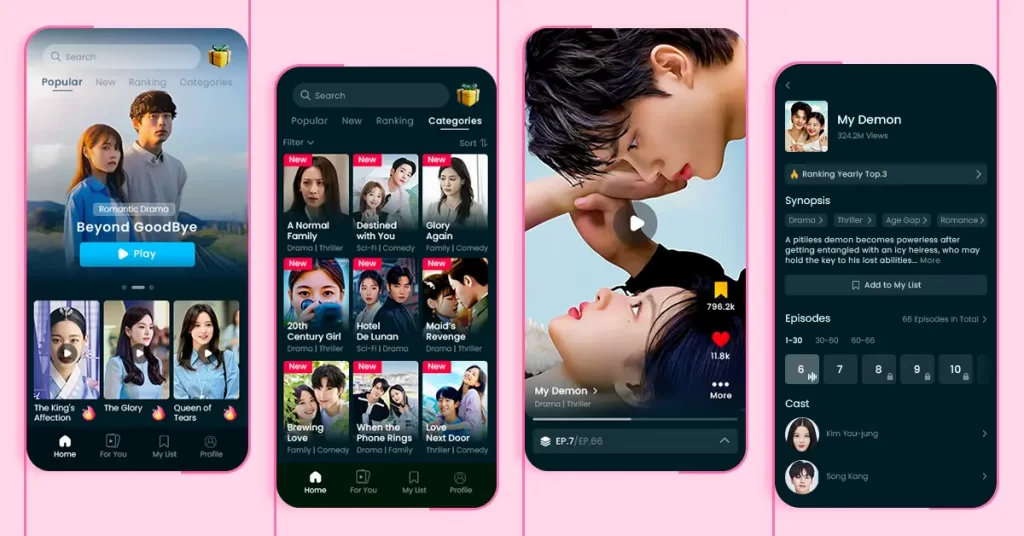
For actors, the implications are profound. Vertical storytelling has created a space where performance is evaluated on intimacy rather than scale. With the camera held so close, subtlety becomes power and overstatement becomes liability. Emotion must register cleanly, authenticity must feel immediate, and character must reveal itself quickly. Many performers are discovering that holding attention in this format requires more control, not less. Range is no longer theoretical—it’s documented, archived, and visible to anyone willing to look.
Writers, too, are being reshaped by the constraints. Vertical narratives reward structure, momentum, and emotional economy. There is no time for indulgent exposition, no forgiveness for scenes that exist without purpose. As a result, the format has become a training ground for storytelling discipline—one where craft is sharpened through repetition and immediate consequence. What survives does so because it works.
The assumption that short-form equals smaller ambition has also proven false. What’s emerging instead is modular storytelling—narratives designed to expand or contract based on response. A story might begin as a single episode, grow into a series, and evolve into something larger, all guided by audience engagement rather than speculative development. Attention becomes collaboration. Viewers don’t just watch the story unfold; they actively shape its lifespan through their participation.
There is also an economic shift embedded in this transformation, one that rarely receives the same attention as the creative implications. Vertical platforms have lowered the cost of experimentation to near zero while opening pathways to monetization and ownership that previously required institutional backing. Creators no longer have to wait for permission to test ideas. They can build proof directly, often faster than traditional systems can react. This doesn’t replace film or television—but it does challenge the monopoly those systems once held over opportunity.
Skepticism around vertical storytelling echoes familiar refrains. It’s been called unserious, uncinematic, temporary. The same was once said about streaming. What distinguishes this moment is that vertical storytelling isn’t seeking validation. It already functions on its own terms, with its own metrics, and with an audience that doesn’t differentiate between “real” and “new” media—only between what connects and what doesn’t.
Vertical short-form works because it lives where attention already exists. It doesn’t ask audiences to migrate. It meets them in the rhythms of their daily lives. That proximity alters everything: how authenticity is felt, how loyalty is built, and how success is defined. The feedback loop is live, global, and continuous. Creation and consumption occur in the same space, almost simultaneously.
None of this suggests that traditional film and television are disappearing. It suggests that the hierarchy that once governed storytelling is flattening. Ideas no longer need to be validated before they’re seen. They need only to resonate. Vertical short-form has become the place where voices are tested, talent is refined, and stories are pressure-tested before they scale. It is not a detour on the path to relevance. It is one of the clearest signs of where relevance now begins.
The future of storytelling won’t belong to a single format. But right now, one of its most powerful proving grounds fits in the palm of your hand.
Related Posts

Eddie Murphy’s Old School Meets Keke Palmer’s Criminal Cool in “The Pickup”
One Night Stand, One Big Heist

Innovative Eyewear Enlists Emmanuel Ogbah as Brand Ambassador
Smart eyewear manufacturer has announced Ogbah as a notable addition

Casio Unveils the GBD-300: The Latest Addition to the G-SHOCK G-SQUAD Line
G-SHOCK releases Workout Logs with More Comfortable Fit

Coach Welcomes Jayson Tatum as Ambassador
Coach proudly announces Jayson Tatum

The DICK’S Sporting Goods Foundation and LISC Grant $1.275 Million to Enhance Sports Facilities in 14 Cities and Towns with Under-Resourced Communities
The DICK'S Sporting Goods Foundation and LISC

Tamla Was the Blueprint. Now It’s the Test Again
Motown Isn’t Going Back. It’s Reinstalling the System