


When Women’s Sports Become the Main Event
By Jacob Miller
The athlete is alone when the work matters most. Knees in the blocks. Fingers pressed into the track. Eyes fixed down a lane that does not care who is watching. This is the part no one sees, and for a long time, it defined the entire category. Women’s sports were positioned as preparation—not because the level wasn’t there, but because the system around it wasn’t built to hold it.
That framing is already obsolete.
What changed is not the athlete. It is everything around the athlete. The crowd is no longer implied—it is present, layered, and paying attention. The sponsors are no longer tentative—they are embedded, visible, and aligned. The broadcast is no longer secondary—it is structured, scaled, and prioritized. The shift did not arrive through announcement. It arrived through accumulation.
Sports don’t change when someone declares them important. They change when attention compounds faster than the system can contain it.
That is what is happening now.
For years, the work existed in isolation. Training, competing, performing at a level that outpaced the infrastructure meant to support it. The gap between effort and exposure created a false narrative: that women’s sports were still building toward relevance. In reality, the relevance was already there. The system simply hadn’t caught up.
Now it has.
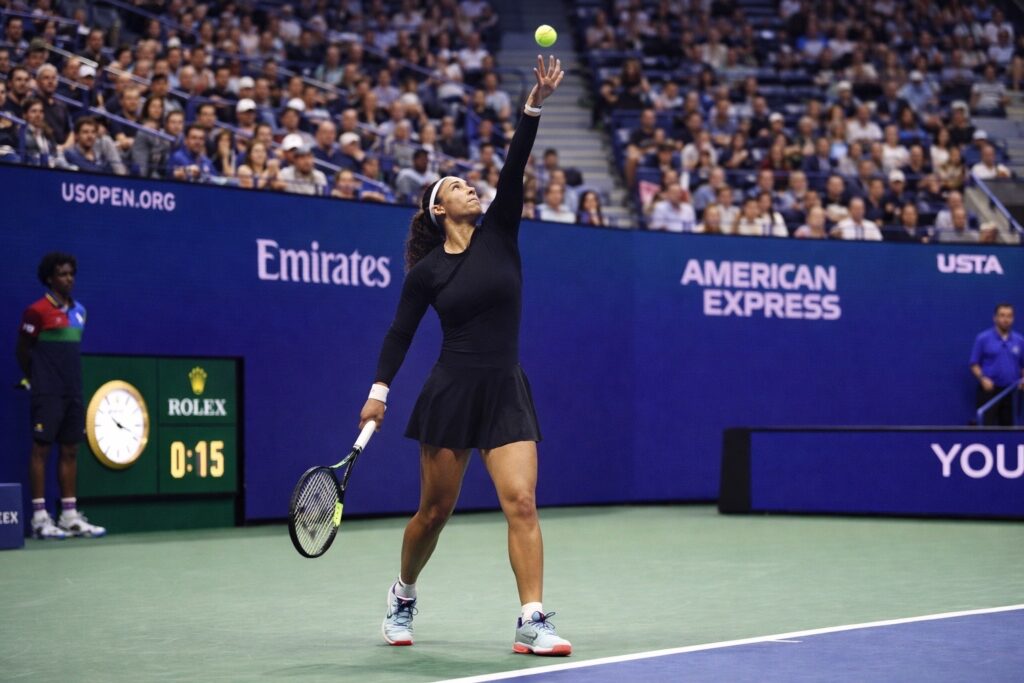
You can see it in the images the culture is producing. A runner in the starting blocks, still, contained, holding tension. A player mid-serve in a packed stadium, the ball suspended, the crowd locked in, the brands surrounding the moment not as decoration, but as confirmation. These are not separate scenes. They are the same system at two different speeds.
The first is preparation. The second is scale.
For decades, the category was judged by what it lacked: distribution, investment, visibility. But those were never indicators of value. They were indicators of infrastructure. And infrastructure follows attention.
Attention is the infrastructure now.
Once that shifts, everything downstream reorganizes. Sponsorship becomes inevitable, not experimental. Broadcast becomes central, not supplementary. The audience stops being framed as potential and starts behaving as demand. At that point, the category is no longer waiting to be validated. It is operating inside its own gravity.
This is the pattern that has repeated across culture. Music did not change when artists improved. It changed when distribution systems collapsed and rebuilt around attention. Film did not change when better stories were told. It changed when stars began to carry audiences independent of the studios that once controlled them. The structure always follows the signal.
Women’s sports are now generating a signal the system cannot ignore.
And when that happens, language lags behind reality. The conversation continues to frame the moment as growth, as momentum, as something still arriving. But the images contradict that framing. A full stadium is not growth. Global sponsors are not momentum. Sustained attention is not potential. These are indicators of arrival.
The category has already shifted. The system is simply catching up to what the audience has decided.
The athlete in the blocks does not need to be told this. The body understands what the culture is still processing. The tension is not hesitation. It is readiness. The stillness is not absence. It is compression before release.
The question is no longer whether women’s sports will reach the main event. The question is whether the systems built around them can keep pace with the speed at which they are already moving.
Because once attention locks, everything else follows.
The runner does not stay in the blocks. The system does not wait for permission to evolve.
When the audience arrives, the category changes.
This is no longer growth.
This is reclassification.
Related Posts

The collaboration between Nike and Spotify is sparking a transformative movement in the UK with the introduction of the Make Moves Fund
By Tucker Adams In the United Kingdom, a remarkable movement of libera

The Humanity of Performance: David Ajala on Storytelling as Survival
Stage, Screen, and Beyond

Feodor Chin Is Everywhere—And Nowhere You’d Expect
Every Voice, Every Moment

Target Serves Up Exclusive Pickleball Collection with Popular Tennis Brand Prince
Target Corporation has introduced an exclusive pickleball collection

The RLJ Companies Appoints Scott Royster as CFO of Caribbean CAGE
CAGE is licensed to operate video lottery and video gaming terminals,

From Bedroom Tapes to Big Screen: Jeremy Allen White Channels The Boss in Springsteen: Deliver Me From Nowhere
Soundtrack of Solitude
POST COMMENT