


When Crocs Stepped Into the Director’s Chair

By Chase Simmons
For most of the last century, advertising lived on the margins of entertainment. Brands interrupted television shows, sponsored radio programs, or purchased pages inside magazines. The relationship between commerce and culture was clear: one paid for attention, the other held it.
But something quieter is beginning to shift.
Today, companies are discovering that the most effective way to capture attention may not be through advertising at all. It may be through storytelling. And increasingly, brands are learning that instead of interrupting culture, they can step inside it.
When Crocs experiments with micro-drama storytelling, the move might seem like a clever marketing tactic. In reality, it signals a deeper cultural migration. Crocs is not simply promoting a product. It is participating in narrative.
For a generation raised on streaming platforms, TikTok arcs, and episodic social media storytelling, narrative has become the dominant container of attention. Traditional advertisements ask audiences to pause their experience for a message. Stories invite audiences to stay.
The difference may seem small, but it changes the entire structure of marketing.
A commercial appears once.
A narrative unfolds over time.
Micro-dramas — short serialized stories designed for mobile platforms — have become one of the fastest-growing storytelling formats in the world. Episodes often last only a few minutes, but they arrive in rapid succession, forming a rhythm of daily viewing that resembles the serialized television of earlier eras.
What makes micro-dramas powerful is not their length but their structure. They are built around cliffhangers, emotional tension, and characters audiences return to repeatedly. In other words, they function less like advertisements and more like miniature television series designed for the vertical screen.
For brands, this format solves a problem that advertising has struggled with for years: the fragmentation of attention. In a media environment where viewers skip commercials and scroll past sponsored posts, narrative offers something advertising rarely can — voluntary engagement.
A story is not something people avoid.
It is something people follow.
This is where the Crocs experiment becomes interesting. Crocs has always existed slightly outside the traditional fashion system. Its rise was fueled not by runway prestige but by internet culture — memes, collaborations, personalization, and a community that treated the product as both functional and playful.
That cultural flexibility makes Crocs a natural participant in narrative experimentation. A brand that already lives comfortably inside internet culture understands that storytelling online is rarely polished or cinematic in the traditional sense. It is fast, episodic, and social.
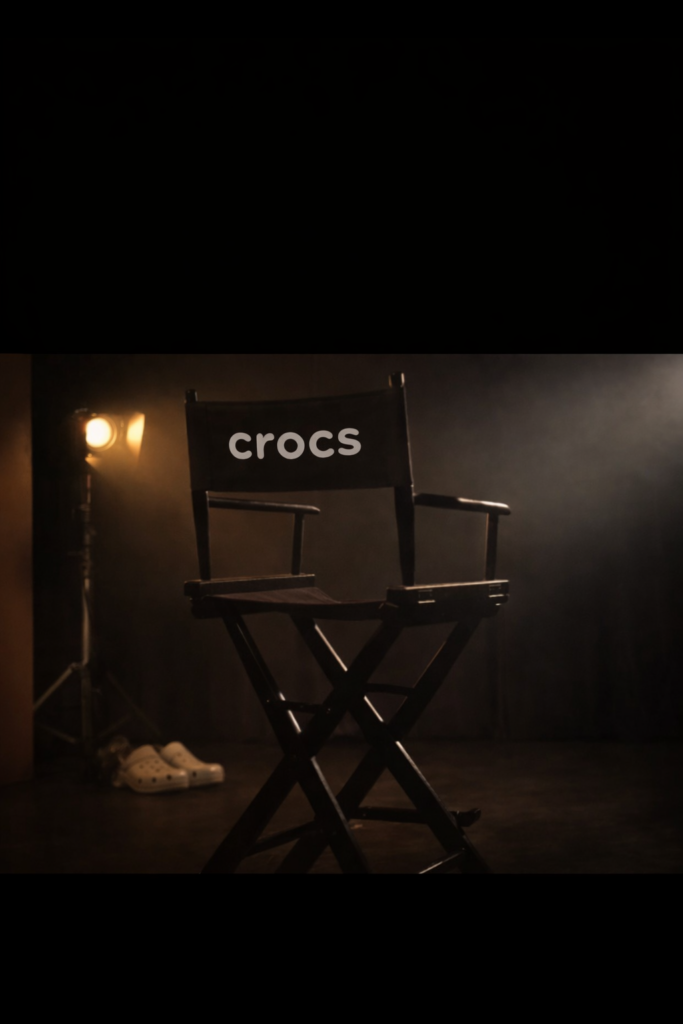
Micro-drama simply formalizes that behavior.
But the larger implication goes beyond Crocs.
For decades, companies funded storytelling from the outside. Brands sponsored television shows, purchased product placements, or advertised alongside films. Entertainment and advertising occupied different lanes of the cultural highway.
Today those lanes are beginning to merge.
Brands increasingly produce short films, narrative campaigns, documentary projects, and episodic content designed specifically for social platforms. Fashion houses release cinematic shorts. Technology companies build entire storytelling ecosystems around product launches. Even beverage companies experiment with serialized content that unfolds across multiple platforms.
The line between advertising and entertainment is becoming harder to see.
In this new environment, the product is no longer always the message. Instead, the product becomes a prop within a larger story — an object that exists inside a narrative world audiences choose to follow.
It is a subtle shift, but an important one.
Advertising once borrowed time from entertainment.
Now brands are learning that the most powerful marketing strategy may be to become the entertainment itself.
If the twentieth century built Hollywood as the center of global storytelling, the twenty-first may produce a more distributed system — one where media companies, creators, and brands all participate in shaping narrative culture.
Crocs stepping into micro-drama may look like a small experiment. But it reflects a much larger transformation in how companies think about attention.
Because in the modern media landscape, the companies that control stories may ultimately control culture.
And increasingly, brands are learning how to write their own scripts.
Related Posts
Netflix Unveils Trailer for Castlevania: Nocturne Season 2, Teasing High-Stakes Battles Between Vampire Hunters and Supernatural Forces
Netflix Releases Trailer for ‘Castlevania: Nocturne’ Season 2
Marvel Comics Celebrates Native American Heritage Month with Kahhori’s Epic Comic Debut
First Look at 'Kahhori: Reshaper Of Worlds' #1
David Yurman Unveils Michael B. Jordan as Global Ambassador for The Vault: A Pinnacle in Men’s High Jewelry
David Yurman introduces brand ambassador Michael B. Jordan.

What Happens When a Shoe Stops Explaining Itself
The Social Work of a Shoe

Usher Reveals Super Bowl Halftime Show Commercial: A 30-Year Journey Unleashed
Usher's Musical Journey Culminates at Apple Music Super Bowl Halftime

Keke Palmer’s ‘Just Keke’ Is a Radical Act of Self-Writing
Vulnerability as Power
POST COMMENT