
The Scroll Decides What Gets Made

By Simone Adler
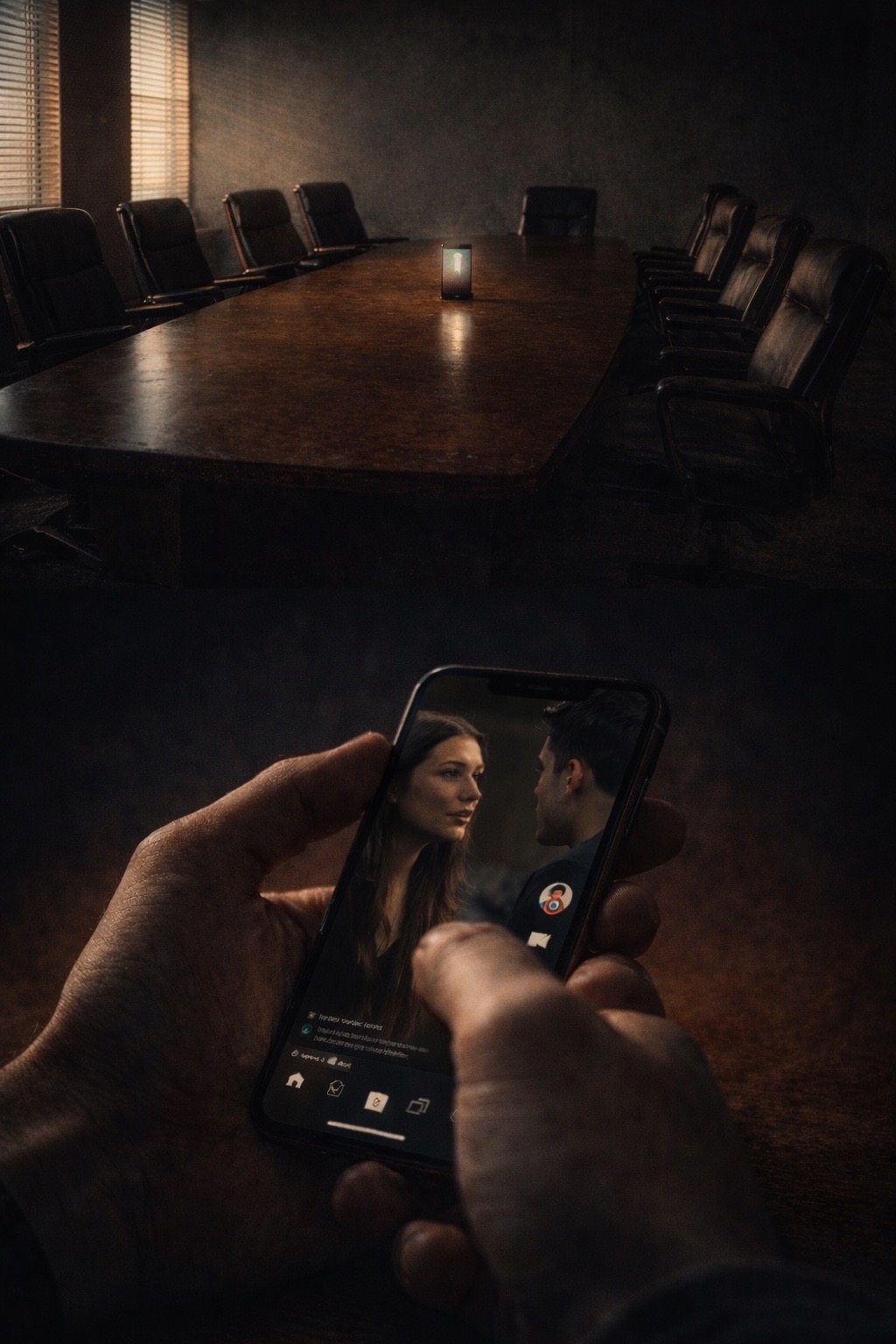
The room is still there. The table, the chairs, the language of authority—unchanged. Light comes through the blinds the same way it always has, cutting across wood that has held decisions for decades. But the center is empty now. Not physically—structurally.
Because the decision is no longer made in the room.
It’s made in the hand.
For most of modern entertainment, power had a location. You could point to it. It sat behind closed doors, inside conference rooms, carried by a small number of people tasked with deciding what the public would see next. Scripts were read. Pilots were tested. Executives debated. The greenlight was a moment, but more importantly, it was a place.
You had to enter the room to receive it.
That requirement is gone.
What replaced it didn’t arrive as a competitor. It arrived as behavior. A phone in the hand, a screen that never turns off, a feed that learns faster than any executive room ever could. At first, it looked like distribution. Then it became taste. Now it is authority.
The shift wasn’t announced. It was absorbed.
Short-form video didn’t just compress storytelling—it restructured decision-making. The first fifteen seconds became the new pilot. Retention became the new approval. Completion rate replaced the meeting. And instead of a room deciding for the audience, the audience—at scale, in real time—became the room.
Not metaphorically. Operationally.
This is why the content feels different. Not because it’s shorter, but because it’s engineered for a different gatekeeper. High-stakes narratives—romance, betrayal, revenge—aren’t new. What’s new is their calibration. Every beat is timed against attention. Every cut is measured against drop-off. Every episode is built not just to be watched, but to survive the scroll.
The greenlight is no longer given. It is earned, continuously.
And once you understand that, the image becomes clear.
An empty boardroom is not abandonment. It’s obsolescence. The structure still exists, but its jurisdiction has been transferred. The authority that once required presence now requires performance. You don’t walk into power anymore. You accumulate it—view by view, second by second.
In the past, distribution followed approval. Now approval follows distribution.
That inversion changes everything.
Studios used to decide what deserved to be seen. Now platforms decide what refuses to be ignored. And increasingly, they don’t decide alone. The system watches, learns, adjusts—quietly building a feedback loop where audience behavior is not just data, but governance.
This is why platforms are moving into original content. Not to imitate television, but to formalize what they already control. The infrastructure is already in place. The audience is already there. The only thing missing was ownership of the narrative layer.
That gap is closing.
What we’re watching is not the evolution of TV. It’s the relocation of the studio.
From the lot to the platform.
From the room to the feed.
From the executive to the system.
And once power relocates, everything built around it follows. Talent adapts. Formats compress. Stories accelerate. Even performance changes—because the audience is no longer waiting. It is deciding.
Continuously.
The room used to matter because access to it determined visibility. Now visibility determines access. That reversal is subtle, but absolute. It redraws the map of the industry without needing permission from it.
Which is why the quietest detail is the most important.
The TV is still on.
It’s just no longer being watched.
The screen in the hand is brighter. Closer. More responsive. It doesn’t ask for attention—it holds it. And in a system where attention is the only currency that matters, proximity becomes power.
This is the part that feels like a shift.
Not because something new has appeared, but because something old has lost control without disappearing. The room still exists. The meetings still happen. But the outcome is increasingly shaped somewhere else—somewhere smaller, faster, and infinitely more precise.
The greenlight didn’t vanish.
It moved.
And it’s not coming back.
Related Posts

Drake’s OVO Hits the Fairway: Streetwear Swagger Meets Callaway Precision
By Jayson Echo Drake’s OVO has officially taken its talents to the f

Ja Morant’s Nike Ja 2 ‘Stargazer’ Colorway Nears Release
Official Look at the Nike Ja 2 "Stargazer"

Taylor Fritz Takes on New Role as Global Ambassador for BOSS
Taylor Fritz embraces new role as BOSS’ global ambassador

The Op Games Unveils MONOPOLY®: Grey’s Anatomy Edition, Inspired by the Beloved Drama Series
MONOPOLY®: Grey's Anatomy Edition, Based on Popular Drama Series
Hennessy Paradis x LOEWE: A Fusion of Luxury, Craftsmanship, and Design
Hennessy And LOEWE colloborate.

Chief of War and Beyond: Siua Ikale’o’s Journey Through Truth
From Tonga to Hollywood
POST COMMENT