

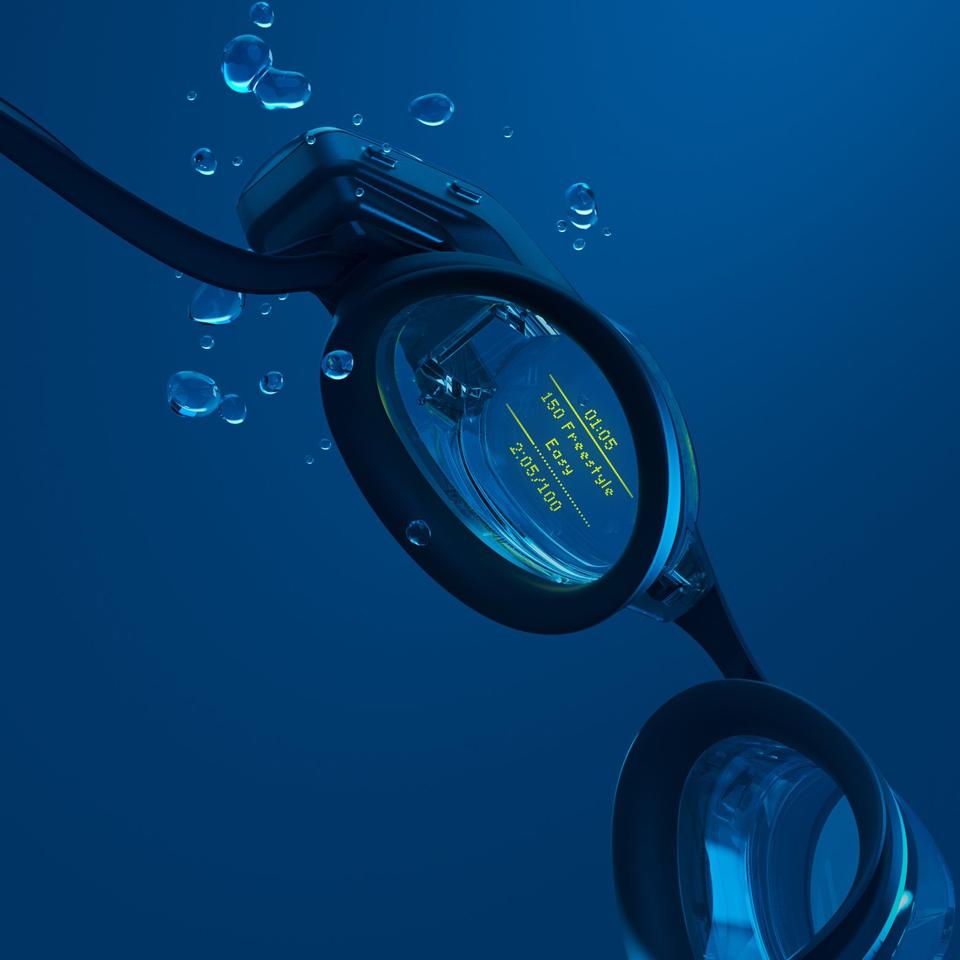
The Quiet Screen: Why AR Is Finding Its Home Underwater
By DaMarko J. Webster
Swimming has always resisted spectacle. There is no applause underwater, no notifications to answer, no audience waiting for performance. There is only breath, repetition, resistance. Which may be why augmented reality—so often imagined as something loud or visible—feels unexpectedly natural beneath the surface.
In the pool, technology doesn’t get to compete for attention. It has to behave.
That’s the quiet revelation behind the current emergence of AR swim goggles. Not as novelty, and not as entertainment, but as a recalibration of how information meets the body. Feedback arrives in rhythm with motion. It doesn’t interrupt; it accompanies. And when it’s no longer needed, it recedes.
This is not the future promised by billboards and demos. It’s subtler. More disciplined.
Swimming, by nature, is honest. Every lap exposes inconsistencies: pacing, breath control, hesitation. There’s nowhere to hide. In that environment, data can’t afford to be noisy. It must be precise, contextual, and brief—useful enough to guide, restrained enough to respect the work being done.
AR swim goggles propose the opposite relationship to most modern tech: intelligence without insistence. Feedback without friction.
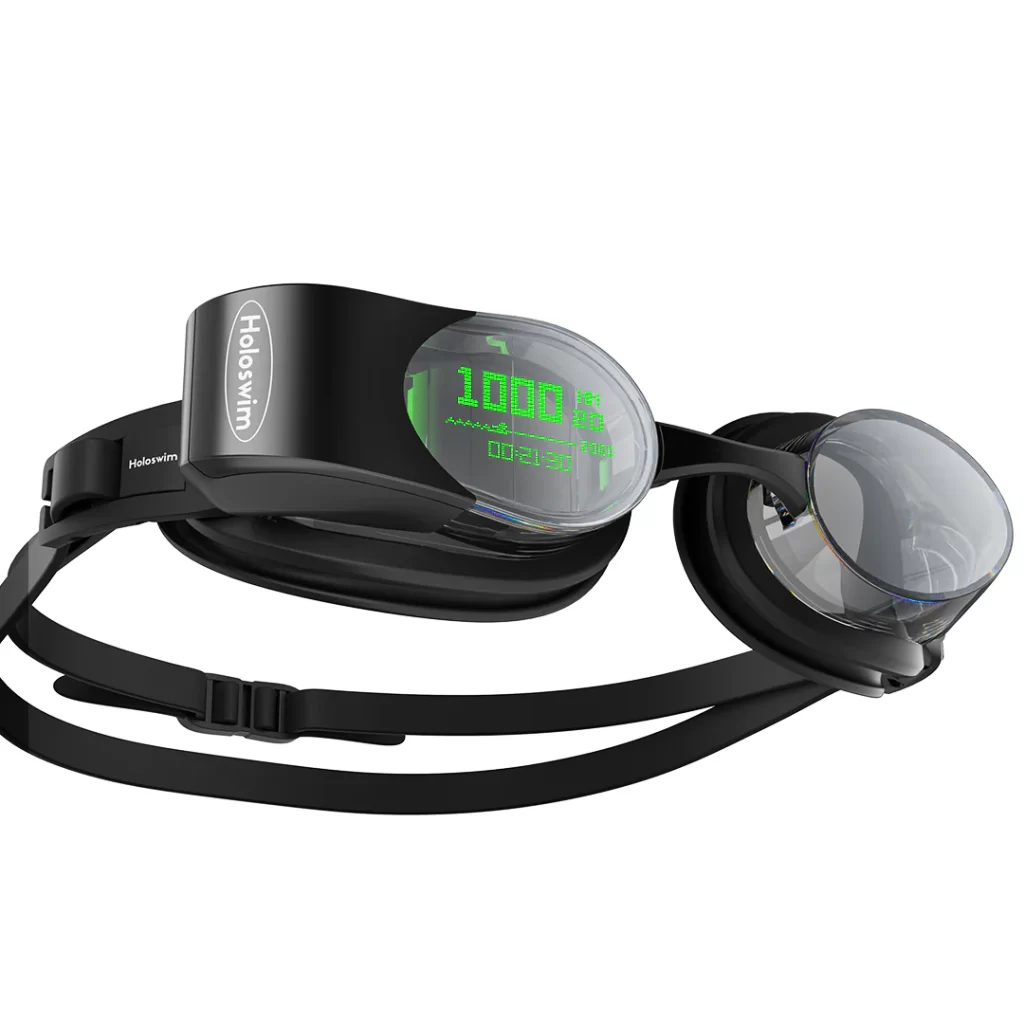
We’ve spent time swimming with Holo’s AR goggles—not to test their limits, but to understand their intent—and what stands out is how quickly they dissolve into the rhythm of the work itself.
Devices like Holoswim’s AR swim goggles belong to a larger cultural shift—one that treats technology less like a screen and more like a whisper. Information appears when it’s relevant, disappears when it’s not, and leaves the swimmer in control of their own rhythm. What’s compelling isn’t the presence of data, but its restraint.
This signals a departure from the dominant tech narrative of the past decade. We’ve grown accustomed to devices that ask for constant attention. Wrist-based alerts. Vibrating pockets. Endless overlays. AR swim goggles offer a different contract—one based on trust. They assume the user knows what they’re doing, and they intervene only when clarity is needed.
In water, that distinction matters. There is no scrolling mid-lap. No second-guessing every metric. The body absorbs what it needs and keeps moving. Technology doesn’t lead the experience—it shadows it.
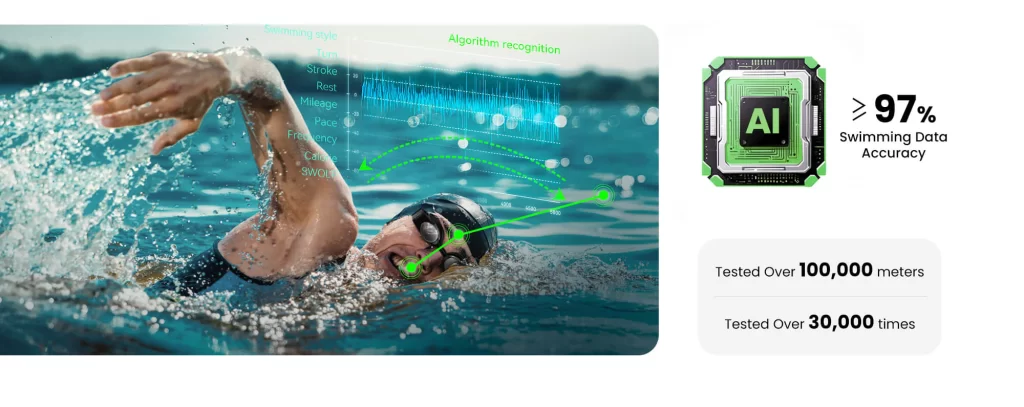
That dynamic places AR swim goggles closer to modern design objects than consumer gadgets. Like a well-designed chair or a thoughtfully engineered vehicle, their success is measured by how seamlessly they disappear into use. The best moments are the ones you barely notice at all.
Culturally, this matters. We’re living through a recalibration of performance—where discipline outpaces motivation, and consistency outweighs spectacle. High performers across creative, athletic, and professional worlds are no longer chasing more tools; they’re choosing fewer, better ones. Tools that respect focus. Tools that understand context.
AR in the pool reflects this shift with unusual clarity. It’s not about gamifying effort or turning training into content. It’s about sharpening awareness—pace, time, distance—without breaking concentration. The swimmer stays with the work. The work stays uninterrupted.
There’s also something quietly radical about where this technology has landed. Augmented reality was once framed as outward-facing—glasses, streets, public space. Here, it moves inward. Toward breath. Toward proprioception. Toward instinct. The interface no longer competes with the world; it aligns with the body navigating resistance.
That alignment hints at what comes next—not just for sports technology, but for intelligent living more broadly. As devices mature, the question won’t be how much they can show us, but how well they know when to stay silent. How gracefully they support judgment under pressure. How intentionally they avoid spectacle.
AR swim goggles aren’t interesting because they add information. They’re interesting because they edit it. They represent a future where technology earns its place by knowing when to disappear—and where performance is guided, not distracted.
Underwater, clarity isn’t optional. It’s survival. And perhaps that’s why some of the most forward-looking interfaces are learning to swim first.
Related Posts
Lucid Air Goes Full Android: Wireless Auto Integration Arrives
Connected in Style
Instagram’s “Your Algorithm” Feature Is a Quiet Power Shift
Reels, Rewritten

ROKFORM Unveils Pro Ball Motorcycle Mount: Premium Quality, Secure Hold, and Infinite Adjustability
ROKFORM, a leading innovator in premium handheld solutions for active

Dove and Open Source Afro Hair Library Introduce Code my Crown: Empowering Authentic Representation in Video Game Hairstyles
Dove, in collaboration with the Open Source Afro Hair Library
The Olympics as Modular Culture
Mass Events, Private Experiences
Mic 3 Joins DJI’s OsmoAudio Ecosystem with Precision, Power, and Portability
Mic Check, Future Ready