


The Optimized Silhouette
By Jessica Simmons
There was a time when clothing began with uncertainty. Fabric was cut, draped, pinned, adjusted. Tailors worked in conversation with the body, not in control of it. The outcome was discovered slowly—through touch, through gravity, through error. Even ready-to-wear, for all its efficiency, was still an approximation: a system built on averages, hoping to land close enough to feel right.
Fashion, at its core, was always a negotiation between intention and reality.
That negotiation is ending.
In the emerging fitting room, the mirror no longer reflects—it resolves. What stands before it is not simply seen, but interpreted, processed, and returned as something cleaner, tighter, more complete. The garment doesn’t just hang; it aligns. The posture doesn’t drift; it corrects. The body, once the starting point, becomes a variable inside a system designed to produce a better outcome than reality itself.
This is the shift: fashion is no longer responding to the body. It is calculating it.
The implications run deeper than novelty. What tools like NVIDIA’s virtual try-on systems—or the early deployments across brands like Zara and Amiri—introduce is not convenience, but authorship. The fitting room is quietly becoming a site of decision-making, where the “best version” of a look is determined before the garment ever exists in motion. Fit becomes prediction. Drape becomes simulation. Taste becomes data-informed.
And once the system can decide how fabric should fall, it begins to suggest how the body should stand.
This is not unprecedented. Fashion has always moved toward standardization. The transition from bespoke tailoring to industrial sizing in the early twentieth century marked a similar moment of compression—when individual bodies were translated into measurable categories. Small, medium, large. Chest, waist, inseam. It was a compromise between scale and specificity, trading precision for accessibility.
But even then, the garment met the body halfway.
Now, the system doesn’t meet the body—it precedes it.
What we are witnessing is a second-order evolution: from standardization to simulation. The difference is subtle, but critical. Industrial sizing asked, “Which category do you fit into?” Simulation asks, “What is the optimal version of you in this garment?” And then it shows you that answer—visually, convincingly, almost imperceptibly improved.
The tension lives there, in the mirror.
The human figure carries slight imbalance, lived-in posture, the quiet irregularities of reality. The reflected figure—nearly identical at first glance—holds itself differently. The line is cleaner. The garment falls with more intention. The expression is resolved, not searching. Nothing is exaggerated. Nothing announces itself. But something has been decided.
You are no longer looking at yourself.
You are looking at a version of yourself that has already been approved.
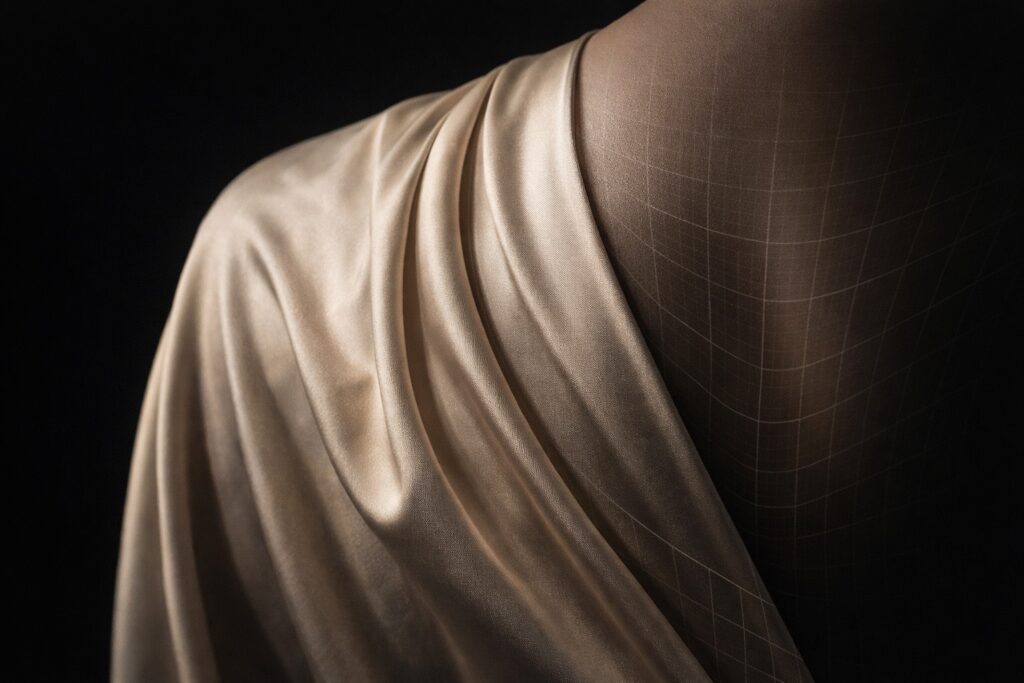
And beneath that moment—beneath the silhouette, the lighting, the subtle correction—is a deeper transformation. Fabric itself is being redefined. Once governed by physics—weight, friction, tension—it now exists as a set of parameters. A surface to be modeled. A behavior to be predicted. The fold is no longer discovered; it is generated. The drape is no longer experienced; it is resolved.
Material becomes information.
This is where fashion leaves the language of craft and enters the language of systems. Not loudly, not disruptively, but with the quiet confidence of something that works. The better it performs, the less it needs to explain itself. The interface fades. The result remains.
And the result is seductive.
Because the system doesn’t distort you—it improves you. It doesn’t replace your identity—it refines it. The promise is not transformation, but alignment: a version of you that feels more correct than the one you arrived with. Over time, that version begins to set the standard. Not just for what you wear, but for how you expect to appear.
This is how convergence begins.
Fashion has always shaped aspiration. But aspiration once lived in imagery—in campaigns, in magazines, in distant ideals. Now it lives in the mirror, personalized, immediate, and specific to you. The distance collapses. The ideal is no longer abstract. It is rendered, in real time, on your own body.
And once you’ve seen that version of yourself, it becomes difficult to return to approximation.
This is the quiet power of simulation. It does not demand change. It suggests it—consistently, precisely, and without friction. The more accurate it becomes, the more invisible it feels. Until eventually, the distinction disappears.
Clothing is no longer chosen.
It is resolved.
And the mirror, once a passive surface, becomes the place where reality is negotiated—and, increasingly, decided.
Related Posts

Secure Your Device According to Your Preferences with Samsung’s Auto Blocker
Samsung Electronics has unveiled Auto Blocker

Tony Hawk’s Pro Skater 3 + 4 Remake Officially Drops This Summer
Iron Galaxy Studios, Tony Hawk, and Activision Team Skateboarding Expe

Wondershare Elevates Screen Recording and Editing with AI-Powered DemoCreator 7
Wondershare DemoCreator, a trailblazer in integrated recording and edi

Apple and MLB Bring Back ‘Friday Night Baseball’ for 2025 SeasonFans Can Enjoy Weekly Doubleheaders with No Blackouts and Enhanced Coverage
Friday Night Baseball returns to Apple TV+ March 28th

Gogoro Introduces Pulse, its Latest Cutting-Edge Smart scooter
Gogoro Unveils New Flagship Smartscooter, Pulse.

Samsung and Google Cloud Forge Groundbreaking Partnership to Integrate Advanced AI Technologies into Galaxy S24 Series
Samsung and Google Cloud announced a multi-year partnership
POST COMMENT