

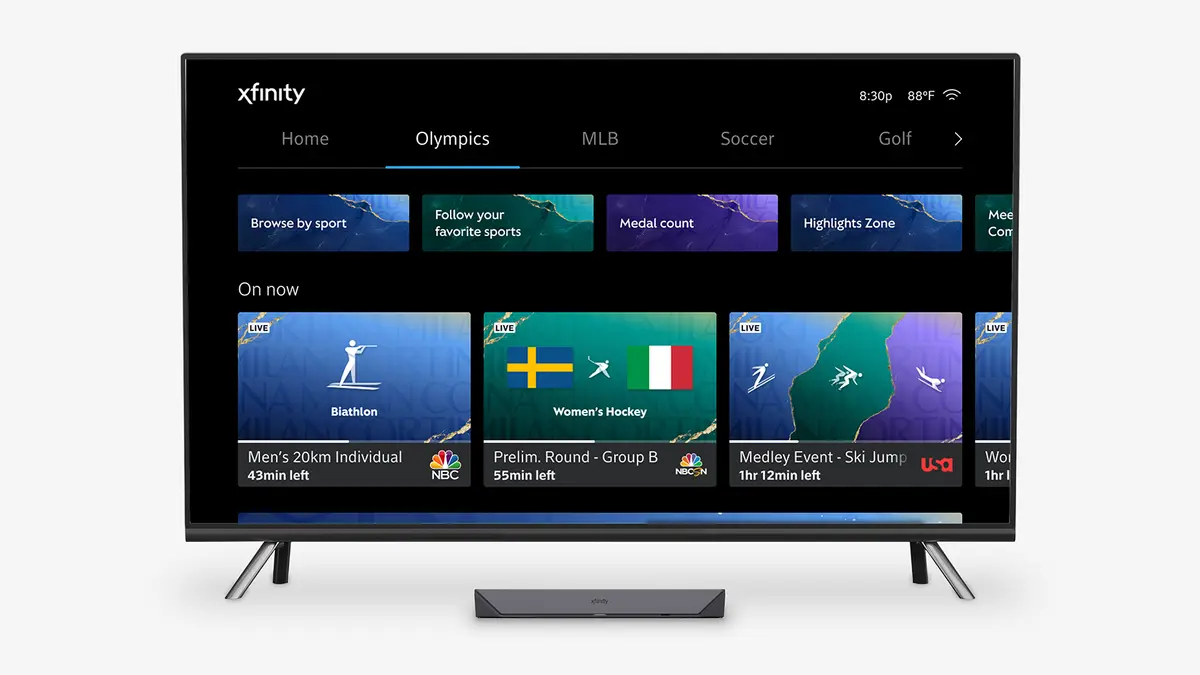
The Olympics as Modular Culture
By Brian k. Neal
For more than a century, the Olympics functioned as one of culture’s last truly shared moments. Entire cities paused. Nations synchronized their attention. Millions watched the same images, in the same order, through the same editorial lens. The power of the Games wasn’t only athletic—it was architectural. The broadcast dictated not just what we saw, but how memory itself would later recall it.
That architecture is now being quietly dismantled.
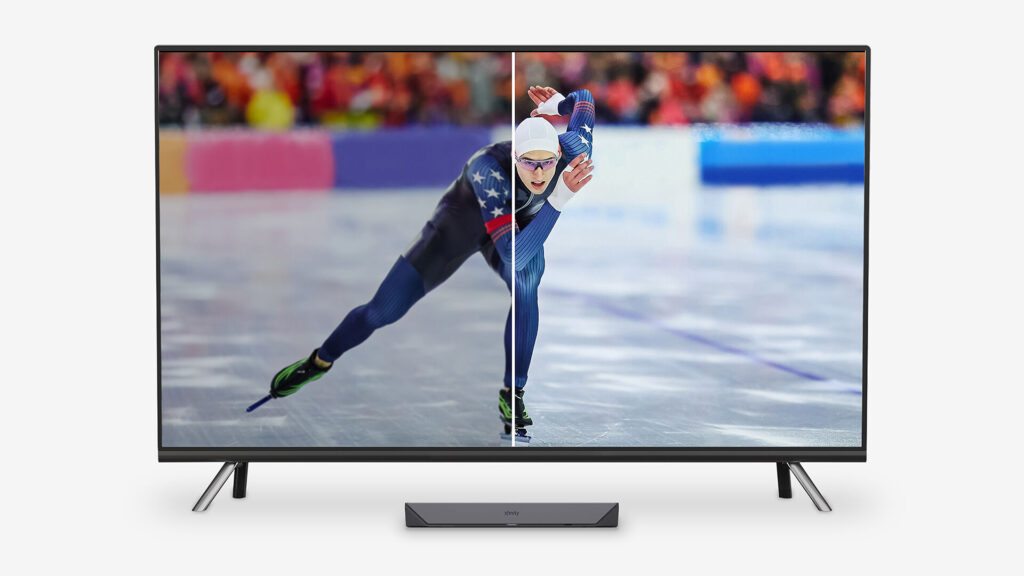
With its latest Olympic viewing framework, Comcast, through Xfinity, is not enhancing the Games so much as unbundling them. Customized viewing dashboards, selectable multiview feeds, and real-time 4K delivery do more than sharpen image quality or reduce friction. They redefine authorship. The viewer is no longer guided through the spectacle; they assemble it themselves.
At first glance, this appears to be a story about choice—more feeds, more angles, more control. But control is never neutral. When viewers choose which sport to foreground, which athlete to follow, which moment to ignore, the role traditionally held by broadcasters dissolves. Editorial hierarchy collapses into personal priority. The Olympic narrative, once sculpted by producers and directors, fragments into millions of privately authored timelines.
This is the deeper shift GREAY is documenting.
The Olympics were never just a sporting event; they were a cultural compression algorithm. They decided what mattered this week, what symbolized greatness, what images would outlive the moment and enter history books. Technology like RealTime 4K and multiview doesn’t merely upgrade that system—it replaces it with infrastructure. Culture is no longer curated for the audience; it is provisioned to them.
Infrastructure changes behavior. When everything is available, attention becomes selective. When spectacle becomes modular, memory becomes uneven. The heroic arc of an athlete once discovered through repetition and shared exposure now risks dissolving into isolated moments experienced alone. The crowd remains massive, but the experience becomes solitary.
This is not decline. It is migration.
Xfinity’s Olympic framework reveals how mass media is evolving across every domain: from film to music, from politics to fashion. Events once engineered for collective absorption are being refactored for individual traversal. The result is power moving away from institutions that narrate culture and toward systems that distribute it.
And yet, paradoxically, this personalization demands even greater scale. Only platforms with immense technical reach, distribution infrastructure, and data fluency can afford to decentralize experience without losing cohesion. The Olympics don’t become smaller in this model—they become denser. More feeds. More data. More simultaneous realities occupying the same moment in time.
This is why the story matters beyond sport.
What Comcast is building is not a better broadcast; it is a template. A vision of how future global events will function when storytelling no longer flows from a single source outward, but from infrastructure inward to the individual. The audience becomes the editor. The feed becomes raw material. Meaning becomes something assembled, not delivered.
In this future, prestige is no longer defined by access, but by intentionality. Luxury is not resolution—it is authorship. To choose is to shape. To shape is to own the experience.
The Olympics, once the ultimate example of collective cultural memory, now stand at the edge of something more complex: a world where everyone watches the same event, but no two people see the same Games.
This is not a story about 4K.
4K is incidental.
This is a story about how culture quietly learns to let go of the center—and how technology builds the systems that make that loss feel like freedom.
Related Posts

Siemens and AWS Collaborate to Democratize Generative AI in Software Development
Siemens and AWS are deepening their collaboration

Saudi Arabia’s Ambitious Leap into the Gaming Industry: A Vision for Powerhouse Status
In recent years, Saudi Arabia has set its sights on becoming a formida
Meet the New King of Handhelds: AYANEO NEXT II Brings Console Luxury to Your Fingertips
Pocket Titan

Belkin Unveils Auto-Tracking Stand Pro: Elevating iPhone Filmmaking in 2024
Belkin has just introduced Auto-Tracking Stand Pro.

Illuni Marks the Dawn of Virtual Socialization’s New Era with Global Debut of Moii
Moii, a virtual platform that revolves around avatar-based social conn

Google Unveils Gemini, Its Most Powerful and Extensive AI Model Yet
Google has introduced its latest and most advanced AI model named "Gem