

The Body Is the Interface Now
By Jaque Pierre
There was a time, not so long ago, when a sneaker’s purpose felt settled. It carried you forward. It signaled allegiance. It completed the sentence of an outfit already understood. Rubber and foam, engineered for motion, wrapped in the language of culture.
But culture rarely shifts all at once. It moves quietly, almost politely, introducing new ideas in forms that appear familiar enough to ignore.
What is emerging now does not announce itself as a revolution. It arrives as a suggestion.
A subtle recalibration in how objects relate to the body. Not louder. Not faster. Not more expressive. But more intimate. Less concerned with how something looks, and more concerned with how it feels from the inside out.
For decades, the trajectory of performance design has been outward-facing. Lighter materials. Greater responsiveness. More efficient energy return. Progress that could be measured, tested, verified. The body, in this equation, was something to optimize—but always from the outside.
What is beginning to take shape now moves in the opposite direction.
It starts not with output, but with state.
The premise—still forming, still unproven, but increasingly difficult to ignore—is that the body is not merely something products sit on. It is something they can communicate with. That sensation, applied deliberately and consistently, can influence awareness. Readiness. Focus.
Not dramatically. Not in a way that demands attention. But subtly, persistently, in ways that accumulate.
If the language feels unfamiliar, it is because we have been trained to recognize interfaces only when we can see them. Screens. Dashboards. Notifications. Information presented and interpreted visually.
But there is another layer of interaction—older, quieter, and far more direct.
Touch.
Pressure.
Physical feedback that bypasses interpretation and moves straight into the nervous system.
It is here, at this intersection, that a new category begins to take shape.
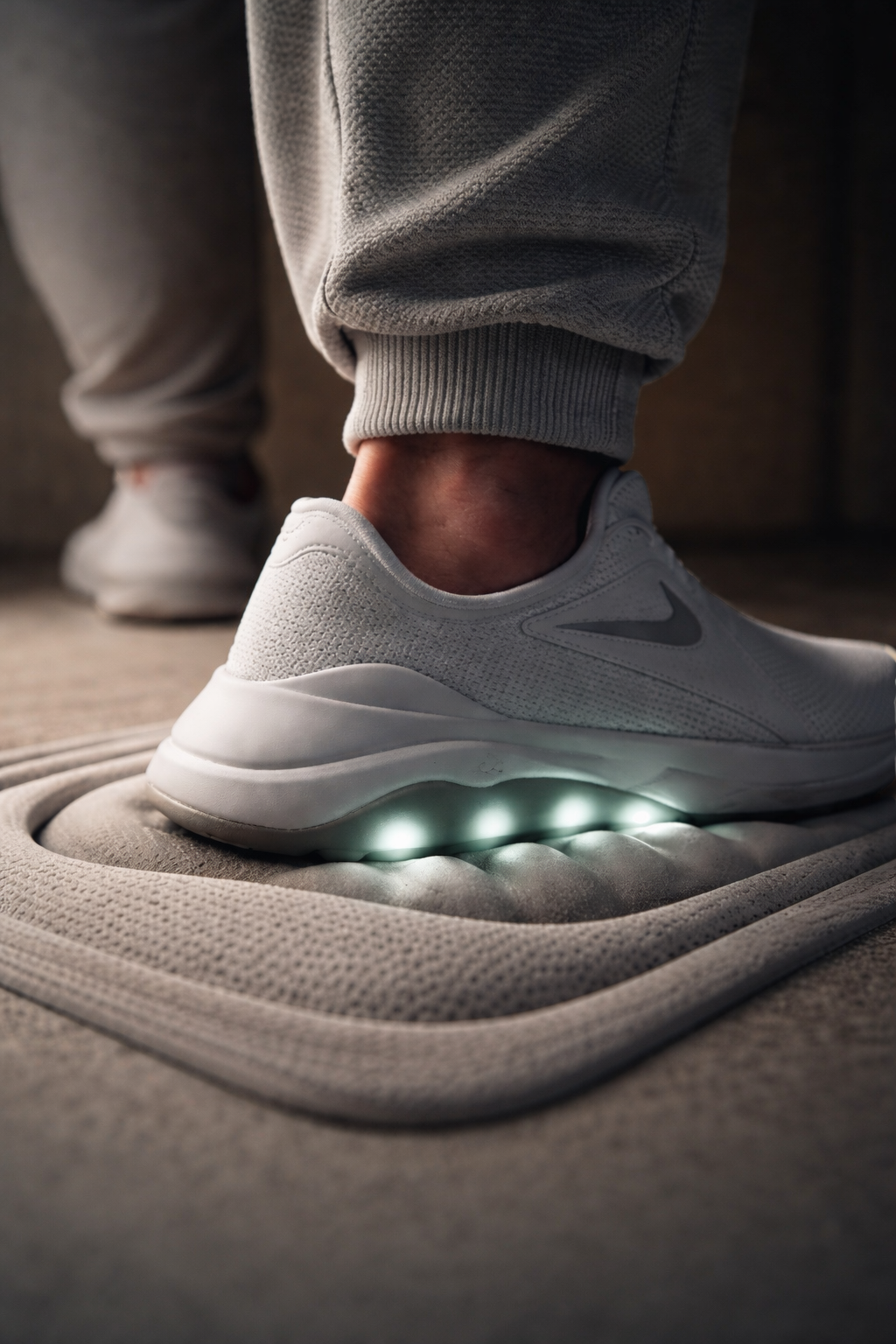
Recently, a product has started to circulate—unassuming in its form, almost casual in its presence. The Nike Mind 001 does not present itself as a breakthrough in the traditional sense. There are no dramatic visual cues, no overt technological declarations.
Instead, it offers something more restrained.
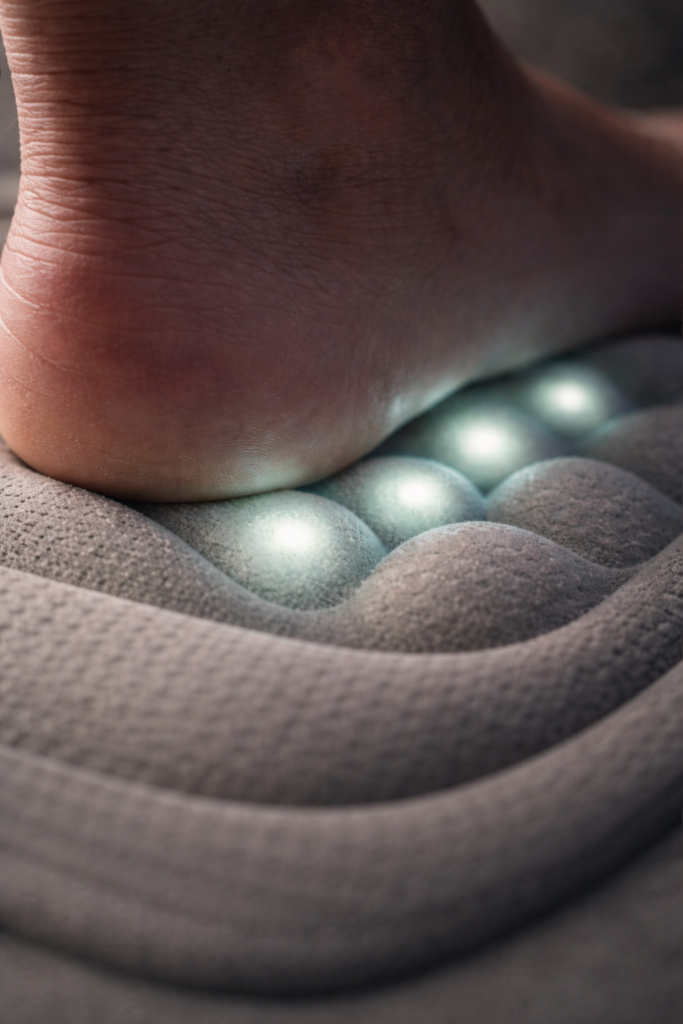
Beneath the foot, a series of subtle nodes create a continuous, low-level stimulation. The effect, in reality, is quiet—felt more than seen. But the implication is clear enough to register.
That sensation might influence something less visible than movement.
Focus.
Readiness.
State.
It is a modest gesture, but a revealing one. Because it marks a shift from products that respond to the body to products that attempt—however cautiously—to influence it.
There is a familiar rhythm to moments like this. When the Leica I was introduced, it did not declare itself as a philosophical object. It was simply smaller, more portable, easier to carry. Yet what changed was not just the camera, but the behavior of the person holding it. Movement became more fluid. Observation more immediate. The world felt closer.
The tool reshaped perception.
What we are seeing now follows a similar structure, though directed inward rather than outward. The ambition is not to change how we capture the world, but how we experience ourselves within it. How we prepare. How we arrive. How we engage.
That is a more elusive territory—and a more consequential one.
Sneaker culture, for all its surface-level associations, has always been attuned to these early signals. Not necessarily in language, but in instinct. A recognition that something new is forming before it has been fully defined.
The response is not driven by comfort alone, nor even by design. It is driven by proximity to an idea. The feeling of being close to a shift before it becomes obvious.
And yet, the success of such an idea does not depend on immediate validation. It rarely does. Culture does not wait for scientific certainty. It moves when something feels plausible enough to believe.
Belief shapes behavior.
Behavior shapes markets.
And markets, eventually, shape reality.
We have seen this progression before. Recovery footwear moving from the margins into everyday life. Wellness practices dissolving into daily routine. The language of optimization—once reserved for elite athletes—expanding outward into the lives of anyone seeking an edge, however subtle.
What is forming now builds on that foundation, but extends it.
Footwear, once neatly divided between style and performance, begins to suggest a third possibility. Less visible. Less easily categorized. A product designed not only to support movement, but to influence the internal conditions that precede it.
Not faster.
But more prepared.
Not stronger.
But more aware.
If this trajectory continues—and it is, at the very least, directionally clear—the implications extend far beyond sport. The audience expands beyond the athlete to include anyone whose outcomes are shaped as much by mental state as by physical ability.
The creator.
The executive.
The performer.
The individual navigating a world that increasingly rewards focus and fragments attention.
In that context, the question shifts.
It is no longer whether a sneaker can improve performance in the traditional sense. It is whether it can influence the conditions that make performance possible at all.
That is a different kind of ambition. Harder to measure. Harder to prove. But potentially far more valuable.
Of course, not every attempt at defining a new category succeeds. Many dissolve into novelty, remembered briefly before being replaced. It is entirely possible that this moment will follow that path.
But it is equally possible that we are witnessing the early articulation of something more durable. A category positioned at the intersection of performance, wellness, and technology—yet not fully owned by any of them.
And categories, once established, have a way of reorganizing everything around them.
For now, the signal remains subtle. Easy to overlook. Easy to dismiss. But its direction is unmistakable.
Sneakers are no longer content to simply exist on the body.
They are beginning—quietly, cautiously—to interact with it.
And once that interaction becomes intentional—once products are designed not just to support the body, but to communicate with it—the boundary between object and experience begins to shift.
The body is no longer just something we dress.
It is becoming something we design for.
Something we respond to.
Something, perhaps, we are only just beginning to understand.
Related Posts

Grand Marnier and Teezo Touchdown Celebrate 50 Years of Hip-Hop with Festive “(W)rapping Paper” Initiative
Grand Marnier is commemorating 50 years of hip-hop in style this festi

Ancestry Inspires People to Discover, Preserve and Represent All That They Are With “It’s a Family Thing” Integrated Brand Campaign
By Tanner James Ancestry®, the global leader in family history, today

Maison Kitsuné Unveils Its Latest Footwear Innovations: The Sora Runners and Chiru Trainers
Maison Kitsuné Unveils Its Latest Footwear

Casio Unveils the GBD-300: The Latest Addition to the G-SHOCK G-SQUAD Line
G-SHOCK releases Workout Logs with More Comfortable Fit

Enter the Grid Again: Tron: Ares Trailer Launches New Era of Digital Chaos
By Kyra Greene After more than a decade of silence, the Tron universe

adidas Originals Teams Up with BAPE® for Special Stan Smith Collaboration Celebrating BAPE®’s 30th Anniversary
Stan Smith Collaboration Celebrating BAPE®'s 30th Anniversary
POST COMMENT