

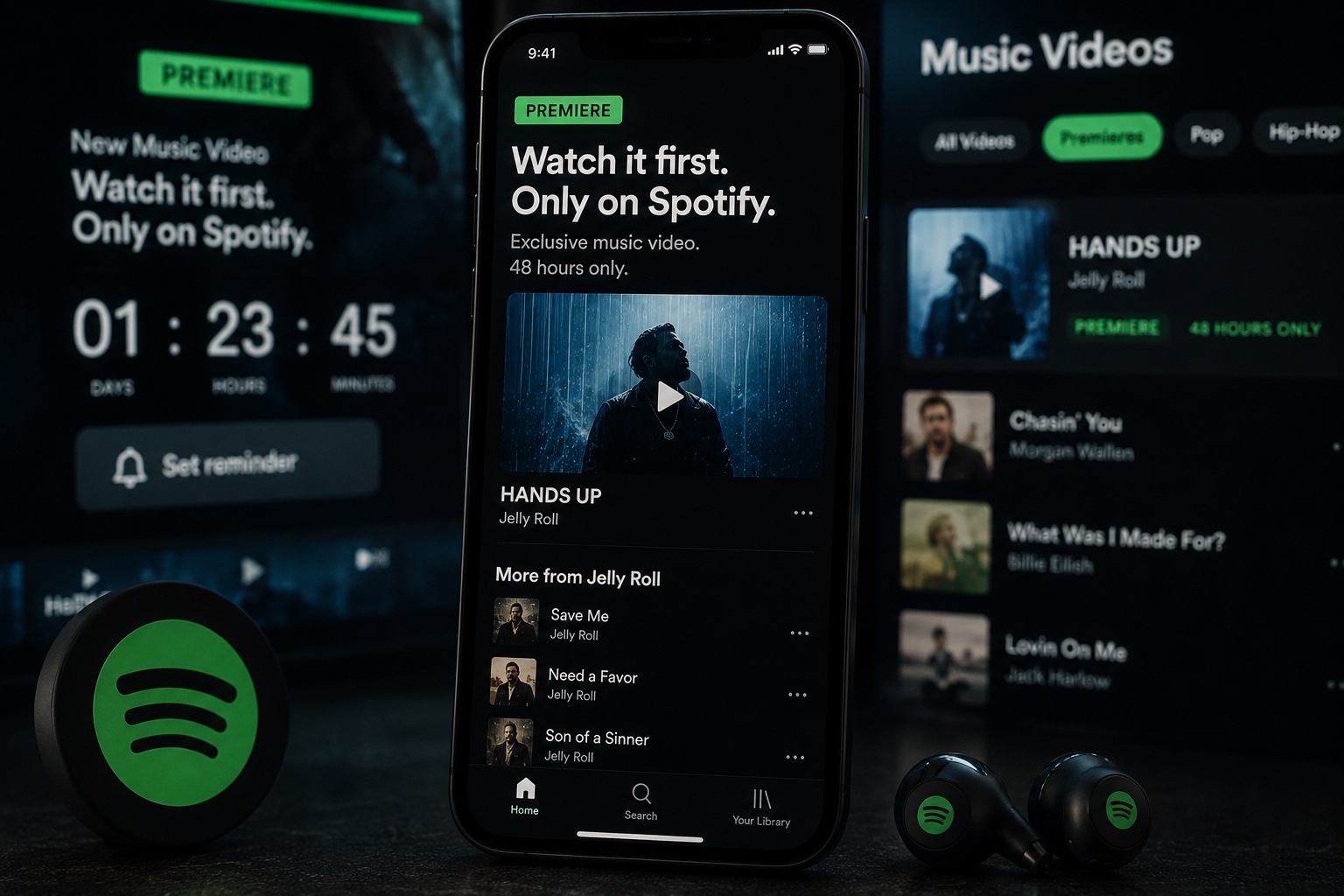
Spotify Doesn’t Need to Take Music Videos From YouTube—It Only Needs the Premiere
By Brian K. Neal
For most of the streaming era, the release of a major song has quietly belonged to several different companies at once.
Spotify could own the listening. YouTube could own the official music video. TikTok could own the first viral moment. Instagram could own the artist’s visual presence and fan conversation. An artist could generate enormous attention around a single release while sending that audience through several different platforms to experience all of it.
That fragmentation became so normal that it stopped looking unusual.
Spotify’s expansion into full-length music video begins to challenge it.
But the larger play isn’t that Spotify now has music videos.
It’s that Spotify is beginning to ask artists to let fans see those videos there first.
That distinction changes the story.
For nearly two decades, YouTube has been deeply embedded in the ritual surrounding a major music-video release. Artists announce a premiere. A page goes live in advance. Fans set reminders. A countdown begins. Thousands or sometimes millions of people arrive around the same moment. The video premieres, conversation explodes across social media, and afterward the upload remains available as part of YouTube’s enormous music archive.
YouTube didn’t merely become a place that stores music videos.
It helped turn the digital music-video premiere into an event.
Spotify is now reaching for that event.
Through limited first-window releases, Spotify has begun experimenting with giving its users access to official music videos before those videos become available more broadly. The window can be short—48 hours in one recent example—but that is precisely why the strategy is so interesting.
Spotify doesn’t need the video forever.
It wants the moment when everyone wants to see it.
Those first hours after a major release carry a different kind of value than the months and years that follow. This is when the artist’s most committed fans are waiting. It’s when reactions appear, clips circulate, group chats light up and entertainment coverage begins. It is when curiosity around the artist is at its highest and the cultural conversation surrounding the release is moving fastest.
Historically, Spotify could benefit from that excitement without necessarily hosting its visual centerpiece.
A fan could hear the new single on Spotify and immediately leave for YouTube to watch the video.
Spotify had captured the listening demand, only for one of the most important moments surrounding that demand to happen somewhere else.
A first-window music-video premiere changes the direction of that movement.
Now the song can be on Spotify.
The video can premiere on Spotify.
The album can sit beneath it.
The artist’s catalog is already there.
The fan can save the song, follow the artist, enter a playlist and continue listening without leaving the platform.
The premiere doesn’t have to send the fan somewhere else.
It can send the fan deeper into Spotify.
That is the strategic advantage.
And it is why Spotify’s move shouldn’t simply be understood as an attempt to compete with YouTube for video views.
Spotify doesn’t have to replace YouTube.
Trying to do so would ignore what makes Spotify’s position different.
YouTube has an extraordinary archive of music videos spanning generations. It has search behavior, massive global reach and an audience conditioned to use the platform for video. Music is also only one part of a much larger video ecosystem.
Spotify enters this competition from another direction.
It already has the listener.
It knows which artists someone follows, which songs they replay, which albums they finish, what they save, what they skip, which playlists they return to and what they discover next.
That gives Spotify something extraordinarily valuable when it introduces video:
context.
Spotify doesn’t necessarily need someone to search for a music video. It can know that the person may want to see it because they have already demonstrated that they care about the song or artist.
And if that video is available on Spotify before it is available elsewhere, personalization suddenly meets scarcity.
That combination is powerful.
Spotify can theoretically tell someone who has repeatedly streamed an artist that the artist’s new video is available—and, critically, available there first.
The listener isn’t simply receiving a recommendation.
They’re being given access.
That is a different relationship.
It also reveals why temporary exclusivity could be more consequential than permanent exclusivity.
Spotify doesn’t need to convince an artist or label to remove YouTube from the release strategy. That would mean sacrificing one of the largest music audiences in the world and potentially giving up years of long-tail viewing.
Instead, the proposition can be much simpler:
Give Spotify the beginning.
Forty-eight hours later, the video can still go to YouTube and other platforms. The artist can still collect those views. Fans can still share it. The video can still live for years inside the broader internet.
But Spotify has already captured the part of the release when attention was most concentrated.
That potentially creates a model in which everybody gets something.
Artists retain broad distribution. YouTube retains the long tail. Spotify gets the exclusive opening window. And fans receive a reason to open Spotify for something they previously would have automatically opened another application to experience.
If Spotify can prove that this behavior benefits artists, the proposition becomes even more interesting.
Spotify has said that people who watch full-length music videos on its platform subsequently engage more deeply with the underlying music through behaviors including additional streaming, saving, sharing, playlisting and catalog exploration.
The company has an obvious interest in demonstrating that relationship, so those measurements should be understood as Spotify’s own. But they point toward the economic logic behind the entire strategy.
A music-video view on Spotify isn’t valuable only because someone watched something.
It can create more activity around the music itself.
That matters because Spotify already owns what comes after the video.
A traditional television music-video premiere could create desire for an album, but the viewer still had to go somewhere else to acquire it.
A YouTube music video can create interest in a song, but listening to the record may still require movement into another service.
Spotify can collapse those steps.
Watch the video.
Play the song.
Enter the album.
Explore the catalog.
Save the record.
Follow the artist.
Return for the next release.
That sequence can happen within a single environment.
The real product Spotify is building, therefore, isn’t music video.
It is continuity.
The fewer times a fan has to leave Spotify to continue experiencing an artist, the more complete Spotify’s relationship with that fan becomes.
And that places its music-video strategy inside a much larger evolution of the company.
Spotify began as a place to listen to music. Podcasts expanded what people could hear there. Video podcasts challenged the idea that Spotify had to be an audio-only environment. Audiobooks expanded the amount and type of attention Spotify could compete for. Artist clips and other visual formats created additional ways for artists to appear inside the application.
But full-length music videos are different.
They bring Spotify’s expansion back to the thing that originally made Spotify powerful:
music fandom.
Spotify isn’t adding video because it suddenly wants to become a general-purpose video platform.
It is using video to make its music platform more complete.
And premieres push that strategy one step further.
Because there is a fundamental difference between being somewhere a piece of culture eventually lives and being somewhere culture happens first.
The first is a library.
The second is a destination.
Spotify has already built one of the world’s largest music libraries. What it has historically possessed less often is the ability to create appointment behavior around visual music culture—to make fans think about opening Spotify at a specific time because something they care about is happening there before it happens anywhere else.
A premiere can create that behavior.
And if Spotify can make first-window music videos recurring rather than exceptional, it could begin changing one of the most established habits of the digital music era.
For years, when a major artist announced a new music video, audiences largely knew where to look.
YouTube.
Spotify doesn’t need that instinct to disappear.
It only needs to introduce a question that previously didn’t need to be asked:
Where does the video premiere first?
That question represents leverage.
Because once artists and labels begin deciding not merely where their videos will live but which platform receives the opening window, music-video premieres become something platforms can compete for.
The first 24 hours matter.
The first 48 hours matter.
The countdown matters.
The fan rush matters.
The conversation matters.
The platform that captures those moments isn’t merely hosting a file. It is participating in the release architecture of the artist.
And Spotify is particularly well positioned to capitalize on that moment because the product being promoted by the music video—the music itself—is already sitting inside Spotify.
That may ultimately be the most important difference between this strategy and the MTV comparison.
MTV’s power came from deciding what millions of people would watch.
YouTube’s power came from giving the world somewhere to watch almost everything.
Spotify’s opportunity is different.
It can connect what someone watches with what that individual already listens to—and what they might listen to next.
The music video becomes less of a separate piece of promotional content and more of an entrance into an artist’s entire world.
That is why the 48-hour window shouldn’t be dismissed as a temporary promotional experiment.
The shortness of the window may actually be the point.
Spotify doesn’t need to own a music video for years to change its position in music culture.
It needs to own Friday morning.
It needs the fan who has been waiting all week.
It needs the first watch.
It needs the moment immediately after the first watch when that fan wants to hear the song again.
It needs the album exploration that follows.
It needs the save.
It needs the follow.
It needs the return.
Spotify doesn’t have to take the music video away from YouTube. It only has to take the premiere.
If it can do that consistently—and if artists discover that those premiere viewers become more valuable listeners afterward—Spotify will have done something much larger than add video to a streaming application.
It will have moved upstream in the music-release cycle.
Spotify spent the streaming era becoming one of the places where the world goes after a song is released.
Now it is positioning itself to become one of the places where the release itself happens.
And that is a much bigger play.
Related Posts
LG Launches Its First Curated Content Channel: “LG Channels Showcase”
LG Electronics USA has announced the launch of a new FAST channel on L
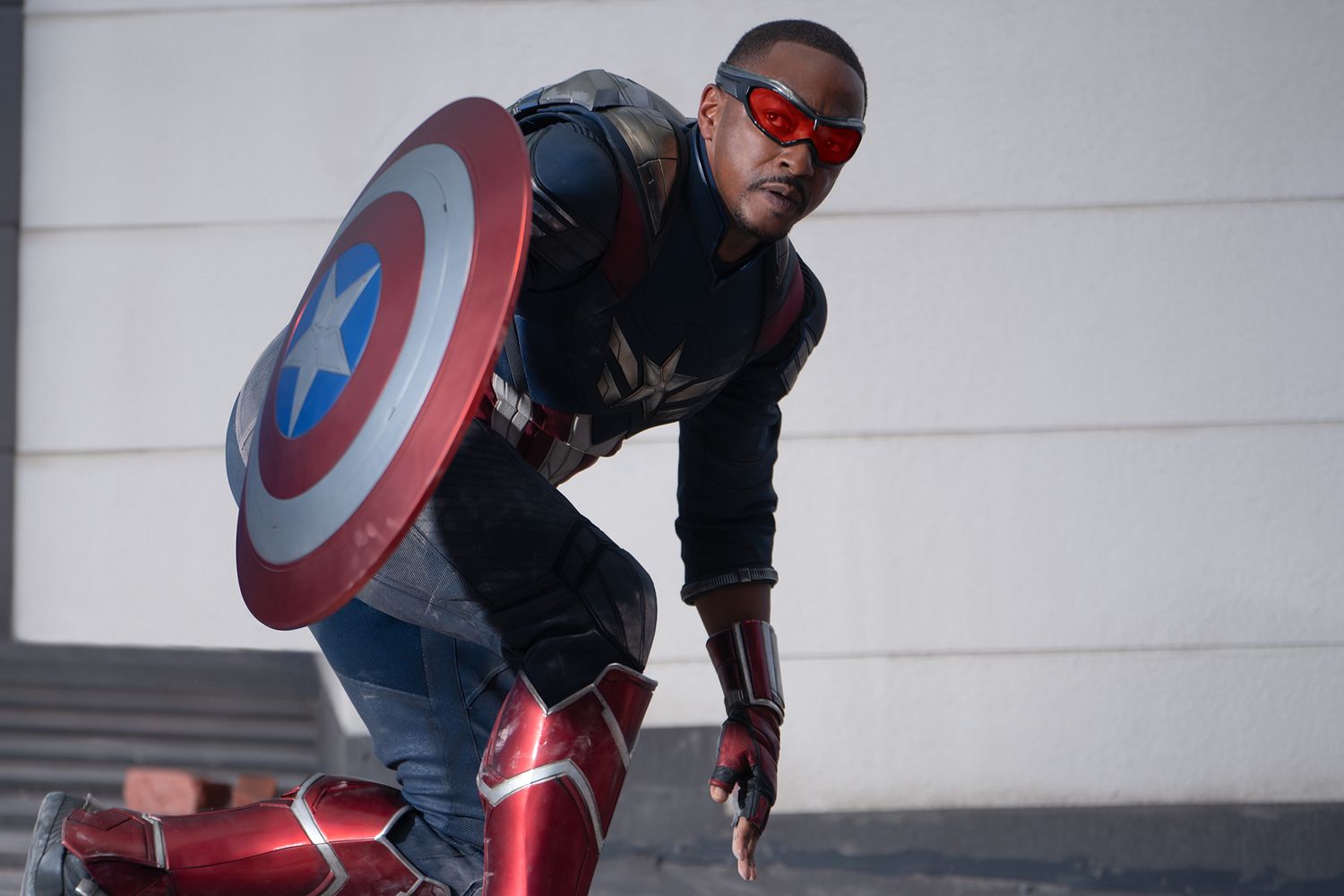
First Teaser Released for ‘Captain America: Brave New World’ Starring anthony mackie
From Falcon to Captain
Splinter Cell: Deathwatch – Sam Fisher Steps Out of the Shadows on Netflix
By DaMarko Webster When Netflix unveiled the exclusive trailer for Spl

The Body Is the Interface Now
Sneakers are no longer worn — they are programmed
Aziz Ansari and Keanu Reeves Flip the Script in Supernatural Comedy “Good Fortune”
Keanu Reeves Loses His Wings
ASOS Names Law Roach Its Stylist in Residence
Styling the Next Chapter