

Photoshop Enters the Chat Adobe and ChatGPT Redefine Creative Workflows
By DaMarko Webster
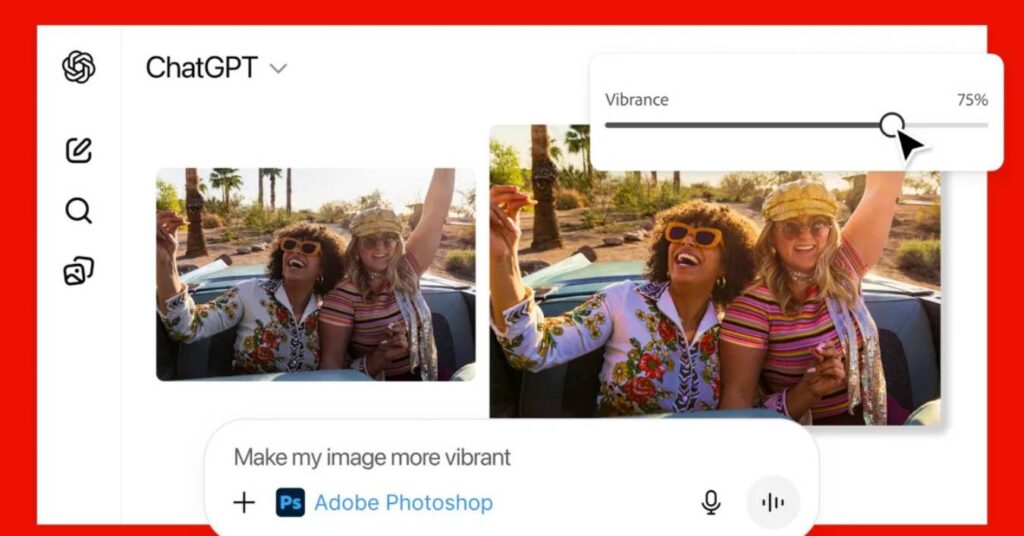
Adobe’s latest move signals a defining shift in how creative software intersects with conversational AI. With the announcement of a partnership that brings Photoshop into the ChatGPT ecosystem, the company is effectively collapsing the distance between professional-grade creative tools and natural language interaction. For the first time, users can access core Photoshop-powered image editing workflows through conversation, turning text prompts into tangible visual outcomes without the traditional friction of jumping between platforms.
At its core, the integration reframes Photoshop as something less menu-driven and more intent-driven. Instead of navigating layers, masks, and adjustment panels, users can describe what they want to achieve—cleaning up a background, enhancing lighting, resizing assets for social, or refining an image’s mood—and let the underlying Photoshop engine handle the technical execution. It’s not a replacement for deep creative control, but rather an on-ramp that makes advanced image editing more immediate and accessible.
The partnership also reflects a broader strategic alignment between Adobe and OpenAI around creative trust and authorship. Adobe has been vocal about building AI tools that respect creators, leaning on licensed content, transparent attribution, and ethical AI development. By embedding Photoshop capabilities within ChatGPT, Adobe is extending that philosophy into conversational workflows, where users increasingly expect speed without sacrificing quality or creative ownership.
Beyond Photoshop, the collaboration folds in tools like Adobe Express and Acrobat, signaling an ambition that goes well beyond image editing alone. The result is a unified creative environment where visuals, layouts, and documents can be generated, edited, and refined in one continuous flow. For creators, marketers, journalists, and brand builders, it represents a meaningful reduction in friction—ideas no longer stall at the gap between concept and execution.
From a technological standpoint, this integration underscores a larger industry trend: software is becoming less about interfaces and more about outcomes. As AI continues to mature, the value proposition shifts away from mastering tools and toward articulating intent. The better you can describe what you want, the faster the system can respond with professional-grade results. Adobe’s decision to meet users inside ChatGPT suggests that even legacy creative powerhouses see conversational AI not as a threat, but as the next logical evolution of their platforms.
For creatives who already live inside Photoshop, the integration won’t replace the nuance of hands-on editing—but it will change how projects begin. First passes, quick revisions, and exploratory concepts can now happen at the speed of thought. For newer creators, it lowers the barrier to entry entirely, making high-end visual storytelling feel less intimidating and more intuitive.
Ultimately, the Photoshop–ChatGPT partnership isn’t just about convenience; it’s about redefining how creativity moves from idea to artifact. As AI becomes a collaborator rather than just a tool, this moment marks a clear signal that the future of creative work will be conversational, connected, and increasingly fluid across platforms.
Related Posts
Hi Power Cycles and Warner Bros. Discovery Global Consumer Products Announce Limited-Edition Wayne Enterprises Electric Bikes
Hi Power Cycles Collaborate with Warner Bros. Discovery Global Consume

Porsche Introduces Third-Generation Panamera: A Fusion of Luxury, Efficiency, and Digital Innovation
Porsche has unveiled the latest iteration of the Panamera.

iFLYTEK Unveils Smart Recorder: Redefining Offline AI Voice Recording
iFLYTEK Unveils Smart Recorder

Saudi Arabia’s Ambitious Leap into the Gaming Industry: A Vision for Powerhouse Status
In recent years, Saudi Arabia has set its sights on becoming a formida

Dreame Technology Unveils Roboticmower A1 at CES 2024, Revolutionizing Outdoor Home Cleaning
The Roboticmower A1 advances lawn maintenance

Hisense Unveils CanvasTV™, Merging Art and Premium Entertainment
Hisense CANVASTV, a new blend of art and technology.