

OpenAI Wants ChatGPT to Become the Interface for Everything You Do on a Computer
By DaMarko GianCarlo
For most of the personal computer’s history, getting something done has required knowing where to go. You open a browser to search, a document editor to write, a calendar to schedule, a spreadsheet to calculate and another application for whatever comes next. The software has changed dramatically, but the relationship has remained surprisingly consistent: you decide what you want to accomplish, figure out which program can do it, learn its interface and operate it yourself.
OpenAI is building toward a different relationship.
The evidence has been accumulating for more than a year, but in 2026 the pieces have started fitting together more clearly. ChatGPT can work across connected apps and files. ChatGPT Work can use files, plugins and approved tools to retrieve information, create finished work and run workflows. Computer History can give ChatGPT and Codex context from selected activity across apps and websites. And Computer Use allows ChatGPT to see and operate graphical interfaces on macOS and Windows. OpenAI describes its desktop Computer Use capability even more plainly: ChatGPT can execute tasks across a person’s apps, tools and browser by clicking, typing and moving files.
Then came another cluster of seemingly smaller additions.
In August, OpenAI introduced interactive quizzes directly inside ChatGPT’s study experience. Google Drive has become more deeply integrated into the broader ChatGPT workflow. These are not revolutionary products by themselves. But viewed alongside Computer Use, Work, connected applications, agents and persistent computer context, they reveal a more consequential direction.
ChatGPT is moving from being another application you use toward becoming an interface through which you can increasingly use everything else.
That distinction matters.
When ChatGPT arrived publicly in 2022, its defining interaction was remarkably simple. You typed something into a box and received an answer. It could explain a complicated idea, write code, summarize information or help draft an email, but the boundary was obvious. ChatGPT produced something; you decided what to do with it.
If it wrote an email, you copied it into your email application. If it created numbers for a spreadsheet, you moved them into Excel or Sheets. If it suggested a restaurant, you went somewhere else to find a reservation. Intelligence existed inside the conversation. Action largely happened outside it.
That boundary is disappearing.
OpenAI introduced ChatGPT agent in 2025 around an explicit idea: bridging research and action. Instead of only providing information, the agent could use tools and its own computer to complete tasks including research, bookings and presentations. OpenAI described the system as one that could think and act while remaining under the user’s guidance.
Computer Use takes that philosophy considerably further.
Software traditionally communicates through structured connections such as APIs. But an AI capable of understanding a graphical interface does not necessarily need every application to be redesigned specifically for it. It can potentially interact with the same screens, buttons, text fields and menus that people already use.
OpenAI has been explicit about the importance of that idea. Its original Computer-Using Agent research described the screen, mouse and keyboard as a universal interface. More recently, GPT-5.4 introduced native computer-use capabilities designed to let agents operate computers and carry out complex workflows across applications. OpenAI’s current Computer Use documentation says ChatGPT can see and operate graphical user interfaces on macOS and Windows.
This isn’t simply automation becoming better.
It potentially changes what the human needs to understand about the software underneath it.
For decades, software companies have spent enormous amounts of money making interfaces easier for people to learn. Commands became menus. Menus became icons. Desktop programs moved into browsers. Smartphones compressed complicated services into apps and taps.
Each generation reduced friction, but the fundamental responsibility remained with the person.
You learned the interface.
AI introduces the possibility of reversing that relationship.
Instead of the person learning how every application works, the AI can increasingly learn how applications work on behalf of the person.
The user can begin expressing intent rather than navigation.
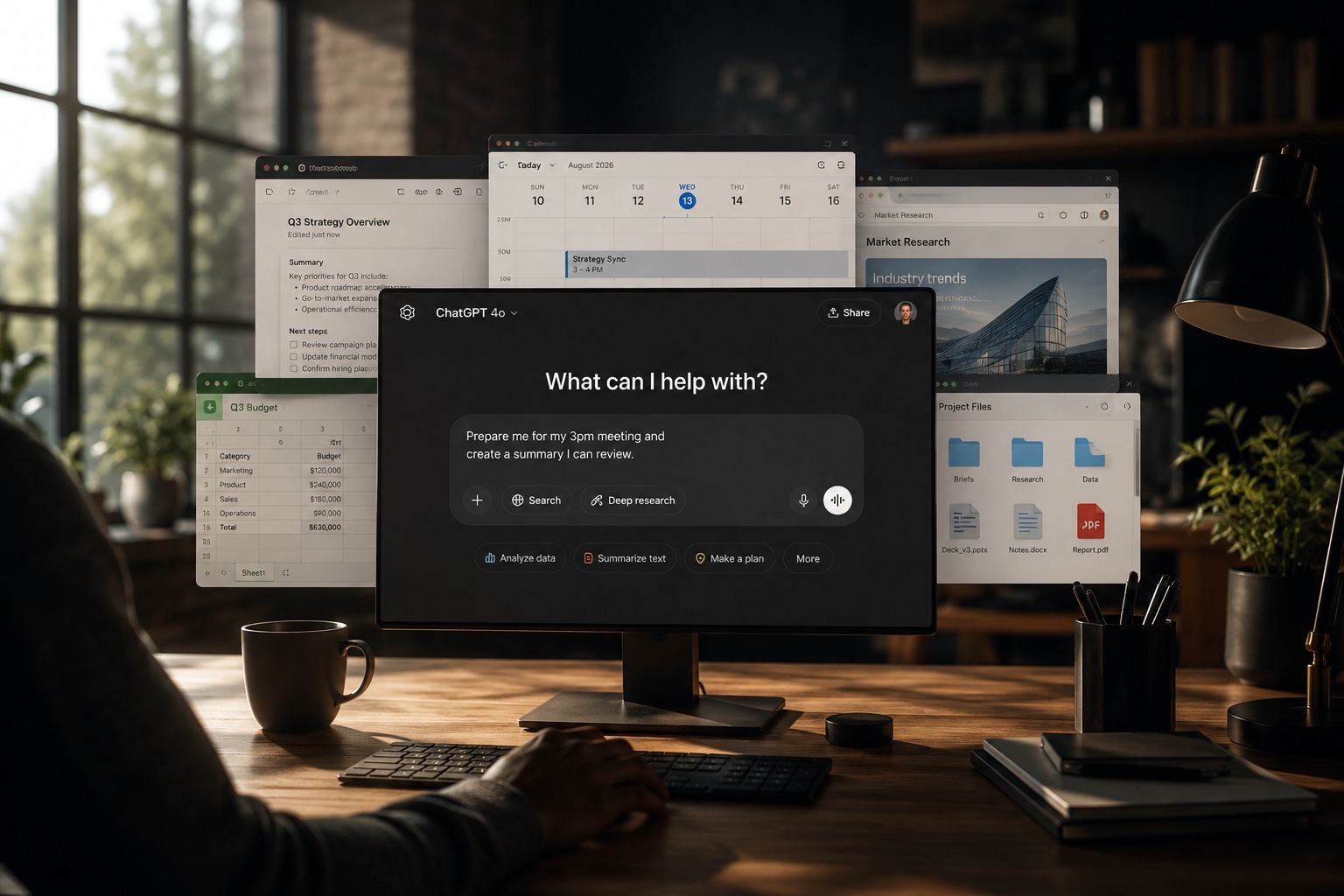
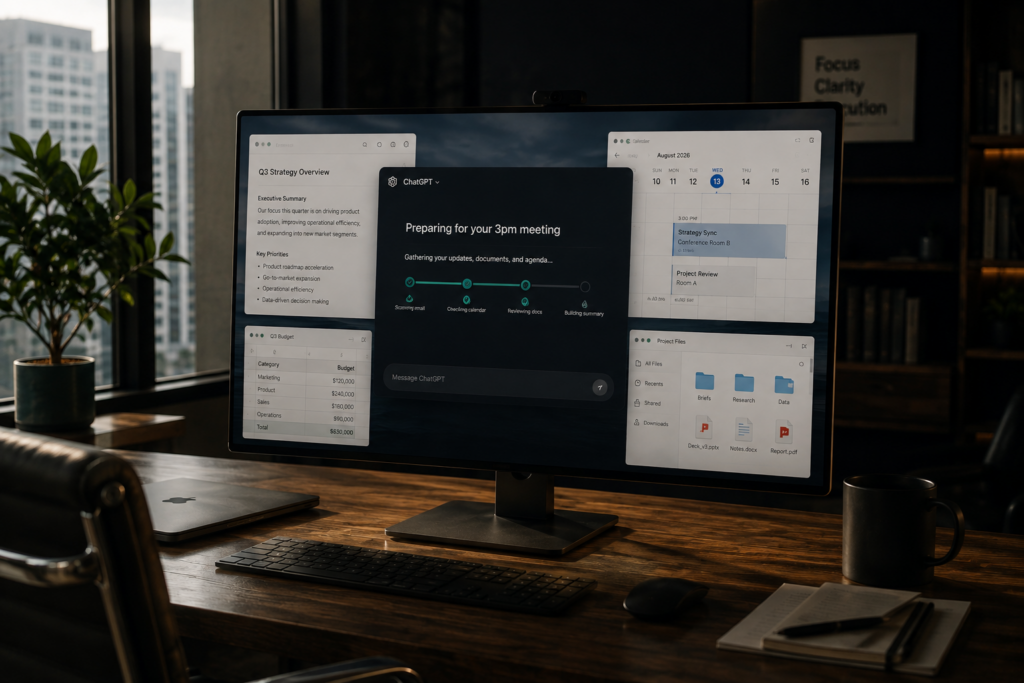
Imagine needing to prepare for a meeting. The traditional computer model requires a series of decisions: find the calendar event, locate the relevant documents, search previous correspondence, identify important information, create notes and perhaps prepare a presentation.
The person is not merely doing the work. They are also managing the movement of that work between systems.
An AI operating across those systems can potentially receive a much simpler instruction: prepare me for the meeting.
Everything between the instruction and the desired outcome becomes the territory AI companies are now competing to occupy.
That is the larger significance of what OpenAI is assembling.
ChatGPT Work can already use approved tools and files to retrieve information, create finished files and complete work for review. On desktop, it can also use local files, apps and the browser where those capabilities are available. OpenAI’s built-in browser experience is similarly designed around working across tools, files and accounts rather than treating the browser as an isolated destination.
The applications underneath that experience do not need to disappear.
Google Drive can remain where documents live. A calendar can remain where appointments are stored. A browser can continue rendering websites. Specialized professional applications can continue performing specialized work.
The strategic opportunity sits above them.
If ChatGPT becomes the place where someone communicates what they want accomplished, OpenAI does not necessarily have to replace every application to change the person’s relationship with those applications.
It can become the layer that coordinates them.
That is a different kind of power.
The first era of the consumer internet was dominated by destinations. You went to Google to search. Amazon to shop. YouTube to watch. Yelp to find a restaurant. Countless specialized websites handled countless specialized needs.
Smartphones reorganized many of those destinations into applications, but the behavioral logic survived.
Choose destination. Open application. Navigate interface. Complete task.
Agentic AI offers another model:
Describe outcome. Let the system determine how to accomplish it.
The difference sounds subtle until you consider what happens to the applications in the middle.
They can remain technologically essential while becoming less visible to the person using them.
That does not mean the death of apps. It means the possibility of another layer being placed above them.
And OpenAI is unusually explicit that interfaces themselves are now part of the problem it wants to solve. The company’s Computer Use and New Interfaces team says it is working on the “next generation of AI-native interfaces,” arguing that the value of AI is increasingly constrained not only by what models can do but by how people interact with those capabilities.
That statement brings the strategy into focus.
The AI race is no longer exclusively a contest over who can produce the smartest model.
It is becoming a competition over who can build the most useful relationship between intelligence and everything people already do with computers.
OpenAI is not alone in pursuing that future. The broader industry is moving aggressively toward agents, tool use and computer interaction. That competition makes the interface layer even more important. Intelligence will continue improving across companies. The differentiator may increasingly become what an assistant can actually reach, understand and accomplish once a person gives it an instruction.
And that introduces the harder half of this story.
Trust.
Giving an AI permission to answer a question is relatively inexpensive. Giving it permission to read a document requires more trust. Allowing it to change files, interact with applications or perform actions across a computer requires considerably more.
The more useful an AI assistant becomes, the more access it may need.
So the race to become the interface for the computer is simultaneously becoming a race to earn permission to operate it.
That is why Computer History is opt-in and allows users to choose which apps and websites contribute information, pause collection and review or delete what has been captured. It is why consequential actions require safeguards and oversight. And it is why reliability matters differently once an AI moves from generating words to performing actions. A hallucinated paragraph can be corrected. An incorrect action taken inside someone’s digital life can have consequences.
OpenAI therefore has to solve something larger than intelligence.
It has to make delegation feel dependable.
Users need to understand what ChatGPT can see, what it can change, when it is acting and when it will stop and ask for permission. The same access that makes an AI assistant powerful also creates the responsibility to constrain that power.
The future OpenAI appears to be pursuing does not require ChatGPT to become an operating system. Windows and macOS can remain underneath it. Websites can remain websites. Applications can continue existing. Specialized software can remain indispensable.
The more interesting possibility is that people may increasingly need to think about those individual interfaces less.
That is why the accumulation of Computer Use, agents, Work, connected applications, persistent context and interactive experiences matters. None proves by itself that ChatGPT will become the dominant interface for computing. OpenAI still has enormous technical, behavioral, security and competitive challenges ahead.
But collectively they make the ambition difficult to miss.
OpenAI began with a product that changed how millions of people asked computers for information. It is now building systems designed to act across the computer itself.
The ambition is no longer simply to shorten the distance between a question and an answer.
It is to shorten the distance between what you want and getting it done.
For most of computing history, the first question after deciding what we wanted to accomplish was essentially the same:
Which application should I open?
OpenAI is building toward a future in which we may simply tell ChatGPT what we want done.
Related Posts
The Sound of Tomorrow: UMG and Stability AI Partner to Redefine Music Creation
When Art Meets Algorithm

Apple Upgrade Makes Premium Technology Easier to Access—Not More Affordable
A Lower Payment Doesn’t Mean a Lower Price

Lyft to Roll Out Mobileye-Powered Robotaxis ‘As Soon As 2026
Lyft’s Autonomous Future: A New Era of Ride-Hailing

Unveiling the Hisense L5H Laser TV in South Africa: Embrace the Big Screen Experience
Explore home entertainment with Hisense's cutting-edge innovations.
Streamer University: Kai Cenat’s Masterclass in Going Viral
Kai Cenat Is Building the Harvard of Hype.
Empatica’s Cardiac Digital Biomarkers Granted Fresh FDA Clearance
By June Alluree Empatica a leading digital health and artificial intel