

Microdrama Studios Are Paying Meta to Find Their Audiences

By DaMarko GianCarlo
As vertical entertainment expands, Facebook and Instagram are becoming important advertising destinations for companies competing to turn viewers into paying customers.
A viewer opens Facebook and comes across a dramatic scene. A woman discovers a betrayal, a wealthy stranger reveals a hidden identity, or a relationship begins to unravel. The video continues well beyond the familiar length of a social media advertisement, building tension across several scenes before reaching a moment that demands an answer. To discover what happens next, the viewer is directed to another application, where additional episodes may require payment. What appears to be entertainment has also become a carefully designed customer acquisition strategy, and the company distributing that experience may be earning money before the viewer ever purchases an episode.
That relationship is becoming an increasingly important part of the microdrama business. As production companies compete to establish themselves in the growing market for short, vertically formatted television, Meta has emerged as a significant advertising partner. The company behind Facebook and Instagram does not need to produce these stories or own the applications where viewers eventually watch them. Instead, it provides access to audiences that microdrama companies are willing to spend substantial amounts of money to reach.
An October 8 investigation by Business Insider journalists Peter Kafka and Lucia Moses examined how much the emerging industry depends on Meta’s advertising services. According to industry estimates cited in the report, some microdrama companies direct as much as 75 percent of their marketing budgets toward Meta’s platforms. Hernan Lopez, founder of research firm Owl & Co., told Business Insider that “Meta gets more than half” of customer acquisition spending at most microdrama applications, according to what he consistently hears from operators. Lopez estimated global microdrama advertising expenditures at approximately $1.5 billion, excluding China, where the format originated. That figure represents spending across advertising channels rather than revenue attributable exclusively to Meta.
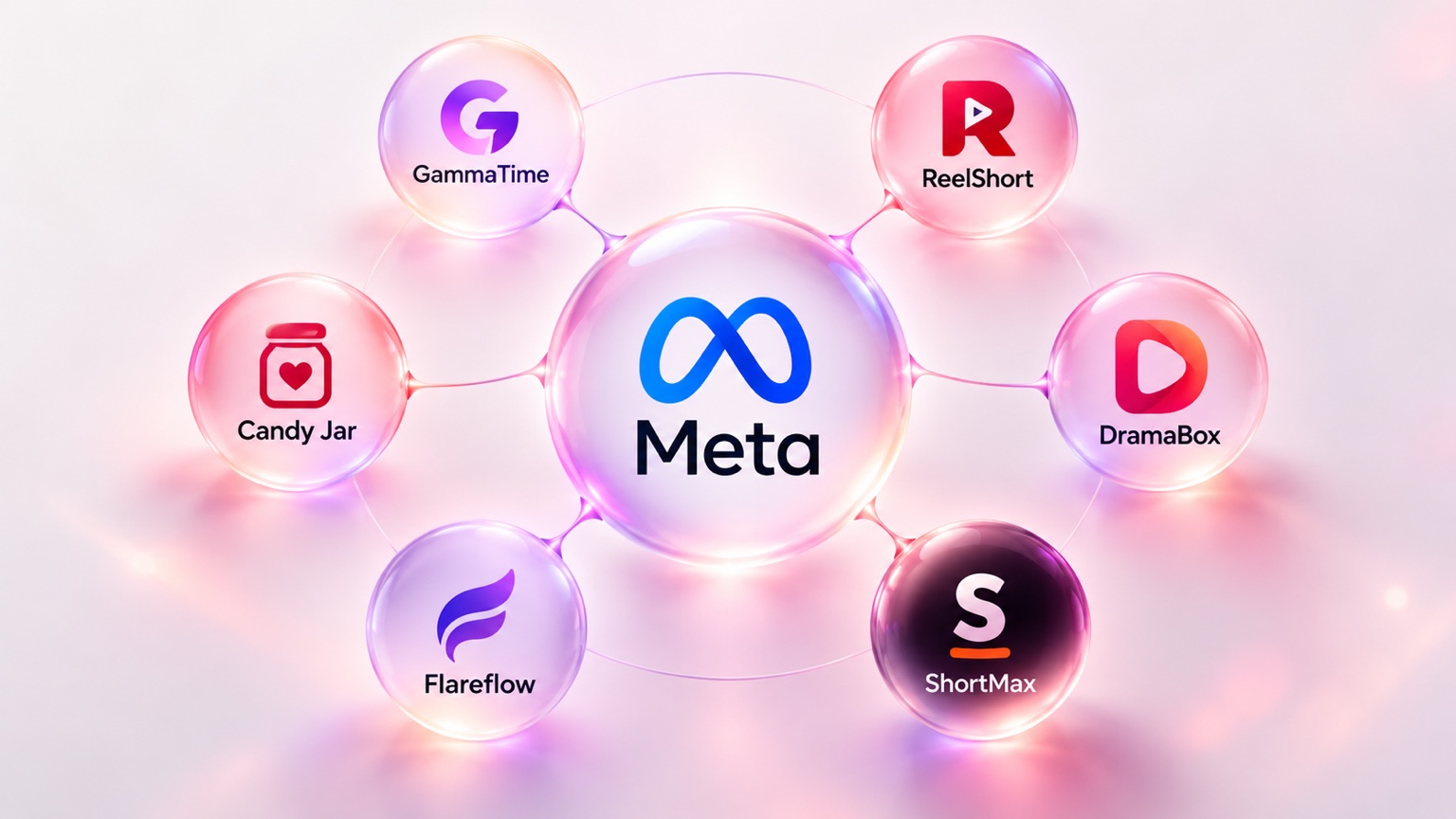
The relationship extends beyond a single production company. GammaTime, ReelShort, DramaBox and ShortMax are among the microdrama businesses identified in industry research as using Meta’s advertising ecosystem. Flareflow and Candy Jar have also appeared in reporting examining the relationship between microdrama promotion and social-platform discovery. The available information does not establish that all six companies allocate similar percentages of their marketing budgets to Meta, nor does it provide a comprehensive count of every microdrama advertiser using Facebook and Instagram. It does, however, demonstrate that the relationship involves multiple participants in a rapidly expanding entertainment market.
The spending is not limited to industry estimates. Slava Mudryk, cofounder of microdrama company GammaTime, told Business Insider that approximately 55 percent of his company’s marketing budget goes to Meta. The distinction matters because marketing is only one component of operating a production and distribution business. Companies must also account for talent, filming, postproduction, technology, payment processing and the continued development of new programming. A large marketing allocation does not establish that most of a company’s overall expenses go to Meta, but it does reveal how important audience acquisition has become to the commercial model.
The scale of the industry’s growth helps explain why those expenditures are attracting attention. According to Sensor Tower’s June 2026 State of Short Drama Apps report, short-drama applications generated more than 850 million downloads worldwide during the first quarter of 2026, an increase of 140 percent from the corresponding period a year earlier. Estimated in-app purchase revenue reached approximately $750 million during the same quarter, up 20 percent year over year. DramaBox and ReelShort each approached $140 million in quarterly in-app purchase revenue, placing them among the category’s leading commercial platforms. These estimates measure activity through Apple’s App Store and Google Play and do not represent the total revenue or profitability of the companies involved.
The difference between download growth and revenue growth is particularly revealing. Short-drama applications are attracting new installations much faster than their in-app purchase revenue is increasing. That does not necessarily indicate weakening demand. Many of the fastest-growing markets, including Southeast Asia, Latin America and India, have different consumer spending patterns from the United States. It does, however, demonstrate why attracting viewers and converting them into paying customers are separate challenges. A company can generate enormous interest in its programming without automatically producing an equally large financial return.
For Meta, the business operates differently. Microdrama producers purchase advertising to reach potential subscribers and paying viewers. Meta can earn advertising revenue from the promotion of microdramas without depending directly on whether those viewers eventually purchase additional episodes. The studio carries the costs of developing and producing the entertainment, while the advertising platform earns revenue from providing access to its audience. Meta still faces the ordinary demands of competing for advertising customers and maintaining effective targeting and delivery systems, but its financial exposure to an individual microdrama production is fundamentally different from that of the company financing the show.
The advertisements themselves introduce another important dimension. Rather than relying exclusively on conventional promotional spots, microdrama companies increasingly use extended scenes and sequences from their productions to attract viewers. Business Insider identified promotional material from companies including ReelShort, Flareflow and ShortMax running as long as 20 minutes. GammaTime cofounder Slava Mudryk, speaking to Business Insider, explained that the company uses longer advertisements when launching programs or promoting especially compelling storylines. He observed that “this long sequence just brings people in to watch,” describing how extended viewing can create demand to continue the story inside the company’s application.
This approach changes the relationship between advertising and entertainment. A conventional advertisement typically attempts to persuade someone to watch a program or purchase a product elsewhere. A microdrama advertisement can deliver a meaningful portion of the entertainment itself. The viewer may spend several minutes following characters and storylines before reaching the invitation to install an application or begin paying for additional episodes. By the time the promotion directs the viewer toward a paid service, the audience has already developed some familiarity with the story.
That arrangement produces two forms of potential value for Meta. The company collects advertising revenue from the producers, while the promotional videos contribute material that audiences can spend time watching on Facebook and Instagram. The arrangement does not mean Meta owns that programming or receives unlimited rights to it. Its advantage comes from hosting commercially sponsored entertainment that may also help sustain user engagement. The same material designed to move audiences toward another service can temporarily keep those audiences engaged with Meta’s own platforms.
Meta’s position also reflects the sophistication of its advertising business. For an emerging entertainment company, the challenge is not simply finding people willing to watch short videos. It is identifying viewers likely to become paying customers. Business Insider reported that microdrama operators value Meta’s targeting capabilities and established advertising tools. Ali Albazaz, whose company Inkitt operates the Candy Jar microdrama application, described viewers attracted by compelling stories as having a “very high likelihood of converting to a paid user.” His assessment underscores the commercial distinction between attracting an audience and finding viewers willing to spend money on additional episodes. It is an operator’s assessment, however, rather than an independently established conversion rate.
The broader entertainment industry has already begun responding to the format’s commercial potential. Established companies, including Fox and NBCUniversal, have pursued investments and partnerships related to vertical entertainment, reflecting growing interest in a market that until recently operated largely outside traditional Hollywood distribution. The format has also generated work for actors, production companies and crews at a time when conventional film and television production has faced considerable pressure. It combines familiar dramatic storytelling with shorter production schedules, mobile-oriented framing and distribution strategies designed around the way audiences discover entertainment on their phones.
Yet the emergence of traditional entertainment companies does not eliminate the audience acquisition problem. Established studios may bring production experience, recognizable talent and greater financial resources into the market, but dedicated microdrama applications still have to persuade audiences to leave familiar social platforms and establish new viewing habits. A recognizable performer or professionally produced series can attract attention, but the commercial outcome also depends on how efficiently the platform converts that attention into recurring revenue.
That distinction places microdramas within a much broader transformation of entertainment distribution. For decades, television networks and theatrical exhibitors controlled much of the relationship between programming and audiences. Streaming introduced direct subscription relationships and allowed entertainment companies to distribute programming through their own applications. Microdramas add another variation: independent producers and dedicated viewing services may control the content and the payment experience while relying heavily on social advertising systems to introduce that content to potential customers.
The arrangement also creates a possible conflict for Meta. A successful advertising campaign may ultimately persuade viewers to spend more time in an application that competes with Facebook or Instagram for attention. Business Insider noted a parallel with TikTok’s earlier growth, when Meta benefited from advertisements promoting a service that eventually became one of its most significant competitors. The immediate advertising opportunity and the longer-term competition for viewers are not necessarily aligned.
Meta is not alone in influencing discovery. TikTok and YouTube are also important destinations for short-form entertainment. Reuters reported in October that microdramas accumulated more than 6.5 billion views on YouTube during the first half of 2026, citing figures from the video platform. That level of viewing activity illustrates how widely the format is spreading beyond dedicated applications, even as the commercial models surrounding those audiences continue to develop.
There is also an important difference between identifying Meta as a major beneficiary and declaring it the industry’s financial winner. Meta has not publicly disclosed a standalone figure for revenue generated specifically from microdrama advertising, and the spending estimates reported by Business Insider do not provide enough information to establish the relative profitability of every participant. Meta declined to comment for that investigation. The available evidence supports the conclusion that the company occupies a commercially advantageous position within the industry’s advertising economy, not that the eventual balance of financial returns has already been determined.
For production companies, the central challenge remains building a business in which the revenue generated by viewers can consistently exceed the cost of reaching and serving them. That calculation becomes more demanding when competing studios pursue similar audiences, advertise through the same channels and depend on continually releasing new programming. The ability to produce an inexpensive series is valuable, but inexpensive production alone does not guarantee an economically sustainable entertainment company.
What makes the microdrama boom significant is that it exposes how several different businesses can operate around the same piece of entertainment. The production company develops the story. The viewing application attempts to turn interest into revenue. The advertising platform connects that programming with potential customers, receiving payment for the introduction. Each participant contributes something different, and each faces a different set of financial incentives.
Microdramas may continue expanding through new genres, recognizable actors, international audiences and partnerships with established entertainment companies. Their long-term commercial development will depend partly on whether producers can cultivate lasting relationships with viewers rather than continually paying to reach them. For Meta, however, the opportunity already exists in the competition itself. As more companies invest in attracting audiences, the advertising systems connecting those companies to consumers can benefit from the industry’s growth, even while individual studios continue searching for a sustainable business.
The larger development is not simply that people are watching television differently on their phones. It is that the companies producing entertainment and the companies earning money from its discovery are not always the same. In the emerging microdrama economy, controlling the story and controlling access to its potential audience have become two distinct commercial positions, and understanding that separation may be essential to understanding where the industry’s value ultimately goes.
Related Posts

MM6 Maison Margiela and SALOMON Unveil the X-Alp: A Stylish Fusion of Urban and Outdoor Footwear
MM6 Maison Margiela and SALOMON Unveil the X-Alp

AI Just Hired Hollywood
The migration from computation to collaboration.
Feodor Chin Is Everywhere—And Nowhere You’d Expect
Every Voice, Every Moment

2024 Welcomes Rapid Arrival of Innovative Drivers by Cobra Golf
Cobra Golf takes a step beyond introducing its DARKSPEED drivers

Sandbourne Santa Monica Opens: A New Era of Coastal Luxury
Sandbourne Santa Monica Opens

Louis Vuitton Forges Alliance with Fencing Champion Enzo Lefort in LVMH Collaboration
By Dean Woods The world of high fashion and the precision of elite fen
POST COMMENT