
Kane Parsons Shows Why Hollywood Is Looking to YouTube for Its Next Filmmakers
BY DaMarko GianCarlo
Hollywood has always searched for extrodinary filmakers.
What is changing is where it finds them.
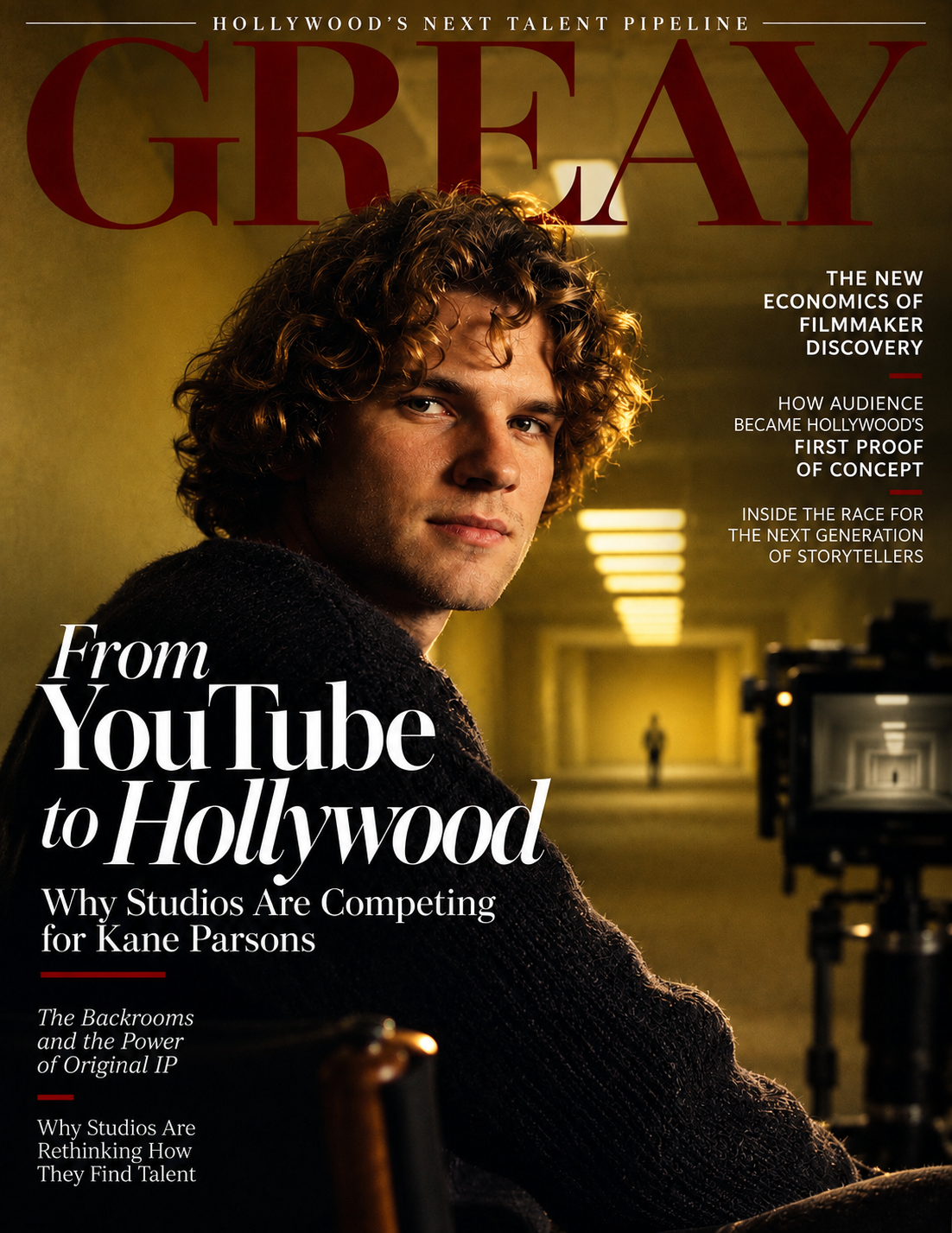
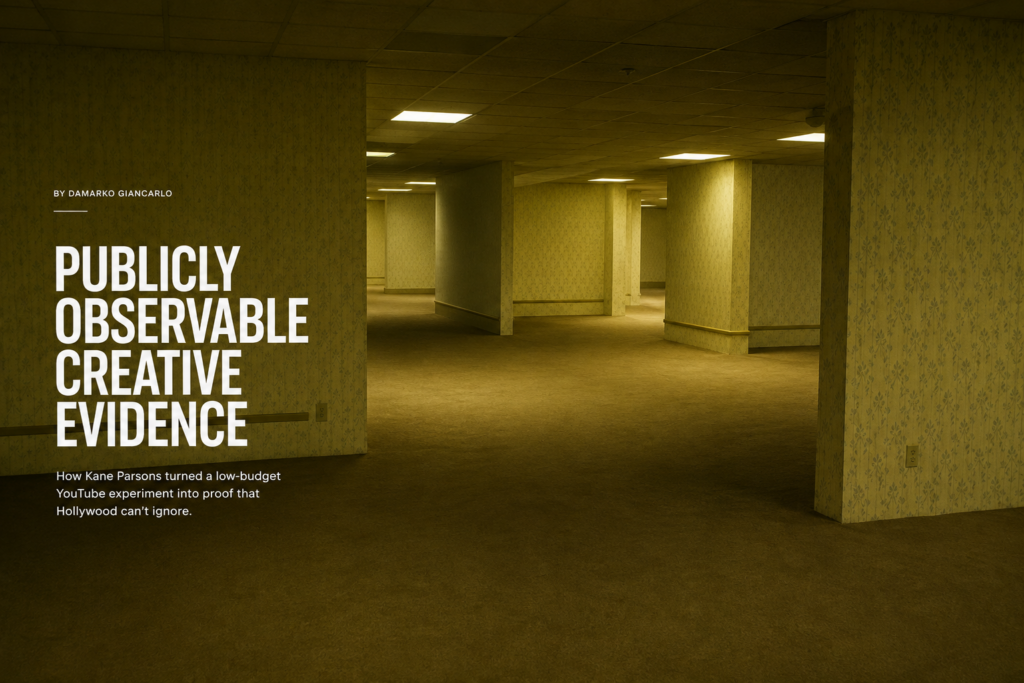
Kane Parsons represents an increasingly important evolution in that search. Long before Hollywood entrusted him with a feature film, Parsons had already spent years developing his filmmaking language in public. Through The Backrooms on YouTube, he created a world, found an audience, refined his craft and demonstrated that people would voluntarily return to something he had imagined.
By the time Hollywood arrived, Parsons was not introducing himself as an aspiring filmmaker.
His work had already introduced him.
That distinction is important because Parsons’ journey is not simply another story about someone becoming famous on the internet. It reflects a larger change in how Hollywood can discover talent, evaluate creative risk and decide which filmmakers might be worth betting on.
For generations, the path into the industry was relatively predictable. Directors developed through film schools, independent productions, commercials, music videos, television or the festival circuit before receiving larger opportunities. Studios, producers and agencies frequently had to make decisions based on what they believed a filmmaker might eventually become.
That system still exists.
YouTube has added another door.
And Kane Parsons helps explain why Hollywood is increasingly interested in what is coming through it.
YouTube was never designed to become Hollywood’s development department. It was built as a platform for people to upload and distribute video. Yet the freedom that made YouTube fundamentally different from traditional entertainment also created an unexpected consequence: filmmakers could begin developing before anyone in Hollywood gave them permission.
They could make something.
Release it.
See whether anyone cared.
Make something better.
And repeat the process for years.
That cycle matters because filmmaking is learned through filmmaking. A creator who spends years writing, shooting, editing, experimenting with sound, building visual effects and studying audience response is accumulating experience whether that work happens on a studio lot or in a bedroom.
Parsons is an unusually clear example.
His Backrooms work did not succeed because audiences were told that he was Hollywood’s next important filmmaker. There was no major studio campaign introducing him. The work had to create its own gravity.
People watched.
They returned.
They shared it.
They discussed the mythology.
And the world expanded.
Every one of those interactions became something increasingly valuable to an industry built around predicting human attention:
Publicly observable creative evidence.
That does not mean YouTube views can predict box-office performance. They cannot. Subscribers are not movie tickets, online fandom does not automatically translate into theatrical audiences, and internet popularity alone cannot tell a studio whether someone can manage the enormous collaborative machinery required to make a feature film.
But that is not what makes the evidence valuable.
The evidence answers different questions.
Can this filmmaker hold attention?
Can they establish a recognizable visual language?
Can they create something people voluntarily share?
Can an original idea survive beyond its first appearance?
Can they make audiences curious enough to return?
Can they build a world rather than simply produce a moment?
Those questions have always mattered to Hollywood.
What has changed is that studios can sometimes begin answering them before ever meeting the filmmaker.
That changes the economics of discovery.
For much of Hollywood’s history, the industry assumed a significant portion of the early creative risk. Studios and producers financed development, assembled talent and attempted to determine whether an idea might eventually connect with an audience.
Today, creators can perform part of that research and development themselves.
They build worlds.
They test ideas.
They fail publicly.
They improve.
They discover what resonates.
They build communities around the work.
By the time Hollywood becomes involved, the conversation can therefore begin somewhere different. Instead of evaluating only what a filmmaker says they are capable of doing, the industry can examine what that filmmaker has already done—and how audiences responded.
Hollywood is not replacing instinct with analytics.
It is gaining another form of evidence.
And Parsons is not an isolated example.
David F. Sandberg gained widespread attention through online filmmaking, with his short Lights Out eventually becoming the foundation for his feature directorial debut before he moved into larger Hollywood productions. Danny and Michael Philippou spent years developing a distinct filmmaking language and enormous online following through RackaRacka before making Talk to Me with A24. Bo Burnham began publishing performances on YouTube as a teenager before developing into a filmmaker whose work would eventually include Eighth Grade.
Their careers are substantially different. Their creative voices are different. Their relationships with YouTube are different.
That is precisely why the pattern matters.
There is no single “YouTube filmmaker.”
The platform is functioning less like a genre than an incubator.
Filmmakers can develop comedy, horror, visual effects, animation, documentary, experimental work or entirely new forms without waiting for a traditional institution to determine whether their ideas deserve development.
The result is not the replacement of Hollywood’s traditional talent pipeline.
It is the expansion of it.
Film schools still matter. Festivals still matter. Independent cinema still matters. Commercials, music videos, television, agencies and producers remain important pathways into filmmaking.
YouTube does something different.
It allows creators to develop in front of the audience.
That distinction becomes particularly important when original intellectual property enters the equation.
Hollywood has spent decades building enormous businesses around recognizable characters, franchises and cinematic worlds. But finding someone capable of originating a world is different from finding someone capable of executing within one that already exists.
Parsons arrived with The Backrooms.
The world existed before Hollywood’s investment.
The audience existed before the studio marketing campaign.
The creative language existed before the feature.
Hollywood did not have to imagine whether Parsons could make people curious about an unfamiliar universe.
People already were.
That does not eliminate risk.
It reduces ignorance.
And in an industry where enormous amounts of money depend on anticipating what people might want to watch years before a project reaches them, reducing ignorance has real value.
This is why Parsons’ story becomes larger than Parsons.
Hollywood is increasingly able to encounter filmmakers after those creators have already built bodies of work, established relationships with audiences and, in some cases, created intellectual property with measurable cultural traction.
The traditional sequence often looked something like this:
Opportunity. Production. Audience.
Another sequence increasingly exists beside it:
Creation. Audience. Opportunity.
That reversal changes where creative leverage begins.
A filmmaker who enters a studio with an idea is asking someone to imagine what might happen.
A filmmaker who arrives with years of work, an established creative language and an audience is bringing evidence of what has already happened.
Those are different conversations.
And they may increasingly produce different negotiations.
That is what makes the reported industry interest surrounding Kane Parsons so revealing. The significance is not simply that Hollywood sees promise in a young filmmaker who began on YouTube. Hollywood has discovered internet talent before, and it will again.
The significance is what Parsons can bring into the room with him.
Not simply followers.
Not simply views.
Not simply virality.
A world.
A body of work.
An audience relationship.
And evidence that an original idea could travel far beyond the circumstances in which it was created.
For most of Hollywood’s history, studios largely determined which emerging filmmakers would receive the resources necessary to reach mass audiences.
Today, audiences can increasingly encounter those filmmakers first.
Kane Parsons did not create that transformation.
His career simply makes it unusually easy to see.
A young filmmaker created a strange, unsettling world and put it on YouTube. Audiences entered it. They returned. The mythology grew. Hollywood eventually followed.
That is the breadcrumb.
YouTube gave Parsons somewhere to begin without Hollywood.
His audience gave Hollywood a reason to look.
And now his trajectory is helping demonstrate something potentially much larger about the next generation of filmmakers:
Hollywood may still decide who gets the biggest opportunities. But increasingly, it may not be the first to decide who is worth watching.
Related Posts

Kansas City Chiefs Launch “Back-to-Back Greatness” Campaign to Celebrate Consecutive Super Bowl Wins
Kansas City Chiefs Launch "Back-to-Back Greatness"

MUSTAAAAAAAAAARRRD Meets Mustard: The Culture-Mixing Collab We Never Knew We Needed
Hip-hop’s hottest producer meets America’s favorite condiment.
Born Again, Uncontrolled: Inside the Radical World of Maggie Gyllenhaal’s THE BRIDE!
A Monster Falls in Love
ASOS Names Law Roach Its Stylist in Residence
Styling the Next Chapter
LACMA and the End of Institutional Control
What L.A. Just Built Isn’t a Museum

Lion Star, Everest Place, and Paramount Announce Nickelodeon Hotels & Resorts Orlando, Opening in 2026
Nickelodeon Hotels & Resorts Orlando, Opening in 2026