


Jessie Prez Builds Through Process Not Performance
Words By Kyra Greene
There’s a specific kind of actor emerging right now—one not built in institutions, but in repetition, proximity, and pressure. Jessie Prez is part of that class. Before the scale of television, there were Chicago rooms where the audience sits close enough to catch dishonesty in real time, where performance isn’t protected by editing, and where listening becomes the only currency that matters. That foundation doesn’t disappear—it compounds. You can see it in how Prez moves between the tonal weight of Bosch: Legacy and Griselda, then recalibrates into the precision timing of Abbott Elementary without losing emotional integrity. This isn’t range as performance—it’s range as control. And as he steps into Georgie & Mandy’s First Marriage, the question isn’t whether he can adapt to an established universe—it’s whether an actor trained in truth begins to quietly bend that universe toward him.
Before audiences began seeing you on television, you spent time working in Chicago’s theater community. Looking back, how did those early stage experiences shape the way you think about acting today?
Chicago theater was my foundation. When you’re doing theatre in that city, you’re doing it for the love of the craft. The rooms are small, the audiences are close, and you have to be fully present every night. That experience really taught me how to listen, how to stay grounded in a scene, and how important the ensemble is. Even now working in television, I still
approach acting the way I learned in Chicago, stay truthful, stay prepared, and respect the work.
Early in a career there are often projects that quietly become important training grounds. When you think back to some of those early roles, were there particular moments that helped define the kind of actor you wanted to become?
Early on every project felt like school for me. I didn’t come from a traditional acting program, so I learned by doing. Being on stage, being on set, watching other actors work their craft. That’s where something would just click and I’d realize how much listening and honesty matters in a scene. Those first few plays I did really shaped how I approach my work today.
You’ve moved between very different storytelling worlds—from the darker tone of shows like Bosch: Legacy to the intensity of projects such as Griselda. What do those kinds of dramatic environments teach you about character-building and emotional range?
Shows like Bosch: Legacy and Griselda live in pretty heavy worlds, so you really have to trust the emotional truth of the character. Being in those environments pushes you to explore different layers and not play things on the surface. It definitely expands your range.
You also appeared in the ensemble comedy environment of Abbott Elementary, which has become known for its sharp comedic rhythm. What do experiences like that reveal about timing and collaboration in comedy?
Man, I love that set! Everyone is so talented from the cast to crew shows why they are at the level they are. You realize real quick how important timing is. That show moves fast and the cast has such great chemistry, so a lot of it is just listening and reacting in the moment. Comedy really works best when everyone’s locked in together and they are LOCKED IN!
When the opportunity to join Georgie & Mandy’s First Marriage came along, what initially stood out to you about the project and the world the show exists within?
First thing that stood out was, I’m starring in a Chuck Lorre Production?! LOL But What really stood out to me about GMFMwas the heart of it. The show lives in this really fun comedic world, but the characters feel
real and the relationships drive everything. That kind of storytelling is always exciting to be a part of.
The series exists within a television universe that already has a very passionate audience. How did you approach stepping into that environment while still finding ways to make your character feel authentic and uniquely your own?
With a show like GMFM, you know there’s already a big audience that cares about that world. My approach was just to stay honest with the character and trust the writing. When you do that, you naturally start to find your own rhythm within the show.

Sitcoms rely heavily on timing, chemistry, and the energy between actors. What has the experience been like discovering that rhythm with the cast once you were on set together?
Comedy really comes down to chemistry. Once we were all on set for GMFM, it was fun finding that rhythm together. When everyone’s listening and playing off each other, that’s when the comedy really works.
Without revealing too much about what lies ahead, what do you think audiences will begin to understand about your character as the story continues to unfold?
I think as the show continues, people will start to see more of who Ruben really is and what drives him. That’s one of the fun things about working on GMFM the characters get room to grow and surprise the audience a bit.
When you begin preparing for a role, where do you usually start in the process—do you look first at the emotional psychology of the character, the physical presence, or something more instinctive?
I usually start pretty instinctively. I read the script a few times and try to understand what the character wants and what’s driving them. Once you lock into that, the emotional and physical pieces start to fall into place.
I love trusting my gut in the moment and see where it takes me.
Over time actors often develop a deeper relationship with the craft itself. What has acting taught you about patience, discipline, or even about yourself as a person?
Acting teaches you a lot about patience and discipline because the career itself takes time. For me it’s been about staying committed to the work and continuing to learn. It’s also made me more aware of people and emotions, which helps both on screen and in life.
When a role challenges you emotionally or creatively, what helps keep you grounded in the middle of that process?
I think it’s really about staying present in the scene and trusting the process. When you focus on the work and the people you’re acting with, it helps keep everything grounded—even when the material gets intense.
When audiences watch your work—whether in comedy or drama—what kind of feeling do you hope they carry with them after the scene ends?
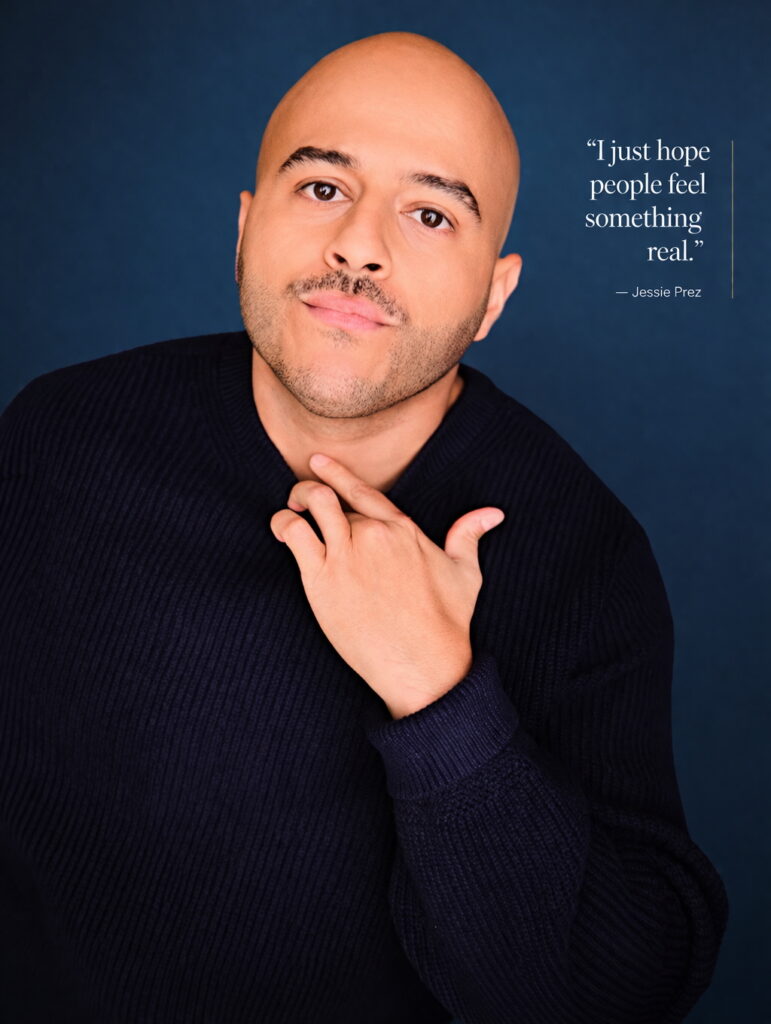
Honestly, I just hope people feel something real. Whether they laugh or connect with the character in some way, that’s what makes the work meaningful.
What Jessie Prez is building isn’t a collection of roles—it’s a method that holds under pressure. In an industry accelerating toward speed, volume, and immediacy, his approach moves in the opposite direction: slower, more attentive, rooted in reaction rather than projection. Whether inside comedy or drama, the throughline remains the same—presence over performance, listening over declaration, truth over effect. And that’s the shift worth paying attention to. Because as audiences begin to understand Ruben in Georgie & Mandy’s First Marriage, what they’re actually responding to isn’t just character development—it’s process made visible. The kind that doesn’t announce itself, doesn’t chase applause, but stays with you after the scene ends. Not because it was loud—but because it was undeniable.
Photographer: Tony Moux @tonymoux
Creative Director & Groomer: Olivia Shipman
Stylist: Rima Vaidila @rimavaidila
Related Posts

Ja Morant’s Nike Ja 2 ‘Stargazer’ Colorway Nears Release
Official Look at the Nike Ja 2 "Stargazer"
Cruise Control: Mission: Impossible – The Final Reckoning Ignites IMAX Screens This May
One Last Ride: Cruise Unleashes Mayhem in Mission: Impossible Finale.

Rihanna’s Fenty x Puma Creeper Phatty Resurrects Iconic Style with Daring Flair
Rihanna's Fenty x Puma Creeper Phatty Resurrects
Inside the Swell Effect: Why Amanda Golka’s Word Moves a Generation
One creator, countless events

2024 Welcomes Rapid Arrival of Innovative Drivers by Cobra Golf
Cobra Golf takes a step beyond introducing its DARKSPEED drivers
Tait Blum Is Quietly Redefining Young Hollywood
Edge of the Horizon
POST COMMENT