

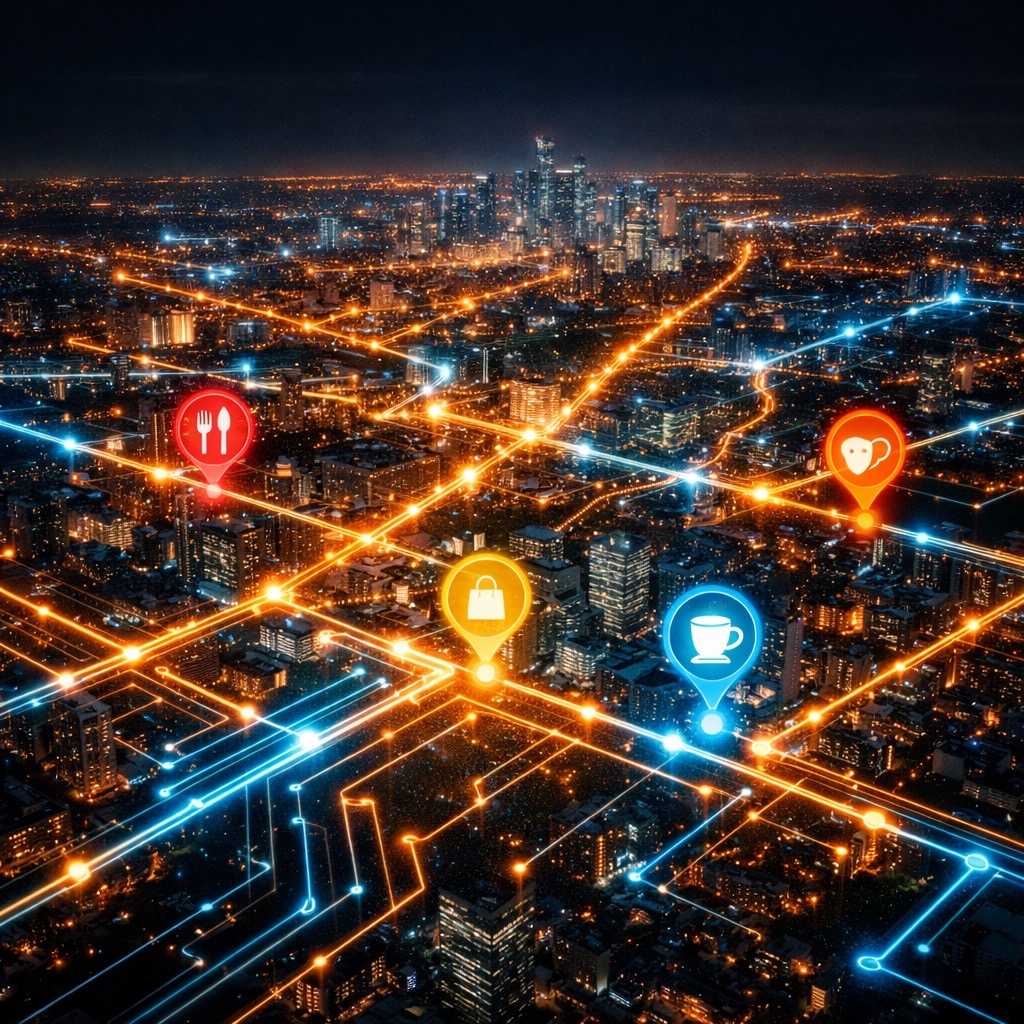
How AI Maps Are Becoming the Visa Network of the Real World
By Brian k. Neal
On any given evening in a modern city, millions of small decisions unfold almost invisibly.
Someone steps out of a subway station and glances down at their phone.
A couple walking along a crowded street slows their pace, debating where to eat. A driver idling at a red light asks their dashboard where to grab coffee before heading home.
For years those moments felt almost too ordinary to notice.
Open the map.
Find a route.
Pick a place.
Move on.
But something subtle has begun to change inside that familiar ritual.
Increasingly, when people open Google Maps, they are not simply asking how to get somewhere.
They are asking where they should go in the first place.
It sounds like a small difference.
But it marks the beginning of a much larger transformation.
What once functioned as a navigation tool is quietly evolving into something far more consequential:
a decision engine for the physical economy.
For nearly two decades the internet organized discovery through lists.
Search results stacked one after another.
Review rankings.
“Best of” guides promising the perfect restaurant or the most charming café.
Platforms like Yelp and Tripadvisor thrived by helping people sift through options—scrolling through star ratings, reading strangers’ opinions, comparing photos before committing to a table or a hotel room.
The system worked because the internet excelled at presenting information.
But the final decision always belonged to the person holding the phone.
Artificial intelligence quietly changes that dynamic.
Instead of presenting dozens of possibilities, the system increasingly offers a handful of suggestions.
Sometimes two.
Occasionally only one.
The browsing step disappears.
The comparison fades away.
What remains is a recommendation delivered with the calm confidence of software that already understands your location, your habits, and the pulse of the city around you.
In that moment the map stops behaving like a static reference.
It begins acting more like a guide.
This shift becomes even more powerful when combined with the immense behavioral dataset behind Google’s mapping infrastructure.
Every day billions of navigation requests move through digital mapping systems.
Each request carries a small signal about how cities actually function.
How traffic flows through neighborhoods.
How pedestrians cluster around certain blocks at certain hours.
How demand rises and falls across restaurants, theaters, and retail districts.
Over time those signals accumulate into something remarkably detailed:
a living portrait of urban movement.
Ride-sharing platforms like Uber revealed just how valuable that knowledge could be.
By understanding how people move through cities, those companies were able to predict demand, reposition drivers, and reshape transportation in ways that would have seemed improbable only a decade earlier.
But ride-sharing platforms mostly focused on improving the journey itself.
How quickly someone could travel from one destination to another.
AI mapping systems may influence something even more powerful.
They may begin shaping the destination.
Once that shift occurs, the economic implications expand dramatically.
Restaurants, retail stores, entertainment venues, and service businesses collectively represent trillions of dollars in global commerce.
If the system recommending destinations sits between customers and businesses, it becomes a quiet intermediary between attention and spending.
History suggests that infrastructure positioned in that space can reshape entire economies.
In the nineteenth century, railroads reorganized the economic geography of entire countries.
Towns that sat along rail lines flourished.
Towns that missed them often faded into obscurity.
The railroad’s power was never simply that it moved goods.
It determined where economic activity flowed.
AI-powered mapping systems may be creating a similar layer of infrastructure for modern cities.
Not by routing freight.
But by routing people.
And wherever people move, spending tends to follow.
Every economic era tends to be shaped by the infrastructure that routes its most valuable resource.
Railroads routed goods across continents.
Search engines quietly routed information across the internet.
Today AI-driven maps may represent the next phase of that pattern.
By routing people through cities—and increasingly recommending where they go—mapping systems could begin shaping how physical-world commerce flows.
The closest modern analogy may be surprisingly familiar.
Companies like Visa and Mastercard do not manufacture products or operate stores.
Their influence comes from the infrastructure they built between buyers and sellers.
Payment networks sit quietly inside transactions.
Invisible to most people.
Yet essential to the movement of modern commerce.
AI-driven maps may be building an equivalent rail for the physical world.
Not the network that moves money.
But the network that moves people.
And wherever people move, spending tends to follow.
The rise of autonomous vehicles could amplify this dynamic even further.
Self-driving systems developed by companies like Waymo depend heavily on mapping intelligence.
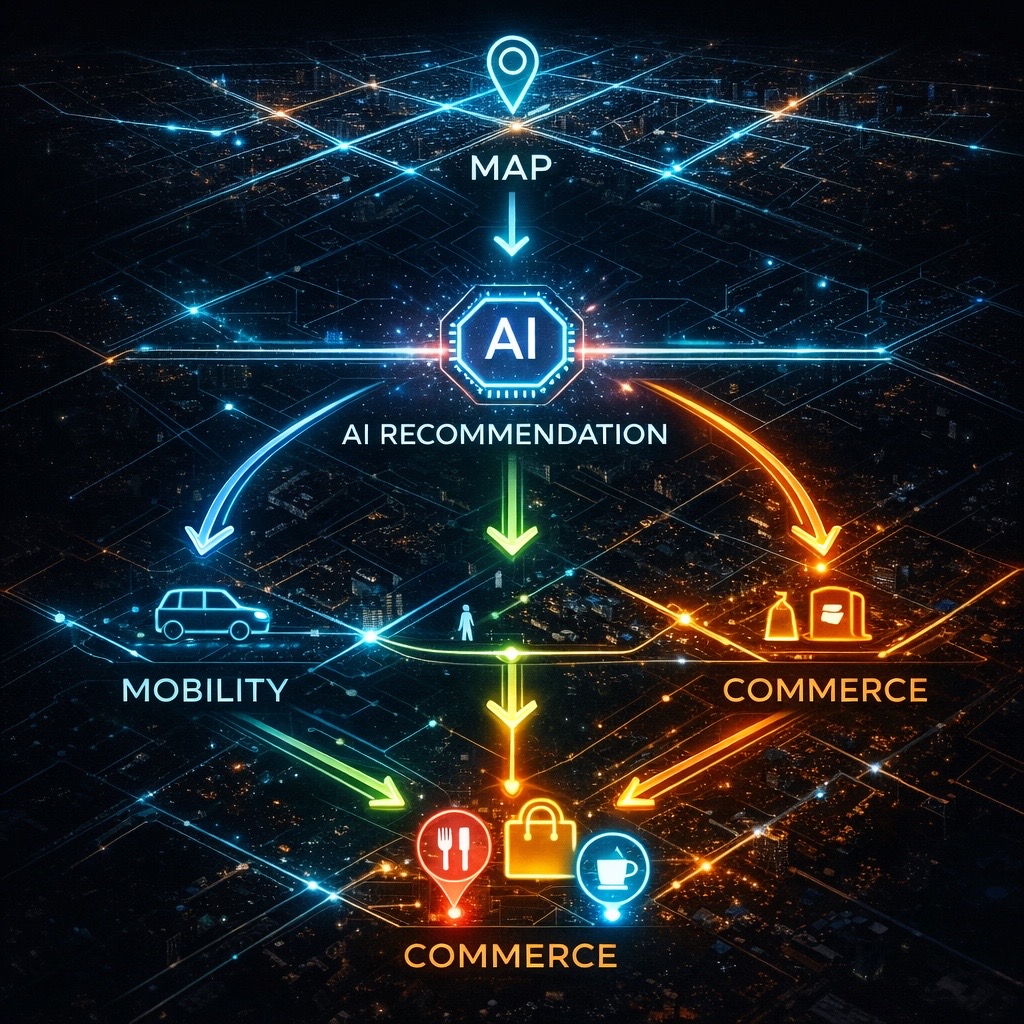
In a future where transportation, navigation, and AI recommendations merge into a single platform, the same system could determine:
which vehicle arrives
which route it travels
which destination it suggests
Mobility, navigation, and commerce begin to blur together.
Cities themselves could start to behave differently as a result.
Neighborhood foot traffic might rise or fall based on algorithmic recommendations.
Restaurants might compete not only for reviews but for visibility inside AI decision systems.
Local marketing could evolve from search optimization into something entirely new:
optimization for recommendation engines.
Most people will never notice the shift happening around them.
They will simply ask their phone where to go.
The system will answer.
A route will appear across the map, glowing softly through the city streets.
But beneath that simple interaction lies a deeper transformation.
The map is no longer just a picture of the city.
It may become the system that quietly decides where the city spends its money.
Citizen Walkaway
When most people open a map, they think they’re looking at a navigation tool.
But the deeper reality is beginning to shift.
Just as railroads once determined which towns prospered, and payment networks quietly determine how money moves through the global economy, AI-powered maps may begin shaping where people go—and where spending follows.
The next time you open a map and ask where to go, you may not just be navigating the city.
You may be participating in the invisible system that quietly organizes how the city’s economy flows.
Related Posts

The Quiet Screen: Why AR Is Finding Its Home Underwater
Swimming With Information—Without the Noise

Stüssy and Beats Collaborate on Exclusive Studio Pro Headphones
Beats, renowned for its collaborative ventures

Accenture and Google Cloud Join Forces to Establish Global Generative AI Center of Excellence
In a groundbreaking collaboration, Accenture and Google Cloud have unv

Lowe’s Introduces Lowe’s Style Studio Exclusively for Apple Vision Pro
Lowe's introduces Lowe's Style StudioTM

The Algorithm Is the New Greenlight
The Feed Owns the First Decision

IHG Hotels & Resorts introduces Apple AirPlay to its North American hotels, allowing guests to stream content from their iPhones or iPads directly to their in-room TVs
IHG Hotels & Resorts, a global hospitality leader, introduces AirPlay
POST COMMENT