

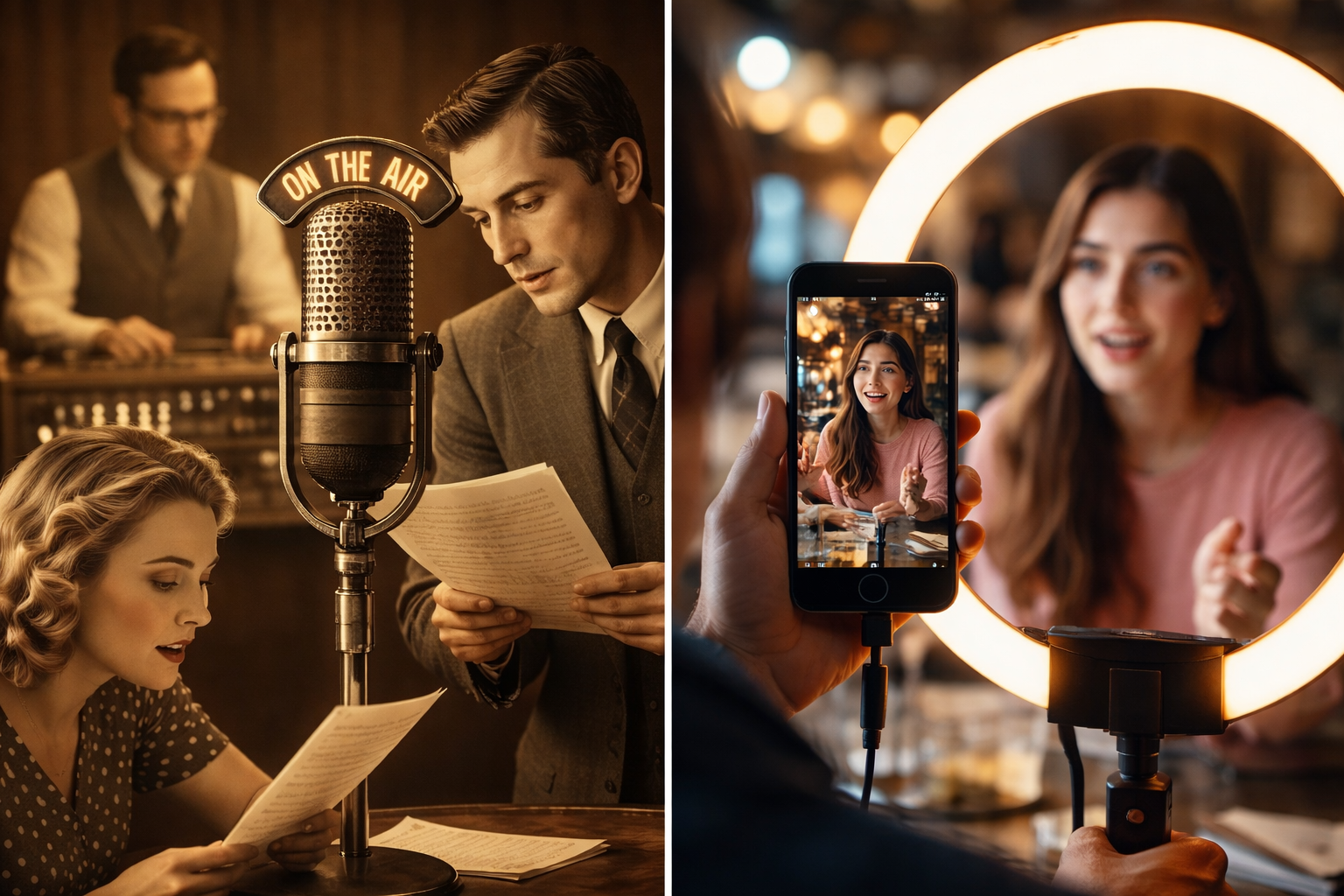
Hollywood Built Stories for Theaters. The Phone Rebuilt Them for the Hand

By Gordon Richter
For most of the twentieth century, Hollywood believed it controlled storytelling. Studios controlled production, distribution, and most importantly, the screen itself. Films were built for theaters, later adapted for television, and eventually compressed onto phones as smaller versions of the same cinematic language. For decades the assumption held: great stories began in Hollywood, and every other screen simply inherited them.
History tells a different story.
The dominant device does not simply distribute stories.
It rewrites the grammar of storytelling itself.
This pattern has repeated every time a new medium has emerged.
The smartphone is simply the latest example.
Vertical dramas are the clearest signal of this shift. Hollywood initially treated phones as miniature movie screens, producing shorter clips or condensed versions of traditional television. But vertical storytelling did something fundamentally different. Instead of adapting cinema for the phone, it rebuilt narrative language around the way people actually hold and watch their devices.
The frame turned vertical. Faces moved closer to the screen. Episodes shrank to minutes instead of hours. Pacing accelerated to match the rhythm of scrolling. These weren’t compromises. They were structural adjustments to a new viewing environment.
Storytelling had been redesigned for the hand.
But this moment is not unprecedented.
In the 1930s, radio reshaped storytelling long before television existed. Early radio broadcasts attempted to replicate theater performances. Actors delivered dialogue into microphones as if audiences could see their gestures and movements. It didn’t work.
Radio forced storytellers to invent something new: intimate voices, suspenseful narration, and serialized drama built entirely around sound. Programs like The Shadow and The Lone Ranger didn’t translate theater to radio. They invented a storytelling language designed specifically for audio.
When television arrived decades later, it repeated the process. Television did not adopt radio’s grammar. It developed its own forms — sitcoms, talk shows, visual news broadcasts — shaped by the physical presence of the television screen in the home.
But the most revealing example appeared even earlier.
In the 1910s, filmmakers discovered that theater acting completely failed on camera. Stage actors performed with exaggerated gestures designed for audiences sitting dozens of feet away. On film, those same performances looked unnatural and overwhelming.
The camera demanded something different.
Directors asked actors to reduce movement, soften expressions, and communicate emotion through subtle facial changes. Cinema invented its own acting language because the camera created a new relationship between performer and viewer.
The lesson repeated across every medium:
The device determines the performance.
Today the smartphone is forcing the same transformation. The phone isn’t simply a smaller screen. It is a personal screen held inches from the face, watched vertically, often in brief moments between other activities. That physical relationship reshapes storytelling choices in subtle but powerful ways.
Vertical dramas emerged as one response to that environment.
But their global rise reveals something even deeper.
Phone-native storytelling exploded first in parts of Asia not simply because of technology, but because of infrastructure. Cities like Shanghai, Seoul, and Tokyo are built around dense public transit systems where millions of commuters spend long stretches of time standing on trains, holding phones with one hand. In those environments, horizontal viewing becomes physically inconvenient. Vertical viewing becomes natural.
Architecture shaped the device.
The device shaped the screen.
And the screen reshaped storytelling.
What looks like a digital trend is actually the result of physical human behavior interacting with technology.
The same pattern may soon repeat again.
Technologies like volumetric video suggest that storytelling will eventually evolve for spatial computing environments where viewers move around scenes rather than watch them from a fixed perspective. In volumetric capture, performances become three-dimensional data that audiences can navigate.
Just as vertical video rebuilt narrative grammar for the phone, spatial media may rebuild storytelling for immersive environments.
Viewed this way, modern media fragmentation begins to make sense. It is not chaos. It is the natural result of multiple dominant screens existing at once. Cinema grammar still belongs to theaters. Vertical storytelling now thrives on phones. Spatial storytelling is beginning to emerge for immersive devices.
The history of media is not simply the history of studios or artists.
It is the history of screens.
Every dominant screen eventually invents its own storytelling language.
Hollywood once built stories for theaters.
Today the phone has rebuilt them for the hand.
And the next device may ask storytellers to invent a language we have not yet imagined.
Related Posts

Jensen Ackles is set to join “Tracker” as the estranged brother of Justin Hartley’s character Colter Shaw
CBS announced Jensen Ackles will soon make a guest appearance on track

Michelle Núñez: Fearless in Film, Music, and Storytelling
Michelle Nunez multi talented.

TWO-TIME GRAMMY® AWARD-WINNING MUSIC PRODUCER CHRISTOPHER “DRUMMA BOY” GHOLSON Debuts HIS MUCH-ANTICIPATED BOOK “BEHIND THE HITS”
By Simone Graves Multi-award-winning music producer Christopher “

Nike’s Rejuven8 Returns: A 2008 Icon Reimagined for 2026
The Comeback Sneaker
Hulu Not moving forward on Sammy Davis Jr. Limited Series; Project Seeks New Platform
Hulu has decided not to proceed with its previously announced limited

Chad Stahelski, Director of the John Wick Franchise, Acquires Rights to Jonathan Maberry’s Joe Ledger Novels for TV Adaptation
Chad Stahelski Adapting Joe Ledger Thriller Novels for TV.